"Never Grow Up" by Jackie Chan
Book summary, review and lessons from “Never Grow Up” by Jackie Chan.
Read about Jackie’s journey from stuntman to global movie star.
Learn about Jackie’s tough childhood, his incredible work ethic and how he sacrificed his body for his art.
Book Summary:
“Never Grow Up” by Jackie Chan is a candid memoir from one of the most recognizable, influential, and beloved cinematic personalities in the world.
Everyone knows Jackie Chan. Whether it’s from Rush Hour, Shanghai Noon or The Karate Kid, Jackie is admired by generations of moviegoers for his acrobatic fighting style, comic timing, and mind-bending stunts.

In his book, Jackie Chan reflects on his early life, including his childhood years at the China Drama Academy (in which he was enrolled at the age of seven), his big breaks (and setbacks) in Hong Kong and Hollywood, his numerous brushes with death (both on and off film sets), and his life as a husband and father (which has been, admittedly and regrettably, imperfect).
Book Lessons:
1) Jackie Had A Rough Childhood
“I spent more time in the hallway outside the classroom than inside it, and became notorious in the school...I kept playing pranks, blowing off my homework, misplacing my books, getting into fights, and being a headache for the teachers.”
Jackie’s childhood was not an easy one. He had difficulty paying attention in school and was a rebellious kid. The only class he cared about was gym and found class lectures to be beyond boring. With that kind of behavior, it isn’t a surprise that he was kept back at the end of his first year.
Jackie’s parents figured he wasn’t going to be an academic, so they sent him to boarding school, Jackie was 7 years-old at the time. The school was called the China Drama Academy, there he learned martial arts, dancing and acting–all skills which would help him become a successful actor.
Here was his school schedule:
Wake up at 5 a.m. for breakfast.
Practice kung fu until noon.
Lunch.
Practice until dinner at 5 p.m.
Dinner.
Practice until bedtime at 11 p.m.
Do it again the next day.
Jackie writes that for “ten years, I got only six hours of sleep, night after night.” Even when he caught a fever, the teacher still made Jackie practice kung fu, no exceptions.
It may seem brutal, but the school taught Jackie the importance of hard work, discipline and allowed him to gain the necessary 10,000 hours needed to become an expert at acting and martial arts.
2) Work Hard In Every Role
“For a long time, Jackie only got to play background roles where his face wasn’t shown, or as a bad guy who got smacked in the face, or someone in a crowd who gets kicked by the hero.
”
Jackie Chan didn’t always play the lead role, especially in the beginning of his career.
He started out as a stuntman and often played one of the bad guys that the main character would knock out with a single punch or kick, and most of the time, had little to no lines in the film.
In one of his earliest roles, he played a corpse on set. Jackie was so good at holding his breath and not moving that the director pointed at him and announced “That guy is the best corpse, make sure we get him in tomorrow as well.”
No matter how big or small the role, Jackie would always give his best because he knew that although he wasn’t the best actor around, he would at least be the hardest working one.
Jackie writes that he became known “as the first to arrive on set and the last to leave. My attitude was enthusiastic and committed. I got into the habit of volunteering to do the most difficult or dangerous jobs...and never let on about how much pain I was in.”
It didn’t matter whether the pay was low or none at all, nor did the size of the role matter, Jackie was determined to get as much experience under his belt as possible and each gig got him one step closer to becoming a global movie star.
Even when things got difficult and Jackie had to move back in with his parents, who lived in Australia, and work construction, he didn’t give up on his dream. When the opportunity arose to play a lead character in a small movie, he decided to go back to China and continue to pursue his dream.
Years of hard work and commitment soon paid off, as Jackie writes, “After fifteen years of hard training, I was an overnight success.”
3) Jackie Sacrifices Himself For His Art
“My ankle joint pops out of its socket all the time...my leg sometimes gets dislocated when I’m showering...I’ve been delaying shoulder surgery for three years now..the cartilage in my kneecaps has been worn away, so I can’t go running.
”
Many artists suffer for their art, some even go so far as for dying for it, Jackie Chan’s commitment to partaking in real stunts for his films have resulted in dozens of injuries and even a couple of near death experiences.
Here are a few of his injuries:
Head: After a stunt went wrong while filming Armour of God, he needed brain surgery.
Ear: He also has permanent hearing loss in my left ear.
Nose: He broke his nose on To Kill with Intrigue.
Cheekbone: Broke cheekbone while filming Police Story 3: Super Cop.
Shoulder: Dislocated shoulder during City Hunter.
Back: Jackie almost snapped his spine between the seventh and eighth vertebrae during Police Story and hurt his back again when a wire snapped and he fell to the ground while filming Chinese Zodiac.
Pelvis: Dislocated during Police Story.
Ankles: Broke his ankle during Rumble in the Bronx.
The list goes on.
Since people were paying money to see his films, Jackie wanted to give the audience their moneys-worth by making the stunts as realistic as possible and thus giving his fans a thrilling and enjoyable cinematic experience.
Although Jackie Chan hasn’t broken every bone in his body, he says, “From my hair to the tips of my toes, every inch of my body has been wounded.”
Now that’s commitment.

With Jackie Chan at a book signing event in NYC.
Book Review:
“Never Grow Up” gives readers a deep insight into Jackie Chan’s journey from starving stuntman to global movie star. Learning about his childhood and adolescence was fascinating, Jackie had a rough childhood and was sent to boarding school away from his parents at an early age to study martial arts and acting.
The book details the many early roles Jackie took on, many of which he worked for little to no pay and usually had no lines. However, most of latter half of book is spent retelling the typical mistakes made my many stars: spending money on silly items, gambling, having affairs, the list goes on.
At some point, you start to dislike Jackie because of his childish behaviors, however, it also proves that everyone is human, even the rich and famous make mistakes.
For the average person, this book doesn’t offer as many life lessons as one would like, I preferred reading “Total Recall” by Arnold Schwarzenegger, and it seems a tad cliche at times.
Nonetheless, hardcore Jackie Chan fans will enjoy this book, as will aspiring actors and stuntmen since the book shares Jackie’s inspiring struggle and what is takes to become a world famous film star.
Rating: 3/5 Stars
If you’re interested in this book, you can get it here.

Here are a few similar articles:
After reading 100+ books, here are the books I recommend reading.
Please consider supporting A&B or signing up for our monthly newsletter. Thank you!

Jordan B. Peterson Shares The 5 Books That Had The Biggest Influence On Him
Jordan Peterson is a Canadian clinical psychologist, professor of psychology and bestselling author.
At the Q&A, I asked Dr. Peterson which 5 books influenced him the most.
Read more to find out his answer!
Last week I had the incredible fortune to meet the one and only Dr. Jordan B. Peterson–a Canadian clinical psychologist, professor of psychology and author of the bestselling book “12 Rules for Life.”
Peterson has been a virtual mentor of mine and was one of the key reasons I started Alex & Books. He also influenced me to stop wasting time on TV, video games and other distractions (Peterson has a great video on that topic here).
I met Dr. Peterson while he was in NYC for his book tour.
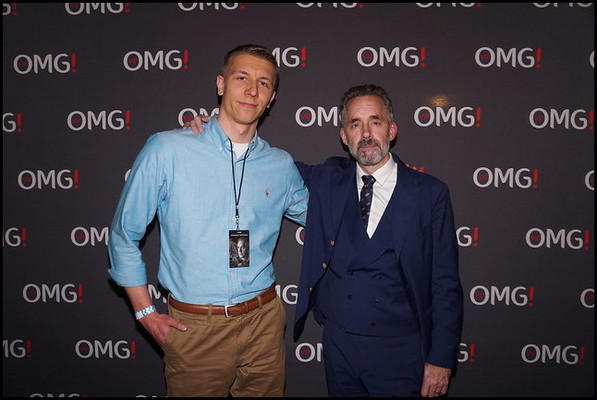
Incredibly humbled to have met the one and only Jordan Peterson.
Since I bought the VIP meet and greet tickets, I had the chance to briefly speak with Dr. Peterson, pose for a picture and participate in the VIP Q&A session (read about the full event here).
About 100 people stayed for the VIP Q&A, it only lasted about 20 minutes since Peterson had a plane to catch. Four people had the chance to ask him a question, luckily I was the fourth and last person he picked.
I wrote down my question on my phone earlier so I wouldn’t stutter or go blank if I got the chance to ask a question.

Jordan Peterson during the VIP Q&A, about 100 people stayed for this part of the show.
I asked:
You recommend over 100 books on your website, so I wanted to ask if you could apply the Pareto Principle to that list and share the 5 books that had the biggest influence on you?
Here is Peterson’s answer:
1) The Gulag Archipelago by Aleksandr Solzhenitsyn

It likely isn’t a surprise for JBP fans to learn that Dr. Peterson ranked “The Gulag Archipelago” as the No. 1 book that influenced him. Peterson constantly shares stories from the book during his lectures, as well as talking about Solzhenitsyn’s other great books. Peterson even wrote the foreword to the new 50th anniversary edition of “The Gulag Archipelago.”
Book Summary:
“The Gulag Archipelago” is a three-volume, non-fictional text written by Russian writer and historian Aleksandr Solzhenitsyn. It was first published in 1973 and covers life in the gulag (the Communist Soviet forced labour camp system) through a narrative constructed from various sources including reports, interviews, statements, diaries, legal documents, and Solzhenitsyn's own experience as a gulag prisoner.
2) Crime and Punishment & The Brothers Karamazov by Fyodor Dostoevsky (Tie)


Peterson said “Crime and Punishment” along with “The Brothers Karamazov” by Fyodor Dostoevsky would tie for second place as the books that most influenced him. Peterson is constantly referencing Dostoevsky’s work during his lectures and has called Dostoevsky one of his favorite authors and recommends reading all five of his great novels.
Book Summary:
“Crime and Punishment” focuses on the mental anguish and moral dilemmas of Rodion Raskolnikov, an impoverished ex-student in Saint Petersburg who formulates a plan to kill an unscrupulous pawnbroker for her money. Before the killing, Raskolnikov believes that with the money he could liberate himself from poverty and go on to perform great deeds. However, once it is done he finds himself racked with confusion, paranoia, and disgust for what he has done. His moral justifications disintegrate completely as he struggles with guilt and horror and confronts the real-world consequences of his deed.
Book Summary:
“The Brothers Karamazov” is a passionate philosophical novel set in 19th-century Russia, that enters deeply into the ethical debates of God, free will, and morality. It is a spiritual drama of moral struggles concerning faith, doubt, judgment, and reason, set against a modernizing Russia, with a plot which revolves around the subject of patricide. Dostoevsky composed much of the novel in Staraya Russa, which inspired the main setting. Since its publication, it has been acclaimed as one of the supreme achievements in world literature.
3) The Road To Wigan Pier by George Orwell

Peterson ranked “The Road To Wigan Pier” as number three and although he didn’t add why this book influenced him, Peterson has talked about this book in his lectures and said “He would highly recommend this book” and called it “A truly great book” in a Facebook post.
Book Summary:
“The Road to Wigan Pier” is a book by the British writer George Orwell, first published in 1937. The first half of this work documents his sociological investigations of the bleak living conditions among the working class in Lancashire and Yorkshire in the industrial north of England before World War II. The second half is a long essay on his middle-class upbringing, and the development of his political conscience, questioning British attitudes towards socialism. Orwell states plainly that he himself is in favor of socialism, but feels it necessary to point out reasons why many people who would benefit from socialism, and should logically support it, are in practice likely to be strong opponents.
4) Affective Neuroscience by Jaak Panksepp

Peterson ranked “Affective Neuroscience”as number four and commented that it is the best book on neuroscience that he’s read.
Book Summary:
“Affective Neuroscience” by Jaak Panksepp provides the most up-to-date information about the brain-operating systems that organize the fundamental emotional tendencies of all mammals. The book offers a comprehensive summary of the fundamental neural sources of human and animal feelings. The book includes chapters on sleep and arousal, pleasure and fear systems, the sources of rage and anger, and the neural control of sexuality, as well as the more subtle emotions related to maternal care, social loss, and playfulness. This book will be one of the most important contributions to understanding the biology of emotions since Darwins’ “The Expression of the Emotions in Man and Animals.”
5) The Neuropsychology of Anxiety by Gray & McNaughton

Fifth place belongs to “The Neuropsychology of Anxiety” by Jeffrey Gray and Neil McNaughton. Peterson said that this book was fascinating but also incredibly dense and each chapter would require the reader to take time to soak in all of the information. He added that it would take the average person probably a year or so to read, and even with Peterson’s background in psychology, he said it took him over 6 months to finish reading.
Book Summary:
“The Neuropsychology of Anxiety” first appeared in 1982 as the first volume in the Oxford Psychology Series, and it quickly established itself as the classic work on the subject. This completely updated and revised edition is essential for postgraduate students and researchers in experimental psychology and neuroscience, as well as for all clinical psychologists.
To summarize, here are the 5 (or technically the 6) books that had the biggest influence on Dr. Jordan B. Peterson:
Thank you everyone for reading my article, I hope you’ve found it helpful!
If you’re a fan of Jordan Peterson, I would definitely recommend going to one of his events, and for those who haven’t yet read Peterson’s book, I would highly recommend doing so.
You can get it here.

A few related articles:
What Dr. Peterson Got Right & Wrong About “A Billion Wicked Thoughts”
6 Profound Quotes from "12 Rules for Life" by Jordon Peterson
"12 Rules for Life" by Jordan B. Peterson -Book Review & Summary
Learn more about Jordan Peterson here:
If you enjoyed this article, consider supporting the site or signing up for my monthly newsletter. Thank you!

Meeting Jordan B. Peterson & "12 Rules for Life" Lecture Recap
Jordan Peterson is a Canadian clinical psychologist, professor of psychology and bestselling author.
I had the opportunity to attend Peterson’s “12 Rules for Life” book tour and meet Dr. Peterson.
Here is a recap of the event!
Dr. Jordan B. Peterson, a Canadian clinical psychologist, a professor of psychology and bestselling author of “12 Rules for Life”, has played an important mentorship role in my life.
His lectures teach valuable lessons such as the importance of responsibility, how to find meaning in life, the differences among human personalities and genders, how to understand ancient stories (Biblical and other classic tales) and much more.
When I found out that he was coming to NYC as part of his book tour, I jumped at the chance to meet him. Fortunately, I was able to buy a ticket before the event sold out.
“12 Rules for Life” Lecture
At the event, people could buy JBP merchandise such as posters and books. However, there were no signed copies for sale, instead, Peterson had signed a small piece of paper that was given to anyone who bought a copy of “12 Rules for Life” for $28.
The event started around 8 p.m. with Jordan Peterson’s daughter Mikahlia coming out on stage and talking about her father. She mentioned that neither her nor Dr. Peterson could have ever imagined that Dr. Peterson would be traveling the world to give lectures about meaning and responsibility to thousands of people.
After being introduced by Mikahlia, Dr. Peterson walked onto the stage and was greeted with a standing ovation.

Dr. Jordan Peterson takes the stage in NYC.
For about an hour and a half, Dr. Peterson elaborated on several lessons from his book. The talk was only slightly different from the hundreds of hours of lectures you can find on his YouTube channel, but it was a completely different experience seeing him in-person and being literally only a few feet away from him.
The audience remained remarkably respectful throughout the talk and there were no protestors or hecklers. Everyone was captivated by Peterson while he discussed the importance of responsibility, taking care of yourself and many more topics.

Peterson at the Beacon Theatre in NYC.
Lecture Takeaways
Two points that really grabbed my attention was when Peterson talked about the difficulty of having good friends, and suffering.
Good friends are people who will tell you the truth when you don’t want to hear it but need to hear it. Although this will hurt at times, it is better to know the truth and act on it than to be friends with people who turn a blind eye to each others shortcomings.
A bad friend will ignore your drinking problem as long as you ignore their smoking problem and both of you will pretend things are fine as if not talking about a problem will make it go away.
This is why it is so easy to be friends with bad influences, because they don’t point out your faults and make you feel that it is okay to not fix your faults.
A good friend however, will tell you that you need to stop getting drunk every weekend because it is bad for your health and unproductive.
A good friend will expect more out of you and push you to reach your full potential in life.
Having good friends is hard and challenging, but it is much better than surrounding yourself with people who ignore their problems and avoid responsibility.
The second point that stuck with me is Jordan Peterson’s classic line of “Life is suffering.” No matter what, you will suffer throughout your life. Even if somehow you manage to avoid almost all suffering in life, you still die in the end. If that’s the case is life worth living?
Yes, just because the journey has an fixed ending, it doesn’t mean the journey is pointless.
Everyone should try to make their life journey as positive as possible.
This means taking on personal responsibility to improve your life.
By doing so, you improve your life, the lives of those around you and possibly the lives of future generations.
No one knows whether Heaven or Hell exists, but we do know Earth exists and everyone of us has the power to make Earth a little more like Heaven or a little more like Hell–let’s go with Heaven.

Mikhaila Peterson and her father Dr. Peterson.
Dr. Peterson finished talking around 9:30 p.m. and then Mikhaila came back on stage to ask questions that were sent in by the audience. The Q&A ended around 10 p.m. and once again Peterson received a standing ovation as he left the stage.
Meeting Jordan Peterson
After the Q&A session, everyone left except for those with a VIP ticket. The VIP meet and greet started a little after 10 p.m. and went on till about 11 p.m. Approximately 150 people bought the VIP ticket to meet Dr. Peterson (myself included).
Each person got to speak with Peterson for about 10-15 seconds and get a picture with him. Unfortunately, Peterson wasn’t signing any books at the event. Many fans gave Peterson gifts such as books or custom artwork.
When it was my turn to meet Peterson, he greeted me with a firm handshake, a warm smile and asked me my name. I told him and thanked him for all his great work. I talked about Alex & Books, how he inspired me to start the site and handed him a few of my bookmarks.
He smiled and was glad to hear that I had been spending my free time reading books and educating myself. He wished me good luck with my site and said to keep at it. I thanked him again, posed for a picture and took a seat.
Incredibly humbled to have met the one and only Jordan Peterson.
The meet and greet ended at 11 p.m. and then the VIP Q&A session started. The session only lasted about 30 minutes since Peterson had a plane to catch. Only four people got the chance to ask him a question, luckily I was the fourth and last one.
I asked him which 5 books out of his 100+ book list influenced him the most, read his answer here.
Peterson also shared that he will be releasing his next book “12 More Rules for Life” in early 2020 and will be doing more Biblical lectures during late 2019/early 2020.
He also mentioned that he had finished a podcast with Milo Yiannopoulos and Joe Rogan, and will be releasing those soon.
The VIP Q&A ended around 11:30 p.m.

My copy of “12 Rules for Life” and the VIP pass.
Conclusion
In total, the entire show lasted about 3.5 hours and aside from the VIP tickets being a bit pricey (I sold my Xbox to help pay for it) and Peterson not signing books, I don’t have anything negative to say about the event.
It was a great experience to see Jordan Peterson in-person instead of on YouTube and I was super lucky to personally meet and talk with him.
If you’re a fan of Jordan Peterson, I would definitely recommend going to one of his events. Keep an eye out for more of his shows here.
Thank you everyone for reading my article, I hope you’ve found it helpful! -Alex
If you haven’t yet read Peterson’s book, I highly recommend it. You can get it here.

Here are a few related articles:
What Dr. Peterson Got Right & Wrong About “A Billion Wicked Thoughts”
6 Profound Quotes from "12 Rules for Life" by Jordon Peterson
"12 Rules for Life" by Jordan B. Peterson -Book Review & Summary
Learn more about Jordan Peterson here:
If you enjoyed this article, consider supporting the site or signing up for my monthly newsletter. Thank you!

"Letters of Note" by Shaun Usher
Book summary and lessons from "Letters of Note” by Shaun Usher.
Read F. Scott Fitzgerald’s letter to his daughter, writing advice from Ernest Hemingway and life advice from Fyodor Dostoevsky.
This book is filled with 125 letters from writers, scientists, artists, musicians, and many more historic individuals.
Book Summary:
“Letters of Note: An Eclectic Collection of Correspondence Deserving of a Wider Audience” by Shaun Usher is a unique collection of 125 letters from famous writers, scientists, artists, and other remarkable people throughout history.
There is an image of each letter and a transcript to go with it for easy reading, the book is also filled with photographs, portraits and relevant artworks that adds a visual treat to this collection of text.

The book contains letters from:
Albert Einstein
Benjamin Franklin
Ernest Hemingway
Fyodor Dostoevsky
Kurt Vonnegut
Ray Bradbury
F. Scott Fitzgerald
Ludwig van Beethoven
And many more.
Book Lessons:
1) Life Advice from F. Scott Fitzgerald
In 1933, the famous American novelist F. Scott Fitzgerald, best known for writing “The Great Gatsby”, sent a letter to his young daughter while she was away at camp.
The letter is filled with wisdom such as the things she should worry about in life and the things that she shouldn’t worry about. Here are a few lines from the letter:

“All I believe in life is the rewards for virtue and the punishments for not fulfilling your duties, which are doubly costly.
”
“Things to worry about:
Worry about courage
Worry about cleanliness
Worry about efficiency
Things not to worry about:
Don’t worry about popular opinion
Don’t worry about dolls
Don’t worry about the past
Don’t worry about the future
Don’t worry about growing up
Don’t worry about anybody getting ahead of you
Don’t worry about failure unless it comes through your own fault
Don’t worry about disappointments
Don’t worry about pleasures”
2) Writing Advice from Ernest Hemingway
Even the best writers encounter roadblocks and question the quality of their work. So in 1934 when F. Scott Fitzgerald needed honest feedback, he turned to his old and trustworthy friend, Ernest Hemingway.
Fitzgerald had just published “Tender is the Night” and wanted Hemingway’s opinion on the book–Hemingway did not hold back and the brutal honesty of his advice remains invaluable for all writers.
Here are a few quotes from the letter:

“For Christ sake write and don’t worry about what the boys will say nor whether it will be a masterpiece nor what. I write one page of masterpiece to ninety one pages of shit. I try to put the shit in the wastebasket.”
“Forget your personal tragedy. We are all bitched from the start and you especially have to hurt like hell before you can write seriously. But when you get the damned hurt use it–don’t cheat it. Be as faithful to it as a scientist–but don’t think anything is of any importance because it happens to you or anyone belonging to you.”
“You’re not a tragic character. Neither am I. All we are is writers and what we should do is write.
”
“But Scott, good writers always come back. Always. You are twice as good now as you were at the time you think you were so marvelous...You can write twice as well now as you ever could.”
“All you need to do is write truly and not care about what the fate of it is. Go on and write.”
3) Advice from Fyodor Dostoevsky
In April 1849, Russian novelist Fyodor Dostoevsky was arrested for discussing literature banned by Czar Nicholas I and sent for execution. At the last minute, the execution was called off and Dostoevsky was instead sent to a prison camp in Siberia.
He would go on to spend almost 5 years in prison and after being released, write such classics as “Crime and Punishment” and “The Brothers Karamazov.”
A day after his execution was called off, Dostoevsky sent a letter to his brother in which he described his death sentence, talked about his new perspective on life. Here are a few quotes from the letter:

“When I look back at the past and think how much time has been wasted in vain, how much time was lost in delusions, in errors, in idleness, in ignorance of how to live, how I did not value time, how often I sinned against my heart and spirit,–my heart bleeds. ”
“Life is a gift, life is happiness, each minute might have been an age of happiness.”
“Now, changing my life, I am being reborn into a new form. Brother! I swear to you that I shall not lose hope, and shall preserve my spirit and heart in purity. I shall be reborn to a better thing. That is my whole hope, my whole comfort!”
“The life in prison has already sufficiently killed in me the demands of the flesh which were not wholly pure; I took little heed of myself before...do not fear that any material hardship will kill me. This cannot be! Ah! To have health!”
Book Review:
“Letters of Note” by Shaun Usher is the perfect coffee table book, especially for people who love to read or write. There is something special about reading letters, particularly handwritten letters, from famous individuals that gives readers an inside look into the person’s soul.
Since most of the letters are only a page or so, you can read this book bit by bit without having to remember past characters or the storyline. Instead, pickup this book whenever you have a few minutes and read a letter from Charles Darwin or John F. Kennedy.
The book is also filled with images and photographs that add another layer of personality to the letters and make the writing come alive. Whether you are into science, writing, art, music–there is something for everyone in this book.
Rating: 4/5 Stars
If you’re interested in reading the full letters or reading more letters from a wide-range of authors, you can get “Letters of Note” here.

After reading 100+ books, here are the books I recommend reading.
Please consider supporting A&B or signing up for our monthly newsletter. Thank you!

"Digital Minimalism" by Cal Newport
Book summary and lessons from "Digital Minimalism” by Cal Newport.
Learn how how social media is designed to be addictive, how to perform a digital declutter and how to replace social media with deep meaningful activities.
Matt Ridley is a professor and author of several books including “Deep Work” and “So Good They Can’t Ignore You.”
Book Summary:
“Digital Minimalism: Choosing a Focused Life in a Noisy World” by Cal Newport takes the concept of minimalism and applies it to personal technology. In an overstimulated world, this book will teach readers how to live a focused and productive life.
The book is similar to Newport’s last book, “Deep Work” but has a greater focus on how to properly use smartphones, personal tech and social media.
Newport identifies the common practices of digital minimalists and the ideas that underpin them. He shows how digital minimalists can rethink their relationship to social media, rediscover the pleasures of the offline world, and reconnect with their inner selves through regular periods of solitude.

He also shares strategies for integrating these practices into your life, starting with a thirty-day "digital declutter" process that has already helped thousands feel less overwhelmed and more in control.
Technology is neither good nor bad. The key is using it to support your goals and values, rather than letting it use you. This book shows the how.
Book Lessons:
1) How Social Media is designed to be addicting
“Just as Tristan Harris warned, in many cases these addictive properties of new technologies are not accidents, but instead carefully engineered design features.
”
When the first iPhone was released in 2007, there was no App store, no social media notifications and no Instagram. Fast forward a decade and almost everyone who has a smartphone is addicted to it and social media.
The average modern user spends around “two hours per day on social media” and checks their phone “eighty-five times a day.” People text while driving, they cross the street while looking at Instagram and watch YouTube videos while using the bathroom–the addiction is widespread.
Tristan Harris, a former Google engineer and whistleblower of tech addiction, explains that minimizing distractions and respecting users’ attention would reduce revenue for companies such as Google. Since many tech giants operate on an attention driven model (the more eyeballs they get, the more ads they can sell), these companies don’t have much incentive to become less addictive.
So how do these companies design tech to grab as much of your attention as possible?
One way is by creating attention-catching notifications and making it easy to find the next interesting post.
The original Facebook notification symbol was blue to match the rest of the site, “but no one used it. So they changed the color to red–an alarm color–and clicking sky rocketed.”
Almost every social media platform has copied this concept and also added a news feed with infinite scrolling. Infinite scrolling allows users to see post after post for hours on end–it’s difficult to stop when there is no finish line and the fear of missing out (FOMO) on an interesting post is always in the back of your head.
Social media is also designed to encourage users to seek social approval.
“In Paleolithic times, it was important that you carefully managed your social standing with other members of your tribe because your survival depended on it.” Today, new technologies hijack this deep drive to create a behavioral addiction.
When someone shares a new post, they aren’t sure whether ‘their tribe’ will approve of it or not so they constantly monitor its progress. If the post gets a lot of likes, hearts or comments, people feel a surge of dopamine. If the post doesn’t do well or doesn’t get as many likes as the last post, people will often delete it.
As Sean Parker, the founding President of Facebook, once said that features like these are part of a “social-validation feedback loop...exactly the kind of thing that a hacker like myself would come up with, because you’re exploiting a vulnerability in human psychology.”
2) Take a digital declutter
“Digital Minimalism:
A philosophy of technology use in which you focus your online time on a small number of carefully selected and optimized activities that strongly support things you value, and then happily miss out on everything else.
”
Much like cleaning out a house that is filled with things that provide little to no value to one’s life, Newport suggests doing a digital declutter in which you clear away distracting tools and compulsive habits.
Here’s how:
Take a 30 day break from optional technologies in your life.
During that break, explore and rediscover activities and behaviors that you find satisfying and meaningful.
At the end of the break, slowly reintroduce optional technologies in your life. For each technology you reintroduce, determine what value it serves in your life and how specifically you will use it to maximize this value.
Newport sent this declutter challenge to his mailing list and surprisingly, over 1,600 people signed up. Here are a few tips from for this challenge:
During the first step, remove social media, video games, video streaming and other technologies that aren’t necessary in your life–you can survive without Netflix or Reddit for a few weeks.
For the second step, focus on spending time on rediscovering what’s important to you and what you enjoy outside the digital world–try different hobbies, spend time playing sports, reconnect with old friends by meeting in person, read some books, etc.
The final step requires you to start from a blank slate and only allow the technology that greatly benefits you life to come back in–ask yourself, is this app, social media platform, video game, tv show...etc, really adding value to your life or not?
Lastly, here are 3 pieces of advice when considering whether to bring an optional technology back into your life, it must:
Serve something you deeply value (offering some benefit is not enough).
Be the best way to use technology to serve this value (if it’s not, replace it with something better).
Have a role in your life that is constrained with a standard operating procedure that specifies when and how you use it.
3) Connect in the real world, not the digital one
“Investing energy into something hard but worthwhile almost always returns much more richer rewards.”
The key issue is that using social media tends to take people away from the real world socializing that’s massively more valuable.
Social media isn’t inherently bad, it’s like a knife– a knife can be used to cut open a watermelon for people to enjoy or as a weapon that hurts people.
This is why it’s important to know when and how to use social media so it’s used for good instead of something bad.
Studies show that people who spend more time on social media feel more lonely and miserable because they are spending most of their time online instead of offline.
The tiny dopamine boost a person gets from getting a lot of likes on their Instagram picture isn’t nearly the same as the dopamine wave one gets from spending quality time with a dear friend.
Instead of using your smartphone and social media to connect with people online, use it as a way to plan activities in the real world.
Plan a weekend basketball pickup game
Host a weekly poker night at your house
Meetup with old friends and reconnect at a local bar
Have a weekly game night with the family
Join a volunteer group to help improve the community
There are countless of activities that will result in deeper relationships and be much more meaningful than stay at home and scrolling through your newsfeed.
If you’re more introverted, find a craft that you enjoy and adds value to your life.
This can include:
Crafting a wooden table
Knitting a new sweater
Renovating your guest room
Creating a new song
Working on your jumpshot
Reading great literature
Writing a journal entry
All of these crafts provide a good source of high-quality leisure. “Craft allows an escape from this shallowness and provides instead a deeper source of pride.”
High-skill effort activities (like building your own coffee table) require more than than low-skill effort activities (like answering emails) but yield much more meaning. “Over time, you’ll soon begin to wonder how you ever tolerated spending so many of your leisure hours staring passively at glowing screens.”
Conclusion:
“Digital Minimalism” by Cal Newport is a book that does exactly what it says, it shows readers how to have a focused life in a noisy world.
Social media apps may be free, but people pay for them with their most precious resources, their time and attention. With this book, readers will be able to fight against the tech giants and regain control of their lives, thus becoming aware of to properly use technology to your advantage, instead of tech companies using it to theirs.
By revealing the forces behind addictive technologies and introducing readers to a minimalism philosophy, readers will be well-equipped to thrive in an increasingly digital-first world. Anyone who owns a smartphone or uses social media for more than an hour each day should read this book.
Rating: 4/5
(Thank you Portfolio Penguin for sending over a copy of this book!)
If you’re interested in getting the book, click here or on the images below.

Here are a few similar articles:
After reading 100+ books, here are the books I recommend reading.
Please consider supporting A&B or signing up for our monthly newsletter. Thank you!

Ernest Hemingway’s Writing Advice to F. Scott. Fitzgerald
In 1934, Ernest Hemingway wrote a letter to F. Scott Fitzgerald.
The letter contains Hemingway’s thoughts on Fitzgerald’s latest book and is filled with great writing advice.
Both writers and authors will find Hemingway’s advice incredibly helpful.
Writing is hard, even the best writers encounter roadblocks and question the quality of their work. So in 1934 when F. Scott Fitzgerald needed honest feedback, he turned to his old and trustworthy friend, Ernest Hemingway.
Fitzgerald had just published “Tender is the Night” and wanted Hemingway’s opinion on the book–Hemingway did not hold back and the brutal honesty of his advice remains invaluable for all writers.
The book “Letters of Note” shares Hemingway’s response.

Here are a few fantastic quotes from his letter:
“I liked it and I didn’t...If you take real people and write about them you cannot give them other parents than they have (they are made by their parents and what happens to them) you cannot make them do anything they would not do. ”
“Invention is the finest thing but you cannot invent anything that would not actually happen. That is what we are supposed to do when we are at our best–make it all up–but make it up so truly that later it will happen that way. ”
“That’s what dries a writer up (we all dry up. That’s no insult to you in person) not listening...You see well enough. But you stop listening. It’s a lot better than I say. But it’s not as good as you can do.”
As the letter goes on, Hemingway advice gets even better:
“For Christ sake write and don’t worry about what the boys will say nor whether it will be a masterpiece nor what. I write one page of masterpiece to ninety one pages of shit. I try to put the shit in the wastebasket. ”
“Forget your personal tragedy. We are all bitched from the start and you especially have to hurt like hell before you can write seriously. But when you get the damned hurt use it–don’t cheat it. Be as faithful to it as a scientist–but don’t think anything is of any importance because it happens to you or anyone belonging to you. ”
“You’re not a tragic character. Neither am I. All we are is writers and what we should do is write.”
“But Scott, good writers always come back. Always. You are twice as good now as you were at the time you think you were so marvelous...You can write twice as well now as you ever could. ”
“All you need to do is write truly and not care about what the fate of it is. Go on and write. ”
Hemingway may have written this letter over 80 years ago but his advice, just like his books, are remain indispensable.
If you’re interested in reading the full letter or reading about more letters from a wide-range of authors, you can get the book “Letters of Note” here.
Here are a few similar articles:
After reading 100+ books, here are the books I recommend reading.
Please consider supporting A&B or signing up for our monthly newsletter. Thank you!

"The Red Queen" by Matt Ridley
Book summary and lessons from "The Red Queen" by Matt Ridley.
Learn why women conceal fertility, why women want rich and tall men and why romance novels are porn for women.
Matt Ridley is a scientist, journalist and bestselling author.
Book Summary:
“The Red Queen: Sex and the Evolution of Human Nature” by Matt Ridley answers dozens of riddles about human nature and culture–including why men propose marriage, the method behind our notions of beauty, why humans reproduce sexually instead of asexually and many more human mysterious.
Author Matt Ridley also argues that men are polygamous for the obvious reason that whichever gender has to spend the most time and energy creating and rearing offspring tends to avoid extra mating, while women are far less interested in multiple partners and will commit adultery if stuck with a mediocre mate.
Read on to learn why women conceal their fertility, why women like men who are tall, wealthy and have status, and why romance novels equal porn for women.

Book Lessons:
1) Why Women Conceal Their Fertility
“Women’s genes seem to have gone to inordinate lengths to conceal the moment of ovulation. ”
A lot of animals, such as chimps, mice and dogs, can tell when the other sex is ‘in heat’ and fertile for mating.
Some animals make it extremely clear, “chimpanzees become pink; cows smell irresistible to bulls...female mice solicit male mice” but when it comes to female humans, women have evolved to hide their ovulation, so much so that even they don’t always know exactly when the moment will happen.
So why do women not advertise to mates that they are fertile like other species?
One argument is that since the man doesn’t know when the woman is pregnant, he must stay around and have intercourse with her often to be sure he is the father of the children. “This keeps him from mischief and ensures he is still around to help rear the babies.”
The second argument, is that if females wish to select their choice of partner, it makes little sense for them to advertise their ovulation. She wants to first choose a mate, then advertise to him that she is fertile afterwards while keeping the other males guessing.
Both arguments are logical and make a strong case. Ideally, a woman would want to select the best mate and then keep him around for form a long-term relationship with him instead of advertising that she is fertile and hooking up with the first guy that comes by,
2) Women Want Men With Status, Wealth & Height
“Men consistently place physical features above personality and status when considering women; women do not when considering men.
”
Good news guys, women don’t care about a guy’s physical appearance as men do!
This isn’t because men are shallow, but rather men look for cues to learn about the health of a woman–a symmetrical face, large breasts and hips are all features that indicate a healthy body (read more from "A Billion Wicked Thoughts” by Ogas & Gaddam).
However, everyone already knew what men desire, the million dollar question is what do women desire?
The answer: Status, wealth and height.
Status: Ideally a woman would want to be with someone who is ‘on the top of the food chain’ such as a doctor or CEO, but since most women choose a mate long before a man has had the chance to become high status, women look for clues for future potential.
This includes clues such as past achievements, intelligence, ambition, optimism, poise–”these are the things that cause men to rise to the top of their professions. And not coincidentally, these are the things women find attractive.”
Wealth: The stereotype is true, women want wealthy men. “Women pay attention to cues of wealth and power, men pay attention to cues of health and youth.”
This is because a wealthy husband helps the wife by increasing “the number of and health of her children.” More money equals more food, medicine, shelter and many more things that will improve the odds of her children surviving and thriving.
Height: “Tall men are universally considered more attractive by women than short men...the principle that a man must be taller than his date is so universal that it has been called ‘the cardinal principle of date selection.”
This doesn’t mean you have to be 6’8” to date women, it means if you’re interested in a women who is 5’4”, she would likely prefer someone 5’5” or taller.
3) Why romance novels Equal porn for women
“Porn is designed for, marketed to, and sought out by men, not women. The romance novel, by contrast, is aimed entirely at the female market.
”
While men are attracted to visual images and having fantasize multiple partners, women are not. They prefer touch and fantasize about a familiar partner.
This is one of the main reasons women prefer romance novels over pornography.
While men are interested in intercourse with as many mates as possible (common theme in porn), to have as many offspring as they can, women have a different strategy.
Since a women can only have one child at a time and usually has to raise that child for a decade or two, women go for the best mate (common theme in books).
There is no evolutionary advantage for a woman to have sex with multiple men since she will only produce one offspring. Women have nothing to gain and in fact have a great deal to lose from this, especially if the women is looking for a long-term partner.
This explains why “male sexual fantasies tend to be more ubiquitous, frequent, visual...promiscuous and active” while “female sexual fantasies tend to be more contextual, emotive, intimate, and passive.”
The men in those novels are discussed in great detail, but with a focus on the man’s character and not his body.
Not surprisingly, sex plays a very small part in romance novels, instead, the majority of the book is about “love, commitment, domesticity, nurturing and the formation of relationships.”
Conclusion:
“The Red Queen” by Matt Ridley is a well-written and insightful journey that takes readers through genetics, neurobiology, psychology and many more areas of science to explore the evolution of human nature.
The book explains the benefits of sexual reproduction versus asexual, the different ways animals and humans evolved over thousands of years and how men and women seek different traits in a mate.
Although there were several nuggets of valuable information in this book, it is a bit outdated since it was written in 1993. I’d recommend first reading "A Billion Wicked Thoughts” by Ogas & Gaddam since it was written 2012 and has much more info on sex and human nature.
Rating: 3/5
If you’re interested in getting the book, click here or on the images below.

Here are a few similar articles:
After reading 100+ books, here are the books I recommend reading.
Please consider supporting A&B or signing up for our monthly newsletter. Thank you!

"Can't Hurt Me" by David Goggins
Book summary of "Can't Hurt Me" by David Goggins.
Goggins went from a living in poverty to joining the SEALs and becoming an ultra endurance athlete.
This book is one of my favorite books of 2019 and I highly, highly recommend reading it.
Book Summary:
“Can’t Hurt Me” by David Goggins is unlike any book I’ve ever read. The story of David Goggins is something out of a Hollywood movie. A young boy with a horrible childhood and a myriad of problems overcomes it all to become part of an elite military team and a world famous ultra endurance athlete.
As a child, Goggins had a learning disability, was often ill, and was raised by a single mother. As a young adult, Goggins’ future seemed bleak. He was depressed, overweight and worked as a bug exterminator.
And yet, he would go on to join an elite military team–the Navy SEALS– break the world record for pull-ups and become one of the world’s top endurance athletes, often running races of 100+ miles.

How did Goggins turn his life around and transform from a literal zero to American hero?
He did it through self-discipline, mental toughness, and hard work.
However, his transformation didn’t happen overnight. In fact, it took him several decades to change his life around.
Let’s start by looking at Goggins’ childhood.
Goggins’ Early Years
David Goggins was born in New York in 1975 and although he lived on Paradise Road, his childhood was anything but that.
Goggins’ father, Trunnis, ran a roller-disco rink during the day, but was also involved in shady activities such as moving prostitutes across the border. When Goggin’s mother disobeyed or argued with Trunnis, such as taking Goggins to the doctor because he had an ear infection, he would beat her for disobeying him. When Goggins tried to stop his father, he would end up catching a beating himself.
““I was covered in welts from my neck to the crease at the knees. I didn’t go to school for several days.””
When Goggins was 8 years old, his mother put together a plan to escape from her abusive partner. Despite his cruelty, Goggins’ older brother decided to stay with Trunnis, and so, only Goggins and his mother managed to escape.
Although Goggins was able to get away his abusive father, his life didn’t get much better. He and his mother were free from Trunnis, but they now had no financial support. The two found shelter in a public housing block and paid $7 a month in rent.
Not only was Goggins experiencing poverty, but he was also diagnosed with ADHD and developed a nervous stutter. His traumatic childhood and toxic environment made it difficult to learn, and so he started cheating in school to pass classes.
““I knew that if I didn’t show some improvement I would eventually be shipped out to that special black hole for good, so I found a solution. I started cheating my ass off.” ”
When Goggins was in the 4th grade, his mother met Wilmoth, a man who was the polar opposite of Trunnis. Wilmoth was kind and laid-back. He treated Goggins’ mother well and even played basketball with Goggins.
However, a happy family was not in Goggin’s future. One night, Wilmouth was shot five times as he tried to enter his home. The cops never found the killers and once again, Goggins and his mother found themselves on their own.
Goggins’ Young Adult Years
As a teenager, David continued to struggle with school. To force himself to learn, Goggins had to read the same text multiple times and rewrite his notes over and over again. His work eventually paid off and he finished high school and was he accepted into Air Force training.
David’s dream was to become an Air Force pararescue, a special group of soldiers who specialize in parachuting into war zones and rescuing their brothers-in-arms. However, to complete his training, David would have to face one of his biggest weaknesses, swimming.
However, as a child, David rarely spent time in a pool. When it came time to the water portion of his military training, Goggins found himself overwhelmed with fear and quit the program. He knew he should have fought through his fear and completed his training, but instead he took the easy way out.
Quitting training would become one of Goggins’ biggest regrets, he started to feel sorry for himself and things began to spiral downhill. After leaving the military, Goggins was 24-years-old and working a dead-end job as a night-shift pest exterminator. He used food as a way to numb the pain of failure and weighed nearly 300 pounds.

After quitting the Air Force, Goggins ballooned up to nearly 300 pounds.
Goggins was nearing a dead-end. He hated his job, ate junk food multiple times a day and had trouble looking at himself in the mirror. Fortunately, his life would soon change.
One day, Goggins flipped on the television and happened to stumble upon a documentary about Navy SEALS. He watched as the narrator talked about the SEALs as the most elite fighting force in the world and that only the best of the best made it through training.
Goggins was stunned and amazed by the mental toughness and determination of the men on the screen. They had to carry boats for miles, lift logs, do countless pushups, swim for hours and perform many more difficult tasks.
Goggins wanted to become one of these incredible human beings and set out on a mission to become a Navy SEAL.
Becoming A SEAL
Before Goggins could even enter training, he first had to lose over 100 pounds of weight in less than three months because of the Navy’s maximum weight limit. Many people would have quit at this point, but Goggins decided to double down and commit 110% percent to becoming a SEAL.
Goggins woke up at 4:30 A.M. every day and exercised for two hours on a stationary bike. He then spent two hours in the pool and hit the weight room afterwards. He would also bike for another two hours after dinner. Working out practically became a full-time job for Goggins.
Remarkably, Goggins’ hard work paid off and he was accepted into the SEAL training program.
However, he would still have to endure his hardest training yet. Goggins participated in three Hell Weeks–where he experienced 5 ½ days of grueling exercise, soaked in water and covered in sand, all while getting barely any sleep during the program. In his third Hell Week, a man actually died during training.
Fortunately, Goggins made it through training and became a SEAL.
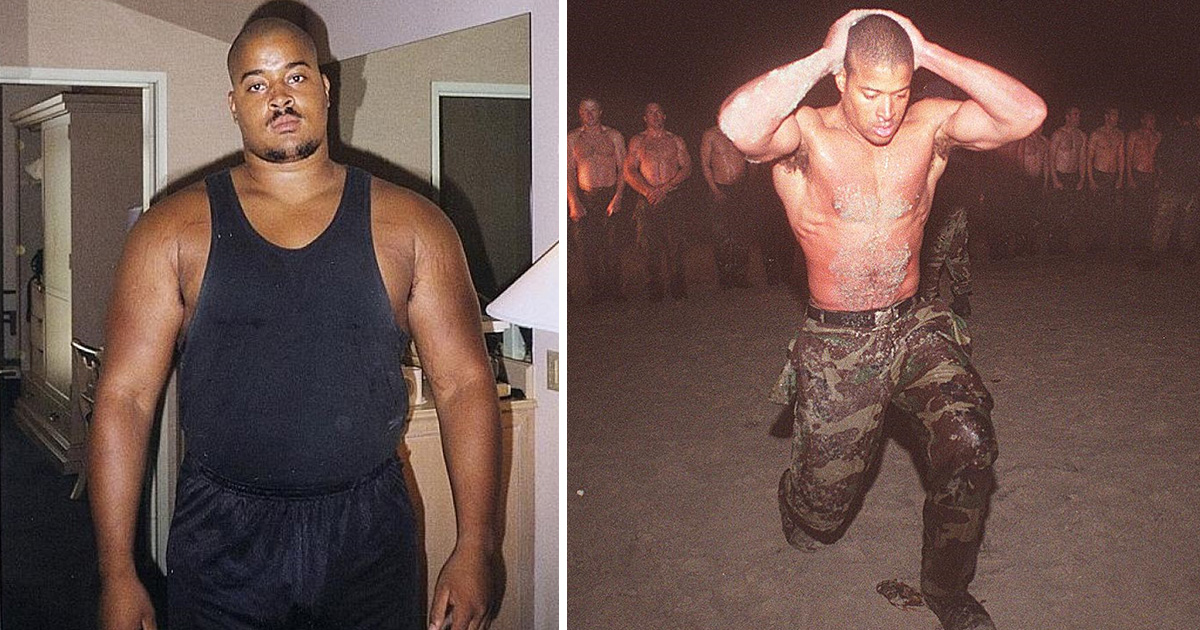
David Goggins (left) before Navy SEAL training and Goggins during Hell Week in BUD/S.
Becoming An Endurance Athlete
Goggins spent several years as a SEAL, but soon found himself craving new challenges. He searched for the toughest challenges known to man and found the Badwater 135, a 135-miles race through California’s Death Valley–one of the hottest places on Earth.
To even qualify for the Badwater race, the race organizers required Goggins to run in a 100-mile race. Although he had never run more than 26.2 miles before, Goggins accepted the challenge and signed up.
Through sheer motivation, willpower and incredible driver, Goggins finished the race in 19 hours, he even ran an extra mile to make sure the judges counted his laps correctly.
Goggins would later describe the race as the most pain he had ever experienced in his life–he was urinating brown piss from experiencing kidney failure and lost his bowel movement while running and defecated on himself. And yet, he would also remember that race as the moment his life changed forever–if he could run a 100-mile race with no training, he could do anything.
Goggins would go on to compete in the Badwater 135 and finish in 5th place, completing the race in 30 hours. He continued to look for the most difficult challenges he could find–he competed in Ironman triathlons, ultra marathons, and even broke the world record for pull-up attempts.
“Talent wasn’t required for this sport. It was all about heart and hard work, and it delivered relentless challenge after relentless challenge, always demanding more.”
Be Like Goggins
Several times throughout the book Goggins admits to readers that he wasn’t born strong, smart or with a hard work ethic. Early on in his life, he took the easy way out by cheating in school, running away from his fears and taking the easy way out as much as possible.
And where did that get him? Nowhere.
Goggins shares that it is only when changed his mindset and realized that the key to success was working harder than anyone else, did his life change for the better.
The secret to Goggins’ accomplishments is his willingess to work and suffer. By punishing himself physically, Goggins was also able to push himself mentally and vice-versa.
Goggins says that too many people get comfortable in their lives, they start to make excuses for working hard, such as not having time to exercise, or even worse, they simply decide not to. But Goggins doesn’t accept excuses.
Goggins didn’t make the excuse of not having time to train when he had a full-time job as a SEAL, he made time to train.
Goggins would get up at 4 A.M. and go for a 6-10 mile run. He would be home by 5:15 A.M., shower and eat breakfast. He would then bike 25 miles to work and arrive at his desk by 7:30 A.M. He would work till lunch time, and lift weights during his break. Once he was done with his day job, he would bike another 25 miles and arrive home at 7 P.M.
“My work ethic is the single most important factor in all of my accomplishments. Everything else is secondary.””
As Goggins says, most people program themselves to seek comfort, carve out safe spaces and spend as little time possible doing things that are hard or straight up suck. Although these things may feel good temporary, in the long-term it makes people weak.
Towards the end of the book, Goggins tells readers to ask themselves one question, “What if?”
Just as Goggins asked himself,
What if I lost 100 pounds in 3 months?
What if a kid afraid of water became a Navy SEAL?
What if I ran 100 miles without any training?
What if you set out to do a so-called impossible goal and actually completed it.
So ask yourself, “What if?”
Book Review:
“Can’t Hurt Me” by David Goggins might be my favorite book of 2019 and the year isn’t even halfway over. David’s story is beyond amazing, if one were to simply look at his achievements, you would took the guy isn’t human. But after reading his book, you realize he is just as human as everyone of us–except he simply chooses to strive for excellence and challenge himself over and over again.
Words cannot convey of important and inspiring this book is–I read the book, listened to the audiobook (which I recommend because Goggins shares bonus stories on the audio version) and watched dozens of podcasts about Goggins, and yet I’m still blown away him.
Just from reading his book, I’ve been motivated to run 5 miles every week–I’ve ran in 20 degree weather, in the snow and in the rain, and have been doing so for almost 4 months now. I’ve even signed up for several races.
This book will motivate you to push yourself to a new level and will make you a better person because of it. Get it, read it and learn from it!
Rating: 5/5
If you’re interested in getting the book, click here or on the image below.

After reading 100+ books, which ones do I recommend? Find out here.
Please consider supporting A&B or signing up for our monthly newsletter. Thank you!

Writing Tips from Dr. Jordan B. Peterson
Jordan Peterson is a Canadian clinical psychologist and a professor of psychology.
Peterson’s book, “12 Rules for Life” has sold over 3 millions copies.
Here are some writing tips from Jordan Peterson.
Writing is often a dreaded task for students–especially writing essays–luckily, Dr. Jordan Peterson recently shared the writing guide he used to give his students back when he was a professor at the University of Toronto.
Peterson’s 25-page writing guide is filled with valuable insights, such as why writing is an important life skill, tips on motivating yourself to write, how to properly edit an essay, and much more. Here are a few key takeaways from his guide.
“The primary reason to write an essay is so that the writer can formulate and organize an informed, coherent and sophisticated set of ideas about something important. ”
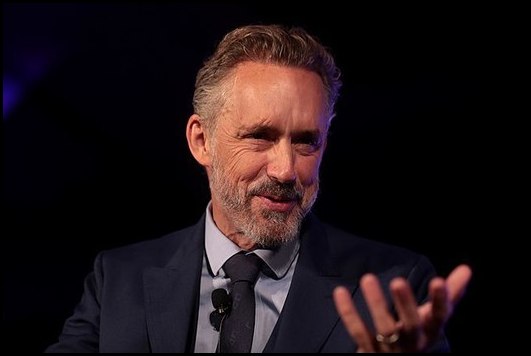
Dr. Jordan Peterson (source).
Why Writing Is Important:
“Writing extends your memory, facilities editing and clarifies your thinking. ”
Peterson claims that there is no difference between thinking and writing.
Thinking is important because it allows you to plan your actions instead of taking unnecessary risks and acting recklessly. Like thinking, writing an essay allows you to plan and organize your thoughts to create a strong and coherent argument instead of simply saying the first thing that comes into your mind.
Additionally, Peterson says that since you can write down more ideas than you can remember, writing gives you the capacity to review your thoughts, reject substandard ideas and strengthen good ones.
Writing isn’t simply a skill used in school, it can be applied to a wide range of scenarios throughout your life:
“Here is something to think about: the person who can formulate and communicate the best argument almost always wins. If you want a job, you have to make a case for yourself. If you want a raise, you have to convince someone that you deserve it. If you are trying to convince someone of the validity of your idea, you have to debate its merits successfully, particularly if there are others with other competing ideas.” -JBP
As the saying goes, the pen is mightier than the sword and by sharpening your ability to think and communicate your ideas through writing, you will become lethal. This skill will become especially valuable as you climb the competence hierarchy because you will need to articulate complex ideas and defend your opinions.
Practical Writing Advice:
Before you even begin writing, Peterson recommends getting a good night’s sleep the day before, then waking up in the morning and eating a healthy breakfast with some protein and fat (ex. Eggs and bacon, avoid coffee–Peterson says it is counter-productive).
If possible, have two monitors–one to present your reference material and your essay on the other. He also suggests getting a good keyboard (ex. Microsoft Ergonomic keyboard).
When you first sit down to write, your brain will likely rebel and look for distractions. Aim to write for 15 minutes without being distracted, soon you’ll find that your mind will settle down and concentrate on the task at hand.
When it comes to writing, go for quality over quantity. Three hours of focused writing is better than 10 hours of scattered self-deceptive work.
Lastly, don’t wait for a large chunk of free time to start writing. “You will never get big chunks of free time ever in your life, so don’t make your success dependent on their non-existent. The most effective writers write every day, at least a bit,” says Peterson.
Learn The Basic Rules of Writing:
“Rules are there for a reason. You are only allowed to break them if you are a master. If you’re not a master, don’t confuse your ignorance with creativity or style. ”
Here are a few basic rules to follow:
Select your words carefully.
Craft your sentence so that the right words are in the right location.
Properly arrange your sentences inside the paragraph.
Organize the paragraphs in a logical progression from the beginning of the essay to the end.
As a general rule, a paragraph in an essay should be made up of at least 10 sentences or 100 words. Each paragraph should present an idea–if you can’t think up 100 words to say about your idea, you may need to rethink it. On the other hand, if your paragraph is 300+ words, you may need to trim it or break it up into multiple ideas.
Peterson adds that writers should “strive for brevity, which is concise and efficient expression, as well as beauty.”
If the reader finds your essay boring, or more importantly, you are bored while writing your essay, something is wrong. Perhaps you’ve chosen the wrong topic (one you don’t find interesting) or you are approaching a good topic in a substandard manner.
Try to find a topic that is important to you and piques your curiosity. By doing so, you will put yourself in “alignment with the deeper levels of your psyche and spirit,” says Peterson.
Advice on Reading:
When reading, make a note of the things that catch your attention–the things you seriously agree or disagree with are worth remembering because it can be used to support or weaken your argument.
Peterson says that the best way to take notes is by writing down what you’ve learned and jotting any questions that come to mind. However, don’t copy the text word for word, it is better to recreate the message in your own language. The goal of taking notes is to eliminate extra details and concentrate on the key lessons learned.
If you find note-taking to be difficult, try reading a few paragraphs and then saying to yourself what the paragraph meant–listen to what you say and then write it down. Peterson recommends taking two to three times as many notes as you think you’ll need. It may sound inefficient, but it’s not. “In order to write intelligibly about something, or to speak intelligently about it, you need to know far more than you actually communicate,” writes Peterson.
Why You Need an Outline:
“Now you have to write an outline. This is the most difficult part of writing an essay, and it’s not optional. ”
Peterson calls the outline the most difficult part of writing an essay because it requires the writer to flesh out their argument. He suggests that a thousand-word essay should have about a ten-sentence outline.
Here is an example of a good outline:
Topic: What is capitalism?
How has capitalism been defined?
Author 1
Author 2
Author 3
Where and when did capitalism develop?
Country 1
Country 2
How did capitalism develop in the first 50 years after its origin?
How did capitalism develop in the second 50 years after its origin?
Historical precursors?
Choose as many centuries as necessary
Advantages of capitalism?
Wealth generation
Technological advancement
Personal freedom
Disadvantages of capitalism?
Unequal distribution
Pollution and other externalized costs
Alternatives to capitalism?
Fascism
Communism
Consequences of these alternatives?
Potential future developments?
Conclusion
Once the outline is finished, you simply have answer each question and provide examples that support your argument. For your first draft, it should be about 25% longer than the required length. This will allow you to trim the excess text and strengthen your essay.
How to Edit Your Draft:
When it comes to editing your work, Peterson recommends separating each sentence from the first paragraph and writing a second version of each sentence under it. Then repeat this for the next paragraph and so on till every paragraph has been rewritten. It is also helpful to read the sentence aloud and listen to how it sounds. If it sounds awkward, see if you can say it in a different, better manner.
Aim to eliminate all unnecessary words in your essay, this should cut the length of your sentences by 15-25%. Additionally, be precise with your words and use words you understand well. Don’t use fancy vocabulary that is beyond your level of comprehension.
Once you’ve finished editing your draft, try to write a new outline of 10-15 sentences. Make sure you don’t look back at your essay while doing this. By forcing yourself to reconstruct your argument from memory, you will likely improve it since you’ll remember most of what is important and forget the less important details. In a sense, your memory will act as a filter and preserve the useful information.
After finishing the new outline, cut and paste material from your previous essay. “Don’t be afraid to throw unnecessary material away. You are trying to get rid of what is substandard, and leave only what is necessary” (this is why Peterson recommended your draft be longer than the required length earlier on).
At this point, you can continue repeating the process of rewriting and re-ordering your work, or if you feel you’re ready to move on, wait a few days so that can you look at your work with fresh eyes for one final editing session.
“You are not genuinely finished until you cannot edit so that your essay improves. Generally, you can tell if this has happened when you try to rewrite a sentence (or a paragraph) and you are not sure that the new version is an improvement over the original.” -JBP
Lastly, make sure you cite your sources–no one wants to be accused of plagiarism and it provides readers the chance to double check your facts or dive deeper into a subject that they find interesting. With that done, your essay is complete.
“If you write a number of essays using this process, you will find that your thinking will become richer and clearer, and so will your conversation. There is nothing more vital to becoming educated, and there is nothing more vital than education to your future, and the future of those around you. ”
To summarize:
Writing is important because it allows you to think about more ideas and organize your thoughts better than keeping everything in your head.
Writing is a life skill that will increase your chances of becoming successful and will grow in value as you climb the competence hierarchy.
Learn the fundamentals of writing, the rules must be learned before you attempt to break them.
When reading, take notes by writing down what you’ve learned in your own words.
Create an outline so you have a fundamental form and structure.
Edit your work sentence by sentence, cut out unnecessary words, and read it aloud to make sure your writing is clear and easy to understand.
Repeat the editing process multiple times, take a few days off before the final edit to look at the work with fresh eyes.
Congratulations, your work is now complete!
Thank you for reading. Please share this post so JBP sees it!
If you want to read Peterson’s full writing guide, you can find it here.
If you haven’t yet read Peterson’s book, I highly recommend it. Click the image below to get it.
If you want to check out my list of recommended books, you can find it here.
If you enjoyed this article, consider supporting our site or signing up for our monthly newsletter. Thank you!

5 Book Bloggers Share Their 10 Favorite Books
Are you looking for book recommendations?
In this article, 5 awesome book bloggers share their 10 favorite books.
This is a must-read article!
One of the best things about the internet is that you get to find and connect with people who share similar passions.
When I first started blogging about books, I thought almost no one else was doing the same, but I soon found several awesome book bloggers that all had the same mission–to encourage people to read books and never stop learning.
So I thought, why not have book bloggers come together and share their favorite books so that readers can get a wide range of recommendations from trusted bloggers whom collectively, have reads hundreds or perhaps even thousands of books.
Now without further ado, here are 5 book bloggers and their 10 favorite books (no specific order):
1) BookMattic

Matt Hutson helps people find meaning through reading nonfiction books. He started doing Personal Development English Lessons with several clients throughout Indonesia and plans on taking on more clients around the world. He believes that the more people develop themselves the better our world will become.
Instagram: @bookmattic & website: bookmattic.com
10 Favorite Books:
“Think & Grow Rich” - Napoleon Hill
“This essential book works on your subconscious mind and mindset so you can become successful at anything you do.”
“The Four Agreements” - Don Miguel Ruiz
“Be impeccable with your word, don’t take things personally, don’t make assumptions, and always do your best are the four agreements that will help you to get out of your own head so you can live how you want, when you want and where you want.”
“The Power of Now” - Eckhart Tolle
“Live in the now, be one with yourself and everything else.”
“The Power of Habit” - Charles Duhigg
“Want to know how to change any bad habit to become a good one? This book tells you exactly how habits make up most of your life and that if you have the right habits you can become extremely successful.”
“Man’s Search For Meaning” - Viktor Frankl
“A WWII holocaust survivor of four death camps explains what kept him alive and how we can overcome any pains in our life no matter how hard.”
“The Alchemist” - Paulo Coelho
“This is a mystical fiction book filled with truths on how to find your purpose in life. It’s short, sweet and inspiring.”
“Start With Why” - Simon Sinek
“You have a purpose driving you even if you don’t know what it is yet. This book helped me to find mine.”
“The Storyteller’s Secret” - Sejal Badani
“Communication skills will only get more important as AI takes over many jobs. Why not learn how to communicate like the masters do by learning how to tell stories just like Malala or Steve Jobs?”
“Building a StoryBrand” - Donald Miller
“Hands down the best marketing book for businesses who want to solve a major problem in their customer’s life”
“If you have a business online or a storefront you need to know how to sell your product or services. Cadence explains simply how to create a sales funnel that will work.”
2) Books of Titans

Erik Rostad started the Books of Titans reading project because he needed help finding the best books. He found out what some of the world's top performers were reading and then started reading those 52 of those books each year. He now helps others find great books and create their own reading plans so they can experience the joy of reading.
Instagram: @booksoftitans & website: booksoftitans.com
10 Favorite Books:
“Crime and Punishment” - Fyodor Dostoyevsky
“This was the first classic novel I read by choice (as opposed to be assigned to read in school) and it opened my eyes to the power of literature.”
“I read it nearly every morning. This book has had the most impact on the direction of my life.”
“Man’s Search For Meaning” - Viktor Frankl
“I've read 100+ books since 2017 for the Books of Titans reading project and this is my favorite book so far.”
“Thinking, Fast and Slow” - Daniel Kahneman
“This is a foundational book and many of the newer non-fiction books relate back to this. Some books take what they learn from this book and apply it to a particular field.”
“Guns, Germs, and Steel” - Jared Diamond
“Another foundational book that provides a framework for considering major historical movements.”
“Start With Why” - Simon Sinek
“People don't care about what you do - they care about why you do it. This transformed how I run my business and help my customers.”
“Born to Run” - Christopher McDougall
“As a runner, this book opened my eyes to new possibilities I never thought possible. I am a better runner today because of this book.”
“The Sacred Romance” - John Eldredge
“I call this my hinge book. My entire library "hinges" upon reading this book. I read it in 1998. It talks about grand story narratives found in novels, movies, and other art, and how they relate to the Christian story. This made me want to begin reading more to see examples in the major works of literature.”
“Les Miserables” - Victor Hugo
“An unbelievable novel of love, war, pain, redemption.”
“The World is Flat” - Thomas Friedman
“I include this book because of its impact in my life. This book convinced me that I needed more education. I went to graduate school as a direct result of reading this book in 2004.”
3) Get Better With Books

Get Better With Books is an online resource dedicated to personal development book readers. Jim (founder) is 31, works in software sales and lives outside Boston with his wife and baby daughter.
Instagram: @getbetterwithbooks
10 Favorite Books:
“How To Win Friends & Influence People” - Dale Carnegie
“Common sense approach for positive personal interactions with others.”
"Rich Dad Poor Dad" - Robert Kiyosaki
“The holy grail of personal finance. While the topics are simple, the concepts are life changing.”
“Arguably the best memoir on entrepreneurship. Beautifully written, packed with lessons for anyone building something from scratch.”
“The Road to Character” - David Brooks
“Thoughtful read that emphasizes the importance of virtues like courage, kindness and empathy.”
“Flow” - Mihaly Csikszentmihalyi
“Brilliant book that describes how happiness works and how we can cultivate it within.”
“Where Men Win Glory” - Jon Krakauer
“Tragic story of Pat Tillman, former NFL star turned US Army hero post 9/11. Vibrant detail and emotion.”
“Watership Down” - Richard Adams
“Classic story about courage, camaraderie, and a journey against all odds.”
“Gripping story of the first trans-Antarctic voyage in 1914. Amazing feat of courage and leadership.”
“Awaken The Giant Within” - Tony Robbins
“Personal development powerhouse.”
“As A Man Thinketh” - James Allen
“Simple and profound process for positivity changing your thoughts.”
4) Timos Notes

My name is Timo, I'm 20 years old and from Germany. I'm currently studying E-Commerce. Ever since I was a little child I loved books. About three years ago I fell in love with personal development and other non-fiction books. One of my favorite genres is biographies.
Instagram: @timosnotes & website: timosnotes.com
10 Favorite Books:
"Rich Dad Poor Dad" - Robert Kiyosaki
“It’s the perfect book to learn the basics of personal finance and start your financial education.”
"Sleep Smarter" - Shawn Stevenson
“This book opened my eyes to the importance of sleep and that we should´nt sacrifice it.”
“Cadence teaches a simple strategy to make your business more profitable, packed in a catchy story.”
“The Alchemist” - Paulo Coelho
“A classic book and a great story, encouraging the reader to chase his or her dreams.”
“Think & Grow Rich” - Napoleon Hill
“One of the best personal development books of all time, teaching you what it takes to be successful.”
"How to Win Friends and Influence People" - Dale Carnegie
“Dale Carnegie teaches you the basics of communication and how to make others feel good about themselves.”
“It blew my mind how George Orwell kind of saw the direction in which our world is heading, back in 1949.”
"Long Walk to Freedom" - Nelson Mandela
“Mandela’s autobiography shows how much he sacrificed for his beliefs and goals, without ever giving in.”
"Can't Hurt Me" - David Goggins
“Probably the most inspiring story I have ever read. Goggins doesn’t just tell you, he shows you, that we are capable of achieving more than we could ever imagine.”
5) Alex & Books

I started Alex and Books because I discovered the incredible value of books, but saw that almost no one I knew read them or took advantage of the treasure trove of important information inside them. So I set out on a mission to read the best books, find key lessons from each one and share them with as much people as possible. On my site, you can find book summaries, lessons, reviews and more great content.
Instagram: @AlexandBooks & website: alexandbooks.com
10 Favorite Books:
“Discipline Equals Freedom” - Jocko Willink
“The more discipline you have in life, the more freedom you’ll have. Wise lessons from a retired Navy SEAL Lieutenant commander.”
“Probably the best book I have ever read on productivity and creating good habits.”
“Extreme Ownership” - Jocko Willink
“Stop blaming the world, by taking extreme ownership of your life you will be able to fix it–no one is doing to do it for you.”
“The Emperor’s Handbook” - Marcus Aurelius
“Aurelius was a wealthy and incredibly powerful Roman emperor that lived a good and just life without corrupting himself and teaches others how to do the same.”
“By changing your mindset, you can quite literally change your life.”
“This book completely changed the way I look at businesses and startups.”
“How To Win Friends & Influence People” - Dale Carnegie
“A must-read book for people who want to improve their social relationships and understand people.”
“Man’s Search for Meaning” - Viktor Frankl
“Viktor Frankl was able to survive and find meaning in Auschwitz, he teaches readers how he endured the camps and how people can find meaning in life.”
“Can’t Hurt Me” - David Goggins
“Probably the most inspiring autobiography I’ve ever read, Goggins pushes his body to incredible limits such as breaking the world pull-up record and running 120+ mile races.”
“12 Rules for Life” - Jordan Peterson
“Perhaps my all-time favorite book, it combines religion, philosophy, psychology and other sciences that teach you if you want to improve the world, the best way to start is by improving yourself.”
Thank you everyone for reading this article. I hope it inspires you to find a fantastic book and to keep learning. Just as the books above have changed the lives of myself and fellow book bloggers, perhaps it will do the same for you.
Read on!
After reading 100+ books, here are my favorite books by genre:
Please consider supporting A&B or signing up for our monthly newsletter. Thank you!
Enjoying A&B?
Consider donating to keep the site up and running!