"Made To Stick" by Chip & Dan Heath
Book Review: Made To Stick by Chip & Dan Heath
Book Review: 'Made to Stick' by Chip Heath & Dan Heath
In today’s world, it seems that urban legends, conspiracy theories, and gossip spread effortlessly, while the truth has a difficult time catching up.
Important ideas such as discoveries in medicine, technology, and politics, often have a harder time reaching the public. Why do some ideas thrive while others die, is the question authors Chip Heath and Dan Heath attempt to answer in their book ‘Made to Stick.’

Authors Chip & Dan Heath
The book serves as a guide that shares the six key qualities needed to make an idea or story stick. These six qualities are simplicity, unexpectedness, concreteness, credibility, emotional, stories. Better known in the book as S.U.C.C.E.S.
The first principle is simplicity. An idea must be stripped down to its core and be both simple and profound. The message should be similar to a proverb. A short statement that a person could spend a lifetime learning to follow, such as, the ones who are crazy enough to change the world are the ones that do.
The second principle is unexpectedness. One method is to use surprise and tell the readers something they weren’t expecting. But, for the idea to endure, one must generate interest and curiosity. This can be done by beginning a story with a mystery, so that the audience has to stay along for the ride until the end.
The third principle is concreteness. Ideas should have concrete images and words. This requires communicating in a universal language and avoiding the ‘curse of knowledge.’ This occurs when a person is highly trained in one area and assumes everyone she is speaking to is an expert in the same space. For example, a CFO explaining the company’s tax savings in detail to a group of people who don't have a background in accounting.

The fourth principle is credibility. People are more likely to believe an idea if it comes from a credible source. This can require live examples or data and statistics. It also helps to be a person of authority, or have external credibility from an organization.
The fifth principle is emotional. For an idea to stick, it must create a strong feeling with the person. One method for doing so is by creating empathy for specific individuals. Associate the idea with things people already like and appeal to their self-interest. This is why charities tell people their donations will go to helping this one girl named Delu, instead of towards the entire country Rwanda.
The final principle is stories. Stories embody most of the SUCCES framework. A story should be simple and concrete, have an element of surprise, and evoke strong emotions.
For each key principle, the Heath brothers provide a case study of a story before and after applying the SUCCES framework. Readers can see how stories differ and apply the knowledge to their own cause.
Whether a person is a researcher, journalist, or any other occupation, if there is an important idea that people should know about, applying the six principles from this book will transform the way people communicate ideas.
If you're interested in read this book, click below!

If you enjoyed this article, consider supporting our site or signing up for our monthly newsletter. Thank you!
Reader freebies:

"Zero To One" by Peter Thiel
Book Review: Zero To One by Peter Thiel
Book Review: Zero To One by Peter Thiel
Peter Thiel is known as one of the most controversial individuals in Silicon Valley due to his unique perspective on business. However, Thiel has the credentials to back up his views; he co-founded two well-known companies, PayPal and Palantir, and made early investments in Facebook, SpaceX, and LinkedIn.

Peter Thiel
Thiel describes his thoughts on business and startups in his book “Zero to One.” His book has received praise from well-known entrepreneurs such as Mark Zuckerberg and Elon Musk, and has even become a required reading in several Baruch classes.
The book’s title refers to the idea of going from nothing to something, or from zero to one. Thiel starts the book by breaking up progress into two sections, vertical and horizontal. Ideally, it would be better to start a company that focuses on vertical progress, making something new, instead of horizontal progress which is copying something that already works.
Too often entrepreneurs create a business around incremental improvements on an already existing product. Making a faster or cheaper typewriter won’t change the world, but building a word processor like Microsoft Word will.
Throughout the book, Thiel provides readers with tips on what to look for when building a startup, how to grow a business, and what successful companies have in common.
Some of his theories may seem unorthodox at first, but Thiel uses data and facts to make a convincing argument.
In business classes, students are taught the benefits of the “first mover advantage.”
If a company is the first to market, it can capture significant market share while competitors scramble to get started.
But, Thiel argues, that being the first mover is not enough. Instead, companies should focus on being the last mover–that is making the last great development in a market.
There were social media networks that had first mover advantage, such as Myspace, but Facebook was able to make a better product and has overtaken Myspace in users and revenue several times over.
Similarly, Yahoo built its search engine in 1995, a whole three years before Google. Yet today, the vast majority of individuals use Google.
Another one of Thiel’s beliefs is that monopolies, for the most part, are good.
Having little to no competition allows a company to become profitable and build market share, eventually becoming a monopoly. In Thiel’s mind, a monopoly can be good because it provides a steady stream of revenue and motivates the company to keep innovating to maintain its profits.
The book uses Google as an example. The firm has a monopoly on search because it has a better product than Bing or Yahoo. Of course, individuals are free to use other searches, but they choose not to.
Google, meanwhile, wants to keep its profits so it constantly works on improving its products. Their large profits also allow them to be innovative and invest in other ventures such as driverless cars, Android, and artificial intelligence.
Thiel’s ideas may seem unconventional at first, but just by looking back on the last ten years, one will find that the best ideas often are often viewed as bizarre at first. Sharing a ride with a stranger or an apartment with one is an odd idea, but these beliefs have created multi-billion dollar startups we now know today as Uber and Airbnb.
Sometimes it takes a radical idea, to build a revolutionary company.
If you'd like to read the book, click the link below!
If you enjoyed this article, consider supporting our site or signing up for our monthly newsletter. Thank you!
Reader freebies:

5 Lessons From "What Every BODY Is Saying"
Have you ever been in a social situation where you wished you had telepathic powers and could read the other person’s mind? Although the ability to read minds is impossible, we can do the second-best thing, read body language.
Have you ever been in a situation where you wished you had telepathic powers and could read the other person’s mind? I’m sure everyone can relate. Perhaps this happened to you at a job interview, or on a first date. We all wish we knew how the person across from us really felt at that time. Although the ability to read minds is impossible, we can do the second-best thing, read body language.
Having spent 25 years as an FBI counterintelligence special agent and supervisor specializing in nonverbal communications, Joe Navarro provides an insightful book on how to read body language.
Here is some advice from Navarro’s book “What Every Body Is Saying.”
1) Establish Baseline Behavior
One of the first lessons that Joe teaches is to establish a baseline behavior of the person you’re observing. This is important because if you don’t have a baseline, it becomes quite easy to misinterpret the person's body language.
Imagine you’re having a conversation with a close friend and you ask him about his relationship with his spouse, he reacts by rubbing his eyes. This signal can mean several different things. It’s possible he’s having problems in his relationship, or perhaps your friend has allergies, or maybe his eyes are tired from spending all day looking at a computer screen.
If the friend has been rubbing their eyes and sneezing, it's safe to assume that he has allergies. If he's been rubbing his eyes the whole conversation, it's possible he is tired from work.
“Even in a single encounter with someone, you should attempt to note his or her “starting position” at the beginning of your interaction. Establishing a person’s baseline is critical because it allows you to determine when he or she deviates from it, which can be very important and informative.”
2) Look at The Distance
One nonverbal cue that is easy to read, is the distance between two individuals. In almost all scenarios, the closer two individuals are to each other, the more comfortable they are with one another.
When you’re talking and walking with your best friend, you’ll often notice that you rub shoulders or bump into each other now and then.
However, when two people aren’t fond of each other, they will keep their distance from the person.
This applies also to strangers. Look at how people sit on a public train or bus; two strangers are going to lean away from each other, while two friends usually lean towards one another.

People may also lean away from each other when they disagree while discussing business.
3) Focus on The Legs
Most people assume that the face is most likely to reveal a person’s true intentions and that this the prime place to look for nonverbal signals that reflect what the person is thinking. However, that is incorrect. The feet, along with the legs, is the most honest body part.
Since childhood, all of us have learned to lie with our words and our faces. When we see a relative we don’t like at an annual family gathering, we smile and tell them that it’s nice to see him or her, even though we despise them.
The same goes for poker matches. People learn to hide their facial expressions and talk in a neutral tone.
However, people rarely remember to hide their nonverbal behavior involving their feet and legs.
When an individual is wiggling and bouncing their feet and legs this is described as happy feet. This is a high-confidence tell that signals that a person is in an advantageous position or is getting what he wants.
Feet can also indicate a negative emotion since we tend to turn away from things that we don’t like or disagree with.

Feet can also tell us when it’s time to leave. If you’re having a conversation with someone and the person starts to turn one foot away or pointing it towards the door, it is a sign that the person wants to leave.
4) Signs of Dominance
In most cases, people who want to demonstrate dominance do so by spreading out and claiming territory. This can include spreading one’s arms apart on a surface or having your arm spread out on a chair.


Poses of dominance usually leave the individual open and not covering vital organs including the heart and genitals.

5) Facial Expressions
The face has the ability to display a variety of feelings, both positive and negative, and even fake emotions.
When someone hears something they don’t like or are angry, they will often squint their eyes. The more negative the news or event, the tighter one’s eyes compress.

When a person hears information they don’t believe, they may “roll their eyes” or move their eyes to the corner.

On the flip side, when a person is excited or filled with positive emotions, their eyes open up completely and look directly at the other person while smiling.
Navarro points out that a real smile forces the corners of the mouth up toward the eyes, while a fake smile moves the corners of the mouth toward the ears.

Body language is a fascinating form of communication that not many people are able to read. However, to completely understand what each body is saying, one must observe individuals and practice often.
Joe Navarro’s book is incredibly insightful and complete with images to help you better understand nonverbal cues. To learn more get the book by clicking the link below!


How To Succeed In Your Internship
I’d like to say thank you to everyone who read my first article “How to get an Internship,” several people told me they found it insightful and helpful. I hope it helps other college students find an internship. If you did land an internship, now you need to succeed in your new position so you can get your professional career rolling!
I’d like to say thank you to everyone who read my first article “How to get an Internship,” several people told me they found it insightful and helpful. I hope it helps other college students find an internship. If you did land an internship, now you need to succeed in your new position so you can get your professional career rolling!
If you haven't read the first article, click here to view it.
Beginning of the Internship
So, you accepted the internship offer, signed the paperwork and you start this Monday, awesome! But, then a bit of anxiety and nervousness kicks in because you realize you’ll be in a new company filled with new people and you'll have a lot of responsibilities to manage.
Don’t stress out, it’s okay to be nervous. Below are some tips and to help you prepare for your internship and soon your anxiety and nervousness will turn into eagerness and excitement!
The night before your first day, set two alarm clocks and get a solid 7-8 hours of sleep. Dress the same way you did to your in-person interview (if you didn’t have an in-person interview, dress on the more conservative side– you can always take your tie or jacket off when you arrive) and eat a healthy breakfast. It’s always good to pack lunch and remember to bring a notebook and a pen or pencil.
Aim to get to your job 15-20 minutes early, you’ll usually have to spend some time with security checking in and getting your work ID. Afterwards, you usually spend some time with HR filling out paperwork and then with IT to set up your computer.

Sending time with security getting my badge ID and printing pass.
Your first day will be spent exploring the company and being introduced to employees. Remember to smile, give a firm handshake, and introduce yourself. Carry a notebook and pen everywhere you go so you can write down everyone’s name and position.

Carry a notebook everywhere you go so you can always jot down notes.
Your supervisor will likely treat you to lunch your first day so jot down any question you have about the company or internship in your notebook beforehand. For lunch, avoid getting messy foods like spaghetti, ribs, or wings. Also, don’t chew with your mouth open or talk with your mouth fill.
During the first few days, you’ll spend time meeting with members of your team to learn new work skills. This could be anything from learning AutoCAD to Photoshop to SAP. Pay attention and take notes, also this is the time to ask questions. Asking questions about how to use Photoshop the first week is better than asking two months into the internship.
To learn more about the company’s mission and history, I’d recommend reading books or articles written by your company’s founder or CEO.

Books by Discovery's founder and SAP's CEO.
Mid-way through the Internship
Since you’ve been carrying your notebook everywhere and taking notes, you should feel comfortable in your position. At this point, feel free to ask your supervisor if they need help on any projects or new assignments. The goal of your internship should be to learn as much as possible, not breeze through it.
Halfway through your internship, you’ll likely have a meeting with your supervisor (if not, ask if you can set one up) to discuss your performance, projects and progress on the goals of the internship.
Whenever you receive feedback or criticism, don’t take it negatively. Performance reviews help you identify areas of improvement you may or may not be aware of; improve on these areas and you’ll become a more qualified and skilled individual.
Throughout your internship, if you receive emails from HR about intern network events, try to attend as many as possible. It’s a great way to meet new people, make friends and learn about different departments and positions from interns working in various positions in the company.

Intern events at Discovery were always fun.
The End of the Internship
Although you may be nearing the end of your internship, there is still plenty of work to be done both literally and figuratively.
For starters, don’t start coming in late or slacking on assignments. You want to finish strong and leave the company on a positive note.
If you’re interested in other roles or departments within the company, ask your supervisor if they can introduce you to other employees. After the introduction, it’s up to you to email them and ask for 15 minutes of their time to discuss their position.
At Penguin Random House, I said I was interested in the different areas of marketing and my supervisor introduced me to four different individuals within the company. It was a great networking and learning experience!
Towards your last week, you’ll most likely meet with your supervisor for a final review of the internship. Again, view all criticism and feedback in a positive light. You’ll also be asked to give feedback on what the company did or didn’t do well. If you’re looking for a full-time position with the company, this is the time to discuss it with your boss.
On your last day return all company equipment and make sure you don’t leave any personal belongings in the office. If possible, thank all the employees that taught and guided you during your internship.
It’s also nice to write a thank you email to your team. It doesn't have to be multiple paragraphs. Keep it short and sweet. Also, add your personal contact information in case anyone needs to get in-touch with you.

Image taken from Careerbright.com.
The last day is always bittersweet, but remember, as one door closes, a new one opens!
I hope this article helps you succeed in your internship. For more advice, I’d recommend reading the book They Don’t Teach Corporate In College by Alexandra Levit. Click here to view the book.

P.S. If any of my co-workers or supervisors are reading this, thank you for believing in me and taking me on as your intern!
If you enjoyed this article, consider supporting our site or signing up for our monthly newsletter. Thank you!
Reader freebies:





5 Business Lessons from "Zero to One"
When Elon Musk and Mark Zuckerberg give a book positive praise, you know it is worth reading. Zero to One is that book. Written by Peter Thiel, the billionaire who co-founded PayPal (he and Elon worked at PayPal together) and Palantir. He also made the first outside investment in Facebook and funded companies like LinkedIn and SpaceX.
When Elon Musk and Mark Zuckerberg give a book positive praise, you know it is worth reading. Zero to One is that book. Written by Peter Thiel, the billionaire who co-founded PayPal (he and Elon worked at PayPal together) and Palantir. He also made the first outside investment in Facebook and funded companies like LinkedIn and SpaceX.
Thiel's book is about creating something new and fresh, instead of making an existing product better. To make something out of nothing, hence the meaning of the book's title.
Here are 5 business lessons learned from Zero to One:
1) Go From 0 to 1, Not 1 to n
“Of course, it’s easier to copy a model than to make something new. Doing what we already know how to do takes the world from 1 to n, adding more of something familiar. But every time we create something new, we go from 0 to 1”
Going from 1 to n is copying an existing model, but going from 0 to 1 is creating something new and fresh. When Bill Gates created Microsoft Word, his company went from 0 to 1. When Larry Page and Sergey Brin created Google, their company went from 0 to 1.
However, when Microsoft tried to copy Google and created Bing, that was a 1 to n moment. Similarly, when Google tried to copy Microsoft and created Google Docs, that was a 1 to n moment.
Thiel notes the importance of startups because most startups focus on creating something new, going from 0 to 1. Startups embrace risk and have a mission to improve the world, while established corporations shy away from risk and have a mission to improve their revenue.

Peter Thiel, the author of Zero to One.
2) Avoid Competition
“Your company could create a lot of value without becoming very valuable itself. Creating value is not enough–you also need to capture some of the value you create. This means that even very big businesses can be bad business”
Thiel uses the airline industry vs Google to demonstrate his idea.
Airlines create hundreds of billions of dollars of value each year but the airlines only made 37 cents per passenger trip. Compare that to Google, which creates less value but captures more of it. In 2012, Google brought in $50 billion in revenue while airlines brought in $160 billion. However, Google kept 21% of those revenues as profits.
In fact, Google makes so much money that it's worth 3x more than every U.S. airline combined. This is because airlines compete with each other while Google has little to no competition.
If you've ever taken an economics class, you've learned about perfect competition.
In perfect competition, the market achieves equilibrium when producer supply meets consumer demand. If there is money to be made, new firms will enter the market, increase supply, drive prices down and thus eliminate profits for others.
This is what is happening to the airline industry. Last year 18 airlines were established; the year before that, 38 airlines were established.
Because airlines are, for the most part, an undifferentiated commodity business (many carriers can get you to the same destination), they compete mainly on the basis of price and availability.
This benefits the consumer in the short term because it keeps prices low but it hurts the company in the long term. No company can make a significant economic profit because if there is money to be made new companies will enter and eat away at any additional profit.
3) Why Monopolies Are Good
“Monopolies drive progress because the promise of years or even decades of monopoly profits provides a powerful incentive to innovate. Then monopolies can keep innovating because profits enable them to make the long-term plans and to finance ambitious research projects that firms locked in competition can’t dream of”
When Thiel mentions monopolies, he isn't referring to illegal bullies or government favorites, but rather creative monopolies. These monopolies give customers more choices by adding new categories of abundance to the world.
The government knows this, that's why they work hard to create monopolies (by granting patents to inventors).
Take Apple's iPhone as an example. Apple helped create the smartphone market with the iPhone and was rewarded with a monopoly share of the smartphone industry. Customers were happy to pay more to get a smartphone that actually worked.
Google is another good example. They have a monopoly on the search market. In May 2014, Google had 68% of the market while Microsoft had 19% and Yahoo had 10%. Since Google has a safe and reliable stream of revenue, they have been able to invest in new products and services. Google has expanded into wearable computers, Android phones, and driverless cars.

The airline industry depicts a perfect competition scenario, the top 3 U.S. airlines are all basically the same and thus have almost equal market share. Google, on the other hand, has been able to monopolize the search market and owns more than two-thirds of the market.
4) Characteristics of a Monopoly
“Every monopoly is unique, but they usually share some combination of the following characteristics: proprietary technology, network effects, economies of scale and branding”
The first characteristic, proprietary technology, is the most important. It is the most sustainable advantage a company can have because it makes your product difficult or impossible to replicate. Your technology should be 10 times or 10x better than your closest competitor.
PayPal's technology was 10x better because instead of having to mail a check that could take 10 days, PayPal let buyers pay the very same day.
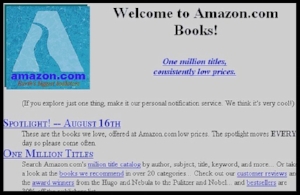
Amazon's homepage in 1995. It had over one million titles to offer to customers.
Similarly, Amazon was 10x better than bookstores because they had 10x more books than a typical retail store. A large retailer could have 100,000 titles in their store, meanwhile, Amazon offered millions of titles. This is because Amazon didn't have any inventory, instead, they simply requested the title from its supplier whenever a customer made an order.
The second characteristic is network effects. This means the product becomes more useful as more people use it. For example, if all your friends and co-workers are on LinkedIn, it wouldn't make sense for you to join a different professional social network.
The third characteristic is economies of scale. As a business gets bigger, the fixed costs of creating a product can be spread out and the cost per unit decreases. This is especially beneficial for software companies. Once the product is created, the marginal cost of producing another copy of the product is close to zero.
The last characteristic is branding. Creating a strong brand is a powerful way to claim a monopoly because you want consumers to think of your brand and feel connected to it. However, a monopoly cannot be built on brand alone. In 2012, the new CEO of Yahoo! rebranded the company in hopes of making it cool again but didn't announce any new product improvements. Yahoo! has since been sold to Verizon.
5) Building a Monopoly
“Brand, scale, network effects, and technology in some combination define a monopoly; but to get them to work, you need to choose your market carefully and expand deliberately”
Your company should start with a very small market, this doesn't mean a nonexistent one. An ideal market is a small group of people concentrated together and served by few or no competitors.
In 1999, eBay had a few thousand users who were high-volume "Powersellers." PayPal focused on serving these individuals, and within three months, 25% of them were using PayPal.
The next goal is to scale up. Once your startup dominates a niche market, then you should expand into a related or slightly broader market. Amazon started with selling books. It then expanded into CD's, videos and software. It continued to add new categories and is now known as the everything store.
Today, eBay sells everything from toys to clothing to cars. But, it didn't jump straight into selling sports cars. EBay launched it auction marketplace in 1995 and focused on niche markets such as Beanie Babies.
Lastly, being the first mover is good, but being the last mover is better. When a company is the first entrant into a market, they take significant market share while other companies scramble to catch up. But this is only a tactic, not a goal.
The last mover is the company that makes the last great development in a specific market and enjoys years or even decades of monopoly profits. Contrary to popular belief, Google wasn't the first search engine. WebCrawler was created in 1994, Yahoo in 1995, and Ask Jeeves in 1996.

It wasn't until two years later, in 1998, that Google was founded. And the rest, as they say, is history.
These are just a few of the lessons learned from Zero to One. If you're interested in learning more, click the link below.
Get the book here: Zero to One

If you enjoyed this article, consider supporting our site or signing up for our monthly newsletter. Thank you!
Reader freebies:

7 Business Lessons from "The Art of War"
Written more than 2,000 years ago, The Art of War was written by Sun Tzu as a guide to military strategy. However, many of the book’s lessons can be applied to the business world.
This book has become a must read for business leaders because it serves as an excellent guide to strategy, tactics and success in the world of business.
Written more than 2,000 years ago, The Art of War was written by Sun Tzu as a guide to military strategy. However, many of the book’s lessons can be applied to the business world.
This book has become a must read for business leaders because it serves as an excellent guide to strategy, tactics and success in the world of business.
Here are 7 business lessons learned from The Art of War:
1) All Warfare Is Based On Deception
“When able to attack, we must seem unable; when using our forces, we must seem inactive; when we are near, we must make the enemy believe we are far away; when far away, we must make him believe we are near. ”
Business, for the most part, is a zero-sum game. It is war. Companies battle for market share, customers, and sales. You must keep your competition unaware of your actions.
When Snapchat rejected Facebook’s offer for the company, Facebook made it seem like they were inactive. Instead, they worked on a new version of Instagram that contained many of the features found in Snapchat and is often referred to as a “Snapchat clone”.
2) Supreme Excellence Is Winning Without Fighting
“The best thing of all is to take the enemy’s country whole and intact; to shatter and destroy it is not so good. So, too, it is better to recapture an army entire than to destroy it.”
Winning every battle is excellent. But, winning every battle without having to fight is supreme excellence. You don’t always have to fight in business to win. One can sell their company, agree to a merge with a competitor or acquire a competitor.
The rise in self-publishing and eBooks has led to increased competition in the publishing industry. Instead of fighting amongst each other, Penguin Books merged with Random House and created Penguin Random House. This created the largest trade book publishing company in the world.
3) Don’t Be Second
“Whoever is first in the field and awaits the coming of the enemy, will be fresh for the fight; whoever is second in the field and has to hasten to battle will arrive exhausted.”
The field, in this analogy, is the marketplace. It is important to get your product into the marketplace before your rivals. You want to be aware of trends and shifts in the market and get new products to market ahead of your competitors.
When Elon Musk saw a need for cars that didn’t produce carbon emission and used renewable resources for fuel he started Tesla. Other car companies didn’t believe electric cars would catch on. In Q3 of 2016, the Tesla Model S had almost double the sales of the Mercedes S-Class. Tesla was first in the field, while Mercedes has to hasten to battle.

Illustration of Art of War author Sun Tzu
4) Never Announce Your Attack
“The spot where we intend to fight must not be made known; for then the enemy will have to prepare against a possible attack at several different points; and his forces being thus distributed in many directions.”
This is often referred to as the element of surprise. If a company doesn’t know what you’ll do next, they can’t plan to defend themselves. They are forced to prepare by distributing resources among varies areas.
A prime example for this is Apple. Apple is notoriously secretive; employees aren’t allowed to talk with other people in the organization about certain products unless they are involved in the project.
Let’s use the Apple Watch as an example:
Dec 2011: Rumors about an Apple-developed wearable device circulate
Feb 2013: WSJ reports that Apple is working on an iOS-based smartwatch
Feb 2013: Bloomberg reports that 100 people are working on the project
July 2013: Financial Times reports Apple hires more people to work on the Apple watch
April 2014: Apple’s CEO says they will launch a product BUT doesn’t say what it is
June 2014: Reuters reports that production will soon start
Sept 2014: Apple’s CEO, Tim Cook, introduces the Apple Watch
Apple kept the project quiet for several years. Even when major publications wrote articles associated with the Apple watch, the company didn’t say a word. The CEO said a new product was in development but didn’t say what it was. Never announce your attack to your competition.
5) If The Left Is Strong, Attack From The Right
“Should he strengthen his left, he will weaken his right; should he strengthen his right, he will weaken his left. If he sends reinforcements everywhere, he will everywhere be weak.”
Every company, no matter their size, is weak in one area or another. Even well-established, multi-billion dollar corporations have their weaknesses.
Let’s take Facebook (FB) as an example. FB has over a billion users but isn’t allowed in China. Thus, several FB clones have appeared in China including Renren.
This also means that FB messenger isn’t allowed in China. However, WeChat is allowed and has over 1.1 billion registered accounts. If FB focuses its resources on the Asian market, it may weaken its strength in the US market to other social media companies such as Snapchat.
6) Warfare Requires Drums And Flags
“On the field of battle, the spoken word does not carry far enough: hence the institution of gongs and drums. Nor can ordinary objects be seen clearly enough: hence the institution of banners and flags.”
In war, there are generals and soldiers. In business, there are executives and employees. However, in both fields, tools are needed to help the leader share their vision and plan.
To communicate their vision for the company, CEOs usually hold an all-hands meeting and share videos of it to all employees. This is the modern-day drum.
When a company wants to change their image, and re-brand themselves, it changes its logo or slogan. One can tell a lot about a company from their logo. Think back to the amount of press Google received for updated their logo. This is the modern-day flag.
7) Avoid The 5 Dangerous Faults
“There are five dangerous faults which may affect a general:
(1) recklessness, which leads to destruction;
(2) cowardice, which leads to capture;
(3) a hasty temper, which can be provoked by insults;
(4) a delicacy of honor which is sensitive to shame;
(5) over-solicitude for his men which exposes him to worry and trouble.”
These are the five dangerous faults of a leader. Being too brave can lead to recklessness, but not being brave at all can lead to cowardice. A leader must be logical and not be provoked by insults from the enemy (This related to my article about Ego).
A leader must know that there is no shame in running away from battle to fight another day. Lastly, a leader must care for their troops but it is impossible for s/he to attend to every single problem. A good leader treats their workers well while staying focused on the larger task at hand.
These are just a few of the lessons learned from The Art of War.
This book is only 68 pages long and less than five dollars on Amazon. It is a quick read and a great investment.
If you’re interested in learning more, click the link below.

If you enjoyed this article, consider supporting our site or signing up for our monthly newsletter. Thank you!
Reader freebies:

"Indispensable! Becoming The Obvious Choice In Business" by David Cottrell
This book was recommended to me by my management professor who worked for IBM for over 25 years.
Written by bestselling author David Cottrell and sales guru Robert Nix, Indispensable! Becoming The Obvious Choice In Business And Life, teaches how to project strength, smarts, competence and leadership.
This book was recommended to me by my management professor who worked for IBM for over 25 years.
Written by bestselling author David Cottrell and sales guru Robert Nix, Indispensable! Becoming The Obvious Choice In Business And Life, teaches how to project strength, smarts, competence and leadership.
The book begins with a quote from Winston Churchill.

The authors wrote this book in hopes of helping readers prepare for their finest hour and thus becoming indispensable.
Here are 7 important lessons from Indispensable! Becoming The Obvious Choice In Business And Life:
1) Becoming Indispensable Begins Now
Most people believe that managers don’t start evaluating employees until a new position opens. They believe that once a new position opens, then they’ll start working hard. But this is mindset is incorrect.
“You see, you are interviewing and competing today and tomorrow and the next week too” (Pg ix)
Employees are assessed for new opportunities long before a new position is announced. If you only start working hard when a new position opens, it may already be too late. Accept the mindset that every day you are being evaluated.
2) Visualize Yourself Being Better
Ask yourself, what do I want? Is it a promotion or a new position at a different company? Find someone who has the position you want and observe them. Learn how they look, act and speak.
“Beginning today, act on your positive vision and begin separating yourself from your competition” (Pg 10)
Think about how successful individuals interact with others. Maintain a positive and dynamic attitude and start visualizing yourself incorporating changes in your life.
3) Don’t Make Excuses
No one has a perfect life or an easy path to becoming indispensable. There will always be bumps and roadblocks. The key is to not make excuses.
“Franklin D. Roosevelt was paralyzed, Beethoven was deaf, Stevie Wonder was born blind, and John McCain was an injured prisoner of war for over five years” (Pg 18)
If you’re facing a difficult situation, research individuals who have been in similar positions and learn how they overcame their problems.
4) Be The Best You Can Be
Everyday try being the best that you can be. Being better requires you to identify weaknesses and areas of improvement and deal with them.
“It is better to understand your weaknesses, acknowledge them, and deal with them than it is to mask them” (Pg 19)
First, admit any weaknesses or areas that might need improvement. This could be anything from lacking a skill like coding to constantly being late to work. Identify possible solutions; in this example, it could be taking an evening coding class or buying a better alarm clock. If you need extra help, seek it. Ask a fellow colleague, mentor or career coach.

Authors David Cottrell and Robert Nix.
5) Take Action And Set Goals
We’ve all heard how important it is to set goals yet most people don’t do it. Some feel it isn’t necessary or they expect to fail so they don’t bother writing it down. Now’s the time to change that.
“Writing down your goals will clarify what you are trying to accomplish. It marks the beginning of your commitment to accomplishing those goals” (Pg 22)
Do not fall into the trap of believe you don’t need to write down your goals. To become indispensable requires you to have specific and measurable goals. They give you direction and provide confidence and momentum when you accomplish a goal.
6) Become A Great Listener
A key skill to becoming indispensable, is making connections with people. Connecting begins with listening.
“Listening effectively is not easy. It requires three things that most people lack: time, patience, and concentration” (Pg 67)
Take the time to have meaningful conversations and let the other person do most of the talking while you listen. Be patient and wait for your turn to respond. Concentrate on what the person is saying and engage by asking thoughtful questions. The speaker will be delighted to have your complete attention and fascination.
7) Become A Great Speaker
Now that you’ve learned how to be a great listener, it is time to become a great speaker. The hardest part of becoming a great speaker, is being able to give public speeches.
“Speaking to groups–of two or three or even a roomful–is required for advancement in almost any industry” (Pg 73)
Politicians, CEOs, and other successful individuals all know how to speak in public. Public speaking is a required skill for people who wish to become indispensable. With effort and practice, you can improve your verbal communication skills and become a great speaker.
These are just a few of the lessons learned from the book Indispensable. If you’re interested in learning more, click the link below.

If you enjoyed this article, consider supporting our site or signing up for our monthly newsletter. Thank you!
Reader freebies:

How To Get An Internship
An internships is a great way to gain professional experience and learn about an industry or company you're interesting in working. Internships allow for networking, skill building and possible full-time job offers. Now, let's get you an internship!
HOW DO I GET AN INTERNSHIP?
This is a question I’ve been asked quite a few times by family members and friends. So, I figured it’s worth writing a blog post to give some tips and advice.
But Alex who are you to give advice?
Good question. I’ve been fortunate to have interned at Fortune 500 companies such as SAP and Discovery Communications. I’ve also interned at Penguin Random House and Citrin Cooperman.
Internships are great for gaining first-hand experience in a career or industry you’re interested in. It is a short-term commitment that allows you to get your foot in the door and learn from experienced professionals.

Celebrating Shark Week at Discovery Communications.
Now let’s help you get that internship.
First off, you need to find an industry or business field that you’re interested in. It could be communications, programming, marketing, etc. Then, go to job sites such as LinkedIn, Glassdoor and even your college job board page. Check out their job postings and make sure to sign up for new job posts as well (ex. Glassdoor emails me a daily list of 30 internships that might be of interest to me).
If you’ve never had an internship before I'd highly recommend interning at a non-profit organization. You’re most likely going to be an unpaid intern for your first internship so why not help a charity. It looks great on your resume and feels good to help others.
Found an internship that peaks your interest? Great! Now proofread your resume, cross your fingers and hit send.
Remember, companies are getting hundreds of applications so it’s important to apply to multiple positions and not put all your eggs in one basket (On my college job board alone, I’ve sent 118 applications).

This image is from my College job board profile.
And now we wait...
Some companies will reply the next day while others may reply two months later. If you get a response, the first interview will most likely be a 10-30 minute phone interview with HR.
The most important thing to do before an interview is to research the company. Read their mission statement and company values. Find out why the company was created, who was the founder and who is the CEO.
But don't stop there, check out the company's product or services. Look through their social media pages to get a feel for company culture. Also, remember to check the LinkedIn profile of everyone that will be a part of the interview.
Go to GlassDoor to learn about the company's culture and review interviews from other people that applied to the same company.
During the phone interview, have your resume in front of you along with the company's job application. Have a pen and paper to jot down notes. Be professional and polite. Ask questions at the end of the interview.

Glassdoor is your best friend when it comes to getting an internship. It has job postings, questions asked during interviews and reviews of the company!
Remember to send a Thank-You Note within 24 hours of your interview. This applies to both virtual and physical interviews!
Hopefully things went well and you're invited for an in-person interview. Once again, research the company's department that you're applying for and the person that will be interviewing you.
Now, follow every cliché you've ever heard:
- Wake up early and eat a healthy breakfast.
- Bring copies of your resume.
- Assume there will be delays in your commute and aim to walk in 15 minutes before the interview start time.
- Dress appropriately and make sure your clothes are clean and ironed.
- Turn off your cell phone and don't chew gum.
- Smile, say hello and give a firm handshake.
- If they offer a drink, just ask for water (It's a job interview, not Starbucks)
- At the end of the interview thank the person for their time and shake their hand.
-Write a Thank-You email for each person that spent time interviewing you.
After a couple of days, you should get an email from HR asking to set up a time to talk. HR will discuss the salary and other information regarding the position and if you accept, they will email you an official offer.
Congratulations! All your hard work paid off and you landed the internship!

If for some reason you didn't get the job offer, don't stress out. Reflect on the interview process and ask yourself what you did well and what you could've done better. View it as a positive experience because even though you didn't get the position, it was good practice and will make you better prepared for your next interview.
Written by Alex Wiec.
For more job advice, I'd highly recommend getting the book:
What Color Is Your Parachute? 2017: A Practical Manual for Job-Hunters and Career-Changers

Enjoying A&B?
Consider donating to keep the site up and running!