"Subliminal" by Leonard Mlodinow
Do you know how much of your decisions are made by your unconscious?
Best-selling author Leonard Mlodinow returns to explain the many ways people are influenced without knowing it.
This book will change how you view yourself and the world around you.
Book Summary:
“Subliminal: How Your Unconscious Mind Rules Your Behavior” by Leonard Mlodinow is an eye-opening book about how the unconscious mind shapes our experience of the world.
Over the past 20 years through neurological research, it has become increasingly clear that the way we experience the world--our perception, behavior, memory, and social judgment--is largely driven by the mind's subliminal processes and not by the conscious ones, as we have long believed.

In the book, Mlodinow employs his signature concise, accessible explanations of the most obscure scientific subjects to unravel the complexities of the subliminal mind. In the process he shows readers the many ways it influences:
how we misperceive our relationships with family, friends, and business associates
how we misunderstand the reasons for our investment decisions
how we misremember important events
And much, much more.
Author Bio:
Leonard Mlodinow has a PhD in theoretical physics from the University of California, Berkeley, and teaches at the California Institute of Technology. His previous books include three New York Times best sellers: “War of the Worldviews” (with Deepak Chopra), “The Grand Design” (with Stephen Hawking), and “The Drunkard’s Walk: How Randomness Rules Our Lives.”

Author Leonard Mlodinow (credit).
Book Lessons:
1) How the subconscious influences marriage
“The source of love has been pondered for eons by lovers, poets, and philosophers, but it is probably safe to say that none of them has ever waxed eloquent about this particular factor: the person’s name.
”
In the book, Mlodinow shows a table containing the five most common U.S. surnames for grooms and brides. The numbers in the table show how many marriages occurred between a bride and groom with the same last names.

Chart from the book “Subliminal.”
The chart shows how Smiths marry other Smiths three to five times more often than any other surname.
And in all five cases, the most marriages occur when the bride and groom share the same last name. Mr. Williams marries Ms. Williams more often that marrying Ms. Jones or Ms. Brown.
So what does this tell us?
“People have a basic desire to feel good about themselves, and we therefore have a tendency to be unconsciously biased in favor of traits similar to our own.” write Mlodinow.
“Even such seemingly meaningless traits as our name” (pg 19) can have an impact on our decision of picking a life partner.
2) How restaurants can influence customers
“In truth, environmental factors have a powerful–and unconscious–influence not only on how much we choose to eat but also on how the food tastes.
”
When visiting a restaurant many people believe they are making the choice of what they want to eat and drink, but is that really the case?
Say you go to an elegant restaurant that has a menu with fancy food descriptions, such as “velvety mashed potatoes” and “slow-roasted beets on a bed of arugula,” as if other restaurants only served non-velvety mashed potatoes.
Adding the word velvety to the menu doesn’t change the physical structure of the mashed potatoes, but it does change the customer’s mind.
Studies show that adding modifiers to the described foods tempts customers to order it and they rate that food as tasting better than the identical foods given only a generic listing.
Not only does the restaurant menu influence people, but so does the music.
In a wine study, four French and four German wines of matching price, were placed on the shelves of a supermarket. French and German music was then played on alternative days and a record was kept of which wines customers bought.
The results?
When French music was played, 77% of the wine purchased was French. When German music was played, 73% of the wine purchased was German. Music was clearly playing a major role in which type of wine shopper bought.
However, when researchers asked shoppers if the music had influenced their choice, only about one shopper in seven said it had.

My copy of the book “Subliminal.” (No hidden messages here folks…)
3) How Expectations can impact reality
“In one line of research he showed that teachers’ expectations greatly affect their students’ academic performance, even when the teachers try to treat them impartially.
”
In one study, researchers asked students in 18 classes to complete an IQ test. However, the teachers were given the results, not the students.
The researchers told the teachers that the test would identify individuals with high intellectual potential or “gifted.”
What the teachers did not know, however, was that the kids named as “gifted” actually had average scores.
Shortly after the exam, the teachers rated the non-gifted or average students as being less curious and less interested than the gifted students, and the student’s grades reflected their rating.
But, it get more interesting.
Eight months later, another IQ test was given.
Researchers found that about half of the average kids had some gain in IQ, however, about 80% of the “gifted” students had an increase of 10 or more IQ points. Even more surprisingly, about 20% of the “gifted” group gained 30 or more points!
Compare that to the “average” group that only had 5% of students with the same leap.
Labeling children as gifted had proved to be a powerful self-fulfilling prophecy, even when both the “gifted” and “average” student groups, had the same test scores!
Bonus: The importance of touch
“Touch seems to be such an important tool for enhancing social cooperation and affiliation that we have evolved a special physical route along which those subliminal feelings of social connection travel from skin to brain.
”
In fact, scientists recently discovered a nerve fiber in people’s skin that appears to have developed specifically to transmit the pleasantness of social touch.
So how does human touch impact another person?
It helps men connect with women:
In one experiment, three young handsome men approached 240 young women and spoke the same line to them:
“Hello. My name’s Antoine. I just want to say that I think you’re really pretty. I have to go to work this afternoon but I wonder if you would give me your phone number. I’ll phone you later and we can have a drink together someplace.”
The variable in this experiment, or the only difference between the control group and the experimental group, is that the men added a light one-second touch to the women’s forearm for half of the 240 women they talked too.
The results?
When the guys give a light touch, they only got the women’s phone number 10% of the time. But, when they did touch the women, their success rate was 20%, the light one-second touch doubled their results.
Helps servers make more money:
In another experiment which involved eight servers and hundreds of customers, servers were trained to touch randomly selected customers briefly on the arm toward the end of the meal while asking if “everything was all right.”
Can you guess what happened?
The servers that didn’t touch a customer were tipped an average of about 14.5% while those that did lightly touch the customer’s arm were tipped about 17.5%.
In another study, 60% of customers ordered the diner’s special after the server touched the customer’s arm while suggesting the special, compared to 40% of those who were not touched.
Why does touch seem to have such an influence on people?
On the subconscious level, “touch seems to impart a subliminal sense of caring and connection” (pg 136).
The author points out that in all of these studies, the touches were subtle and not gropes or forceful contact with a stranger. In fact, in a debrief after the studies, less than one-third of the subjects were even aware that they had been touched.
And that is what this whole book is about, how subtle and sometimes invisible actions can influence a person’s decision without them even realizing how their subconscious rules their behavior.
Conclusion:
“Subliminal” does a great job of providing readers with countless examples of how even the smallest of changes can affect a person’s mind. From food descriptions at a restaurant to setting expectations for students, the world is filled with tiny gears that can turn the wheel on our personal behavior.
The book is exceptionally well-written and Mlodinow does a good job of keeping readers engaged by telling countless stories from scientific studies. That being said, there are a lot of studies in this book so be prepared for lots of facts and figures.
With all of the studies and stories packed into this book, I wish Mlodinow gave readers a summary at the end of each chapter or action steps for readers to use the new information they’ve learned. Aside from that critique, there isn’t much this book is missing. If you’re interested in science, specifically psychology or neurology, you should definitely read this book.
And if you’re not, you may want to consider getting this book just because it has the coolest cover of any book I’ve seen.
Rating: 4/5 Stars
If you’re interested in getting the book, click here or on the image below.
Here are a few similar books to “Subliminal”:


For literally a few dollars and hours, a book will give you an enormous amount of valuable information that can help you in life. It’s practically highway-robbery. So take advantage of this and read as much as you can.
If you want to check out my list of recommended books, you can find that here.
If you enjoyed this article, consider supporting our site or signing up for our monthly newsletter. Thank you!

The 20+ Books J.K. Rowling Recommends Reading
J.K. Rowling is the creator of the “Harry Potter” series and the world’s first billionaire author.
Want to know which books she loves and inspired her?
Here’s a list of books she recommends reading!
Joanne Rowling, better known by her pen names J.K. Rowling and Robert Galbraith, is a British novelist, philanthropist, film producer, television producer and screenwriter, best known for writing the Harry Potter fantasy series–which have sold more than 500 million copies, becoming the best-selling book series in history.
Rowling is also known for her “rags to riches” life story, where she went from living on state benefits to becoming the world’s first billionaire author.
Interestingly, she lost her billionaire status because she gave away much of her earnings to charity (that’s incredible of her to do that).

Joanne Rowling, better known by her pen name J. K. Rowling and Robert Galbraith.
Similar to other famous authors including Stephen King and Ernest Hemingway, Rowling loves to read books.
“I don’t believe in the kind of magic in my books. But I do believe something very magical can happen when you read a good book.
”
I was curious to learn which books Rowling loved or inspired her, so I did some research to find out which books the former billionaire author recommends, here is the list of the 20+ books she recommends:


“Little Women” by Louisa May Alcott
Rowling is a big fan of Little Women, saying that her “favorite literary heroine is Jo March. It is hard to overstate what she meant to a small, plain girl called Jo, who had a hot temper and a burning ambition to be a writer.”


"The Woman Who Walked Into Doors" by Roddy Doyle
"My favorite living writer is Roddy Doyle," Rowling told Amazon. This novel in particular — about a woman's relationship with a violent man — was one of the most important books in her life. "I don't think I've ever encountered such a believable, fully rounded female character from any other heterosexual male writer in any age," she told O, The Oprah Magazine.


“Grimble At Christmas” by Clement Freud
"Grimble is one of funniest books I've ever read," Rowling told Amazon. "Grimble himself, who is a small boy, is a fabulous character. I'd love to see a Grimble film. As far as I know, these last two fine pieces of literature are out of print, so if any publishers ever read this, could you please dust them off and put them back in print so other people can read them?"


“The Story of the Treasure Seekers” by Edith Nesbitt
“She’s the children’s writer with whom I most identify,” Rowling says of Nesbitt. Rowling calls The Story of the Treasure Seekers a “breakthrough children’s book” because it wasn’t a morality tale like the other children’s books of the time.


Jane Austen is J.K. Rowling's favorite author of all time, and "Emma" is her favorite of her books. "I've read all her books so many times I've lost count," she told Amazon. Of those many book-reading sessions, she said she read "Emma" at least 20 times.


“The Song of Achilles” by Madeline Miller
“I loved it.”- J.K. Rowling


"Team of Rivals" by Doris Kearns Goodwin
In 2012, Rowling described Team of Rivals as the last truly great book she read. “I lived in it the way that you do with truly great books,” she says, describing the experience as “putting it down with glazed eyes and feeling disconcerted to find yourself in the 21st century.”


“The Little White Horse” by Elizabeth Goudge
On a deeper level, Rowling was attracted to how cleverly the book was constructed, even though it seemed simple on the surface. "Perhaps more than any other book, it has a direct influence on the Harry Potter books," she told The Scotsman.


"The Diaries of Auberon Waugh" by Auberon Waugh
Auberon Waugh, son of Evelyn kept a diary between 1972 and 1985 in which he mocked the trends of the day. You may not know this, but J. K Rowling says she keeps a copy in her bathroom and “It’s always good for a giggle.”


When asked to name her favorite books as a child, Rowling said she loved "anything with a horse on it." Among those, "Black Beauty" is one of her favorite.


"Hons and Rebels" by Jessica Mitford
Rowling loves Mitford so much, she named her daughter after her. Rowling's great aunt gave her the journalistic memoir when she was 14, and she instantly became her heroine.
"I love the way she never outgrew some of her adolescent traits, remaining true to her politics — she was a self-taught socialist — throughout her life," Rowling told The Scotsman. "I think I've read everything she wrote."


"Manxmouse: The Mouse Who Knew No Fear" by Paul Gallico,
This book about a mouse who went off on epic adventures was one of Rowling's favorites when she was a child. "Gallico manages the fine line between magic and reality so skilfully, to the point where the most fantastic events feel plausible," she told the Sydney Morning Herald.


"Chéri" by Sidonie-Gabrielle Colette
Of all of Colette's books, Rowling loves "Chéri" the most. It's about a romance between a young man and her mistress. "I absolutely bow to Colette," Rowling said. "But I think if she could hear me, she would probably tell me where to get lost, because she was that kind of woman."


"I Capture the Castle" by Dodie Smith
Rowling calls "I Capture the Castle" one of her "favourite books for younger people." It's about a 17-year-old girl who lives in a castle with her family. In a recent edition of the novel, Rowling blurbed it, saying its narrator, Cassandra, is "one of the most charismatic narrators I've ever met."


"A Tale of Two Cities" by Charles Dickens
Rowling read Dickens' masterpiece in her third year of college. She shared a flat with"with an Italian, a Russian and a Spaniard," according to The Scotsman. "She found the Italian disagreeable and would avoid him by spending whole days in her room reading."


"Macbeth" by William Shakespeare
Like any British author — and any author working in the English language — Rowling loves Shakespeare. Her favorite is about a fellow Scot, "Macbeth." Its prophecy and fate-driven plot is an influence on the plot of "Harry Potter."


Rowling referenced the Greek epic at the end of "Harry Potter and the Goblet of Fire," when Harry saved Cedric's body. "That's where it came from," Rowling told Entertainment Weekly. "That really, really, REALLY moved me when I read that when I was 19. The idea of the desecration of a body, a very ancient idea… I was thinking of that when Harry saved Cedric's body."


"There are two books whose final lines make me cry without fail, irrespective of how many times I read them," Rowling told BBC Radio 4. "One is 'Lolita.'"
Like many other admirer's of Nabokov's novel of a pedophile who pursues a 12-year-old girl, Rowling loves it for the writing style.
"There just isn't enough time to discuss how a plot that could have been the most worthless pornography becomes, in Nabakov's hands, a great and tragic love story, and I could exhaust my reservoir of superlatives trying to describe the quality of the writing," she said.


“The Casual Vacancy” by J.K. Rowling
That's right, even J.K. Rowling loves J.K. Rowling, or at least she makes herself cry, too. She admitted to bawling her eyes out while writing, editing, and rereading The Casual Vacancy . That's some kind of endorsement, right?
If you don’t see any books on this list that you may want to read, here’s a piece of advice from Rowling.
“If you don’t like to read, you haven’t found the right book.
”
You may also want to check out the books Stephen King recommends reading or Ernest Hemingway’s list.
If you still can’t find the right book, here’s my personal list of great books (split up by genre): Recommended Books
And remember, books turn muggles into wizards, so go and read as much as possible!
If there’s a book on this list that you think is a must-read, let me know in the comments below. Thank you everyone! -Alex W.
This article was based on several articles. The sources can be found here, here, here, here and here.
*The links throughout this site are Amazon affiliate links. Amazon pays me a small fee from each purchase which helps keep this website up and running ad-free. It does not affect the price of your purchase in any way.*

"The Messy Middle" by Scott Belsky
Creating something from nothing is hard, but the unpredictable journey can be even harder.
This book covers how to endure the low points of building a business to how to optimize the high points and much, much more.
If you’re a business owner, entrepreneur or manager, you should read this book.
Book Summary:
“The Messy Middle: Finding Your Way Through the Hardest and Most Crucial Part of Any Bold Venture” by Scott Belsky, is an indispensable guide to navigating the volatility of new ventures and leading bold creative projects.
Creating something from nothing is hard, but the unpredictable journey can be even harder. People love talking about starts and finishes, but often ignore the middle stretch even though it is the most important and often the most misunderstood part.

The book has 100+ lessons and will help you:
• Endure the roller coaster of successes and failures by strengthening your resolve, embracing the long-game, and short-circuiting your reward system to get to the finish line.
• Optimize what’s working so you can improve the way you hire, better manage your team, and meet your customers’ needs.
• Finish strong and avoid the pitfalls many entrepreneurs make, so you can overcome resistance, exit gracefully, and continue onto your next creative endeavor with ease.
With insightful interviews from today’s leading entrepreneurs, artists, writers, and executives, as well as Belsky’s own experience working with companies like Airbnb, Pinterest, Uber, and Sweetgreen, The Messy Middle will help you find your way through the hardest parts of any bold project or new venture.
Author Bio:
Scott Belsky is an entrepreneur, author, and investor. He is currently Chief Product Officer at Adobe, serves as a board member to several early-stage companies, and is a Venture Partner at Benchmark, a leading venture capital firm based in San Francisco. He was previously the founder and CEO of Behance. He is also the creator of 99U, Behance's think tank and annual conference devoted to execution in the creative world.

Author Scott Belsky (all images credit to Scott Belsky).
Book Lessons:
1) It’s not about the start or finish, but the journey in between
“The middle makes and breaks you, and ending up on the right side of this line depends on how you manage everything in between. It requires immense perseverance, self-awareness, craftsmanship, and strategy.
”
People love stories about success, especially about how a small team that worked really hard with little funding was able to build a startup and sell it in just a few years for millions of dollars.
However, that story is missing one very important part, the messy middle.
The messy middle is about all of the obstacles and the signed deals, the disappearing customers and the move to pivot, the employee that stole secrets and the day the team signed their first major client.
The messy middle is the journey all creative endeavors encounter, from the highest highs to the lowest lows.
For instance, take Scott Belsky’s company Behance.
He founded the company in 2006 to connect and empower creative professionals. The team bootstrapped the business for five years before one of their products gained traction and he was able to raise venture capital. He used the money to grow the business and in 2012 Adobe knocked on their doors and acquired the company.
Simple and easy right?
On the surface, yes, but the true story went something like this:
There were years at Behance when nobody beyond the team could understand or care about the work they were doing. The company was on the brink of falling apart more than once. In the early days, Scott had to take anti-nausea medication because it was the only way he could keep an appetite. In the first year, there were only four employees, each unqualified for the journey ahead, but they were the only ones crazy enough to accept the risks and join the journey.
So how did Scott Belsky manage to survive the messy middle?
That is exactly what this book is about.

The Myth of how people believe building a business works.
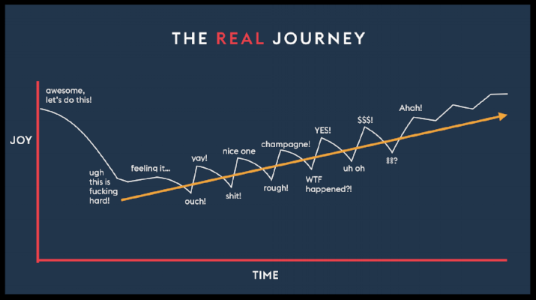
The Real Journey of how building a business looks like.
2) Resourcefulness > Resources
“Too many teams hire when they should be optimizing the people they’ve already got. You can always get more resources, but resourcefulness is a competitive advantage. Resources become depleted. Resourcefulness does not.
”
As Scott was growing Behance, his engineers had a list of people they “absolutely needed” to hire. The problem was that the designers and community management and support teams, all had similar lists as well.
Since the company was bootstrapping and had very little capital to hire anyone, Behance’s head of operations, Will Allen, advised the teams to come up with a list of process improvements they could make with their existing time to improve productivity without having to hire a new person anytime soon.
Here are a few questions you can ask your team before hiring an additional team member:
Are there better tools that could be adopted?
Can some of the work be automated?
Are there time-consuming processes that can be killed?
Scott points out that by not having the resources available to hire more people, his teams would uncover serious inefficiencies and exciting opportunities to boost productivity.
The team became more efficient before they became bigger which allowed them to attract high-quality individuals because efficient people want to work in an efficient environment.
“Resources come and go, but resourcefulness is a muscle that kicks in throughout the life cycle of any business. Without it, capital cannot be used efficiently. Focus on building your team’s resourcefulness” (pg 102).
3) Be frugal with everything except your bed, your chair, your space, and your team.
“In the process of building a business–and in life, generally–you should manage expenses carefully. But sometimes frugality backfires.
”
The author goes on to write that there are a few things in life, and business, that you should not be frugal with. For instance, given that you spend about 30% of your life in bed and since sleep is so important to being healthy and productive, you should not try to cut costs on getting a good bed.
The same goes for office chairs and desks. So people spend more time in the office sitting in their chair at their desk than they do lying in bed, so go out and find the best chair you can find.
Scott also advises companies not to be frugal with their office space. The space should be designed based on making people productive and creative, not on focusing on the cost per square foot or logistical efficiencies.
One of Scott Belsky’s mentors, James Higa, spent a lot of time with Steve Jobs through his time at Next, Apple and Pixar. James said that Steve would fly around the world to acquire Japanese American sculptures and put them in the building’s lobby just so employees could have a “daily encounter with beauty.”
Similarly, at Apple’s new Spaceship campus, Steve wanted the bathrooms to be placed in the building’s center so that it would pull people together every day and promote “serendipitous idea exchange” when nature called.
Steve Jobs had many responsibilities, including leading Apple, and yet he chose to focus on office space because he knew the importance environment and design had on employees and the company.
Lastly, don’t be frugal when it comes to paying your team, writes Scott. Sure, a company can get away with underpaying someone in the short term, but great talent will recognize their value over time and at that point, the company will have to pay the price to either attempt to save them, or worse, have to replace them.
“Your team must feel taken care of and must have no doubt that they are being rewarded as best as possible for their achievements–and then a little bit more” (pg 142).
Conclusion:
“The Messy Middle” is a wonderful guide for the entrepreneur or business owner that is growing their business and is facing, well, the messy middle. The book teaches readers how to endure the low points of hard truths, facing failure and keeping the business alive.
It also talks about optimizing the high points of the journey including what to look for when hiring people, how to design office space, and how to continue scaling the business.
This is a very brief summary, there are countless more important lessons to learn from this book.
The book also isn’t one long story, but rather each lesson has a one to three-page mini-story from either Scott’s personal experience or wisdom gained from a close friend or fellow entrepreneur, which is great because it’s not just theory, but rather filled with real world examples.
To conclude, I would highly recommend reading this book, but only for a specific audience. For instance, if you are a founder, entrepreneur, business owner or manager, then you should get this book. It will teach you how to survive and thrive through the hardest parts of growing a business. If you have yet to start a business, put this book in your cart and buy it when you do.
Rating: 4.5/5 stars
If you’re interested in reading the book, click here or on the image below.

If you’ve enjoyed this book, here are three similar great books:


For literally a few dollars and hours of time, a book will give you an enormous amount of valuable information that can help you in life. It’s practically highway-robbery. So take advantage of this and read as much as you can.
If you want to check out my list of recommended books, you can find that here.
If you enjoyed this article, consider supporting our site or signing up for our monthly newsletter. Thank you!

"The Compound Effect" by Darren Hardy
This is an incredible book that teaches the importance of small changes.
The book covers habits, productivity, and similar topics.
I’ve read this book twice and will read it many more times in the future.
Book Summary:
“The Compound Effect: Jumpstart Your Income, Your Life, Your Success” by Darren Hardy is based on the principle that everyday small decisions shape your destiny. The little decisions you make on a daily basis, will either take you to the life of your dreams or to disaster.
Darren Hardy shares lessons learned from his personal experiences and lessons from some of the most successful people on the planet, including Richard Branson, Warren Buffett and many more.
Here are a few things readers will learn from this book:
How even the smallest actions can lead to a radical positive result over time.
How to break your bad habits (some you might be unaware of) that are derailing your progress.
The real, lasting keys to motivation--how to get yourself to do things you don't feel like doing.
How to capture the elusive, awesome force of momentum.
And much more.
Author Bio:
Darren Hardy has been a leader in the personal growth and success industry for more than 20 years. He has led three success television networks and for eight years, Darren led the rebirth of SUCCESS Magazine as its publisher and founding editor.
These positions have given Darren unprecedented access to interview, investigate and publish the stories of the most successful entrepreneurs and business leaders in the world, including Richard Branson, Steve Jobs, Elon Musk, Jeff Bezos, Mark Zuckerberg, Howard Schultz, Steve Wynn, Jack Welch and many more.

Businessman, publisher of SUCCESS magazine and author Darren Hardy.
Lessons:
1) Use the Compound Effect to your advantage
“The Compound Effect is the principle of reaping huge rewards from a series of small, smart choices. What’s most interesting about this process to me is that, even though the results are massive, the steps, in the moment, don’t feel significant.
”
Darren Hardy starts the book with a story about a magic penny.
If you were given a choice between getting $3 million in cash today or a single penny that doubles in value every day for 31 days, which one would you choose?
Darren points out that the majority of people would take the $3 million today because it not only looks like the better deal, but it also takes a lot longer to see the payoff for the magic penny.
In fact, the Compound Effect of the magic penny is invisible for much of the time.
For instance, if you picked the magic penny and your friend took the other option, on day 10 your friend would have $3 million in cold, hard cash, while you would have only $5.12.
On day 20, you would have $5,243, which is a lot better than $5 but still nowhere near the $3 million dollar mark.
By day 29, you’ll have $2.7 million, almost as much as your friend’s $3 million. However, it isn’t until day 30, that your magic penny bet pays off and is now worth $5.3 million. On day 31, the very last day, your penny doubles again and is now worth a total of $10,737,418.24.
About three times more than your friend’s, now tiny, $3 million prize.

This is the power of the compound effect:
Small, Smart Choices + Consistency + Time = Radical Difference
Let’s look at another example.
Suppose your friend puts away $250 every month into an IRA (that grows 8% each year) after getting their first job after graduating college at age 23. You, on the other hand, don’t start saving until you’re 40.
By the time your friend hits 40, she’ll never have to invest another dollar and will have more than $1 million by the age of 67. You, on the other hand, will have less than $300,000 in your account, even though you invested $27,000 more than she did.

Don’t waste another day waiting to start a good habit, the earlier you start, the sooner you’ll see a positive outcome.
Both you and your friend made a small and smart choice by putting away money for retirement, and both of you were consistent with putting away $250 each month, so why did your friend have nearly three times as much money in the end?
It’s because she were able to use time to her advantage. The Compound Effect multiples your efforts so the more time you invest into a good habit, the greater outcome you’ll see.
2) Own 100% of your life
“Everything in your life exists because you first made a choice about something. Choices are at the root of every one of your results...In essence, you make your choices, and then your choices make you. Every decision, no matter how slight, alters the trajectory of your life.
”
Darren Hardy goes on to say that choices can be our best friend or our worst enemy. They can deliver us to our goals or send us into a galaxy far, far away.
Every decision, no matter how small, can change the direction of our lives.
That is why it’s so important to own 100% of your life.
The author writes that too many people point fingers, play the victim, blame the government or expect someone else to solve their problems; that is not owning your life.
People that don’t own their life will say:
I was late to an important meeting because of traffic.
My co-worker messed up the presentation, not me.
My teenage son and I don’t get along because he’s a jerk.
However, people who do own 100% of their lives will say:
I should have left my house 30 minutes earlier to make sure I wasn’t going to be late.
I should have double-checked the presentation a few days before the due date to make sure the work was excellent.
I should read parenting books about teenagers and try to bond over common hobbies.
See the difference? (This lesson is also found in “Extreme Ownership” & “12 Rules for Life”)
Darren writes that “You alone are responsible for what you do, don’t do, or how you respond to what’s done to you...If it was to be, it was up to me.”
This empowering mindset revolutionized his life.
It’s easy to blame others, make excuses, say that the economy isn’t doing well or the President is doing a bad job, but none of that victimhood mentality will help you succeed in life.
You can’t control the world or other people, but you can control yourself.
3) Avoid the Trap of Instant Gratification
“Why are we so irrationally enslaved by so many bad habits? It’s because our need for immediate gratification can turn us into the most reactive, nonthinking animals around.
”
If you took a bite of a Big Mac and immediately fell to the ground from a heart attack, you’d probably never eat one again in your life.
And if you smoked a cigarette and all the sudden your face was wrinkled and your teeth turned yellow, you’d likely quit smoking forever. Or if you ate a piece of ice cream cake packed with chocolate and frosting, and it added 30 pounds to your frame, saying “no thank you” to dessert next time would be a piece of cake.
The problem, however, is that all of these actions involve an instant sense of gratification and your mind doesn’t concern itself about the long-term consequences.
Having a burger, smoking a cigarette or eating cake, provides us with pleasure and there are no apparent negative effects at the moment.
But, as Darren Hardy mentioned earlier, the Compound Effect is always in motion, for both good and bad habits.
Even the smallest change can have a huge difference.
For instance, imagine a plane leaves from Los Angeles to New York City. If the nose of the plane is just 1% off, the plane will end up about 150 miles off course and will arrive in either Albany, New York or Dover, Delaware.

Even a small change, such as a 1% change in direction, can result in a completely different outcome. Make sure your habits are taking you in the right direction.
The same goes for habits. A single bad habit may not look like much at the moment, but over time it can lead you miles off course from the direction of your goals and the life you desire.
There’s a great quote in the book by leadership expert John C. Maxwell that says, “You will never change your life until you change something you do daily. The secret of success is found in your daily routine.”
So look at the actions and habits you take every day and ask yourself, “Is this bringing me closer to my goals or away from them?”
Conclusion:
There’s a reason this book is a New York Times, Wall Street Journal, and USA Today bestseller, it’s because this book is incredibly insightful. Darren Hardy does an excellent job of teaching readers the amazing impact of the Compound Effect and provides several analogies that really stick in the reader’s head.
The shocking part is that this book is only about 160 pages. There is no fluff or guff. It’s pure gold. I would recommend reading this book at least twice and make sure to highlight important passages, jot down notes and write down steps on how you can start changing your life for the better.
Definitely get this book, it will be going into my Book Hall of Fame.
Rating: 5/5 stars
If you’re interested in reading the book, click here or on the image below.

If you’ve enjoyed this book, here are three similar great books:


For literally a few dollars and hours of time, a book will give you an enormous amount of valuable information that can help you in life. It’s practically highway-robbery. So take advantage of this and read as much as you can.
If you want to check out my list of recommended books, you can find that here.
If you enjoyed this article, consider supporting our site or signing up for our monthly newsletter. Thank you!

The 25+ Books Gen. Mattis Recommends Reading
It’s always a good idea to learn from smart people and know which books they recommend.
James Norman Mattis is the current the U.S. Secretary of Defense.
However, he is probably best known for serving as a U.S. Marine Corps general.
James Norman Mattis is the current United States Secretary of Defense, but is probably best known for serving as a U.S. Marine Corps general.
Mattis is one of the most admired leaders serving America today and credits books as one of the best tools available to becoming a great leader. His personal library is said to house over 6,000 books!
I’ve found that reading a ton of books is a common trait among many successful individuals, including Stephen King, Ernest Hemingway, James Altucher and Elon Musk.

Secretary of Defense James Mattis.
In an email from November 20th, 2003, Mattis wrote:
“The problem with being too busy to read is that you learn by experience (or by your men’s experience), i.e. the hard way. By reading, you learn through others’ experiences, generally a better way to do business, especially in our line of work where the consequences of incompetence are so final for young men.”
He continued by saying:
“Thanks to my reading, I have never been caught flat-footed by any situation, never at a loss for how any problem has been addressed (successfully or unsuccessfully) before. It doesn’t give me all the answers, but it lights what is often a dark path ahead.”
It’s clear that Mattis is a strong advocate of reading books. So, without further ado, here are the books he recommends reading:
“With the Old Breed: At Peleliu and Okinawa” by E. B. Sledge
“One Bullet Away: The Making of a Marine Officer” by Nathaniel Fick
“Scipio Africanus: Greater Than Napoleon” by Basil H. Liddell Hart
“Gates of Fire” by Steven Pressfield
Pressfield is an amazing author and I highly recommend reading his other work, especially “The War of Art.”


“Military Innovation in the Interwar Period” by Williamson Murray
“Before the First Shot Is Fired: How America Can Win Or Lose Off The Battlefield” by Tony Zinni
“For Country and Corps: The Life of General Oliver P. Smith” by Gail Shisler
“Sherman: Soldier, Realist, American” by Basil H. Liddell Hart
“Duty: Memoirs of a Secretary” at War by Robert Gates
I recently got this book, Gates served as Secretary of Defense (the same position Mattis now runs) and worked for the CIA and National Security Council.


This is an impressive list of books and I hope to someone day read all of them. As a civilian who has never served in the military, I’m oblivious to how the military functions, what actually happens in war, and how wars impact countries and the world as a whole–which is something I believe more people should learn about.
As Mattis wrote in his email above, reading books is the easier path to knowledge instead of learning from other people’s experiences, i.e. the hard way. And although books won’t give you all the answers, “it lights what is often a dark path ahead.”
So read often and as much as possible!
If there’s a book on this list that you think is a must-read, let me know in the comments below. Thank you everyone! -Alex W.
For just a few dollars, books give you an enormous amount of valuable information that can help change your life. It’s practically high-robbery. So take advantage of this and read as much as you can.
Also, if you want to check out my list of recommended books, you can find that here.
If you enjoyed this article, consider supporting our site or signing up for our monthly newsletter. Thank you!

"Atomic Habits" by James Clear
Learn how tiny changes can lead to remarkable results.
Find easy and proven ways to build good habits and break bad ones.
This is one of the best books on productivity I’ve ever read.
Book Summary:
“Atomic Habits: An Easy & Proven Way to Build Good Habits & Break Bad Ones” by James Clear, provides readers with a proven framework for improving themselves in both their personal and professional lives.
Clear is an expert on habit formation and teaches readers exactly how to form good habits and break bad ones, and the importance of tiny changes.
Everyone has bad habits that they want to get rid of, this book teaches you the four laws needed to replace bad habits with better ones. Clear draws on proven ideas from biology, psychology, and neuroscience to create an easy-to-understand guide for making good habits inevitable and bad habits impossible.
Readers will learn how to:
make time for new habits (even when life gets crazy);
overcome a lack of motivation and willpower;
design your environment to make success easier;
get back on track when you fall off course;
...and much more.

Author James Clear.
Author Bio:
James Clear is an author and speaker focused on habits, decision-making, and continuous improvement. His work has appeared in the New York Times, Entrepreneur, Time, and on CBS This Morning. He is a regular speaker at Fortune 500 companies and his work is used by teams in the NFL, NBA, and MLB.
His website receives millions of visitors each month and hundreds of thousands subscribe to his popular email newsletter at jamesclear.com.
Book Lessons:
1) Strive To Be 1% Better Everyday
“If you can get 1 percent better each day for one year, you’ll end up thirty-seven times better by the time you’re done. Conversely, if you get 1 percent worse each day for one year, you’ll decline nearly down to zero. ”
Clear starts his book with a story about the British cycling team, who, to put plainly, weren’t very good. Since 1908, British riders won just one gold medal at the Olympics and in 110 years, no British cyclist had ever won the Tour de France.
Then in 2003, the team hired a new performance director named Dave Brailsford.
Brailsford’s strategy was to search for tiny marginal improvements in everything the team did. His idea was that if the team could get 1% better in every aspect of cycling, it would compound into a huge advantage.
So Brailsford and his coaches made every improvement, no matter how small:
They redesigned the seats for more comfort.
Added rubbing alcohol on the tires for better grip.
Gave riders electrically heated overshorts to maintain ideal muscle temperature.
Switched racing suits for better aerodynamics.
But, it didn’t stop there.
They tested different massage gels for fastest muscle recovery.
They tested pillows and mattresses for the best night’s sleep.
And much more.
Each change made a tiny, tiny difference. But put together, the changes were enormous.
From 2007 to 2017, the British Cycling team won 178 world championships, 66 Olympic or Paralympic gold medals and 5 Tour de France victories.
The same strategy can be applied to one’s personal life, constant small improvements over time accumulate into a major positive outcome:
Saving $250 each week isn’t much, but it multiplies into $1,000 a month and $12,000 saved by the end of the year.
Going to the gym 3 times in one week won’t get you in shape, but do it every week for a year and you’ll completely transform your body.
Reading 15 pages a day is not a lot, but it accumulates into 105 pages a week, 420 a month, and 5,040 pages a year. An average book is 250 pages, so you’ll end up reading 20 books a year just from reading a little bit each day.
So remember, becoming 1% better today may not seem like much, but with time, it can make a huge difference.

How much of a difference does 1% make? If you can get just 1% better each day, you’ll end up with results that are nearly 37 times better after just one year.
2) Focus on Your Systems, Not Your Goals
“It wasn’t the goal of winning the Tour de France that propelled the British cyclists to the top of the sport...The goal had always been there. It was only when they implemented a system of continuous small improvements that they achieved a different outcome.
”
The idea of forgetting goals and focusing on systems instead is one of the most important lessons readers can learn from this book.
Here are a few problems that arise when people focus on goals:
#1: Winners and losers have the same goals.
Every athlete that goes to the Olympics has the goal of winning a gold medal, but only one will finish in first place. It isn’t the goal of winning that propels the athlete to the top of the sport, the goal had always been there.
It’s only when they implement a system of continuous small improvements (more training, better diet, etc.) that they create a competitive edge over the competition and win gold.
#2: Achieving a goal is only a momentary change.
Imagine you have a messy room and you set a goal of cleaning it. If you can summon the energy to tidy up, you’ll have a clean room and achieve your goal, but if you continue following your old sloppy habits, the room will be messy again in no time.
You’re treating a symptom without addressing the cause. What you really need to do, is to create a system of habits that keep your room consistently clean (always make your bed in the morning, put your dirty clothes in the laundry bin every night, etc). Fix the inputs and the outputs will fix themselves.
#3: Goals are at odds with long-term progress.
Having a goal-oriented mindset and create a “yo-yo” effect. Many people set the goal of running a marathon and work hard for months, but after finishing the race, they stop running because they already achieved their goal.
You see this all the time when people have the goal of losing weight. They do crazy juice diets or insane cardio workouts and eventually lose the 15 pounds they wanted, but then after hitting their goal, they go back to their old habits of eating junk and sitting on the couch all day.
Clear has a great line in the book that says, “You do not rise to the level of your goals. You fall to the level of your systems” (pg 27).
By creating a system of good habits, you’ll be able to achieve better results and create a stable long-term solution instead of focusing on reaching short-term goals that only provide a temporary solution.

Systems continue to provide results, while goals are hit-or-miss. (All images credit to JamesClear.com)
3) Design Your Environment for Success
“The most powerful of all human sensory abilities, however, is vision. The human body has about eleven million sensory receptors. Approximately ten million of those are dedicated to sight. Some experts estimate that half of the brain’s resources are used on vision.
”
For this reason, what you see can lead to a big shift in what you do.
Clear tells a story about the energy crisis of the 1970s, where Dutch researchers looked at energy usage in a suburb near Amsterdam. They found that some homeowners were using 30 percent less energy than their neighbors–despite the fact that the homes were of similar size.
So why did some owners use less electricity and others more?
Researchers found that homeowners who had the electrical meter in the main hallway of their house could easily observe and track their energy usage while others had the meter in their basement where they rarely checked their usage.
This example shows how a person’s behavior can be easily influenced by their environment, often times more than they consciously realize.
Clear then applies this lesson to everyday life.
It’s easy not to practice the guitar when it’s hidden in the closet.
It’s easy not to read a book when the bookshelf is in the guest room.
It’s easy not to take your vitamins when they are hidden in the back of the top shelf.
Once Clear learned this lesson, he set out to find ways to apply it to his daily life.
For instance, he used to buy apples because he wanted to eat more fruit. However, he stored the apples in the back of his fridge, but because they were out of sight, he often forgot about them. By the time he remembered about them, they had were already rotten.
So, Clear decided to take his own advice and redesigned his environment for success. He bought a large display bowl and placed it in the middle of the kitchen in the open where he could see the apples and easily grab one. This simple change led him from eating no apples all week to eating multiple apples a day!
Here are a few more ways people can redesign their environment for success:
If you want to practice playing guitar more often, place your guitar in the middle of your living room so it’s easier to start playing it.
If you want to drink more water, fill up a few water bottles or containers, and place them in common locations around your home.
If you want to read more books, keep a book on the nightstand near your bed so you can easily grab it and get through a few pages before going to sleep.
And for bad habits, you want to do the opposite and make things harder to do:
If you have trouble staying off your phone, leave it in the other room and turn off notifications.
If you’re wasting too much time watching television, move it to a room that you rarely go into, or better yet, sell it.
If you’re playing too many video games, unplug the console and put it in the closet after each time you play it so it’s harder to turn on next time.
“Self-control is a short-term strategy, not a long-term one,” Clear writes.
Instead of summoning a new dose of willpower every time you want to do the right thing, your energy would be better spent optimizing your environment.
The goal of behavior change is to make cues for good habits obvious while making cues for bad habits invisible. That is the secret to self-control.
Book Review:
I’d put this book in the top 3 best productivity books I’ve ever read, it’s that good.
James Clear did an excellent job with this book. It’s an easy and entertaining book to read filled with personal stories as well as scientific studies. There’s a lot of information to absorb, but each chapter ends with a summary and important lessons are repeated throughout the book.
This will definitely be a book that I will be reading more than once, that’s how much value you’ll find in these pages. I’ve already started applying a few of Clear’s lessons to my life and started seeing small, but promising results.
If you’re looking for an easy and proven way to build good habits and break bad ones (which is everyone), this book is for you. Read it, highlight it, take notes, and start applying the lessons to your life and achieve success that lasts.
Rating: 5/5 Stars
If you’ve enjoyed this article and want to get the book, click here or on the image below!

If you already read “Atomic Habits” here are some similar books I’d recommend reading:


If you enjoyed this article, consider supporting our site or signing up for our monthly newsletter. Thank you!

3 Reasons Why You Should Get A Home Gym
Would you pay $80 to get 52 days of extra work outs and 17 hours of free time?
Learn how getting a home gym improved my life and why you may want to get one yourself.
Having a home gym has greatly improved my life, here are a few reasons how it can benefit you too.
There are countless studies showing the wide range benefits of exercise, everyone knows this. Everyone also knows that they should be exercising every day for 30 minutes or so. At yet, not everyone does (myself included, no one is perfect) because life can get in the way.
I don’t have enough time today.
I don’t feel like going to the gym.
It’s too cold/hot out today.
It takes too long to get to the gym.
The gym is closed today.
There’s no shortage of excuses.
But, there’s actually a solution to ALL of these issues.
Sounds too good to be true? It’s really not.
The answer is a home gym.
And no, I’m not talking about having one of those fancy home gyms where an entire family can live in (like the one the Rock uses, although it is an awesome gym that goes with him wherever he shoots movies).

Dwayne “The Rock'“ Johnson’s traveling/home gym.
I’m talking about having a pull-up bar and a couple of dumbbells.
If you can afford a squat rack that you could also use to deadlift or bench press, or have a Body Solid home gym, that’s great. But, for the average person who doesn’t have a lot of extra space in their home or is short on cash, all you really need is a workout bar and some dumbbells.

You don’t need to spend $2,995 on fancy equipment like this to create a decent home gym.
Here’s a picture of my home gym.

My “home gym.”
That’s right, it’s just an iron gym workout bar, dumbbells, and a t-shirt that I lay on for ab workouts.
How much did this home gym cost me?
In total, $0. Well if you include the shirt it was $15, but the equipment was free.
My neighbors were moving apartments and made a big pile of things they were going to throw out. I saw the workout bar and figured I’d save it from going to the junkyard. The same thing happened with the dumbbells expect my dad got them from someone else that was moving out.
I’ll admit I got lucky, but even if you have to buy the workout equipment it will cost less than $80.
The workout bar goes for $25 and you can use it to do pull ups, chin ups, push ups and crunches. With this bar alone, you can work out your chest, arms, and abs–three very important body parts.

Here are a few exercises you can do with the iron gym bar, it goes for about $25 (link).
I’d also recommend getting some dumbbells–the ones with adjustable weights (you can add or subtract weights to the bar instead of buying multiple dumbbells of different weights).

Together, this will cost you about $80 for the bar and weights, but it’s well worth and here’s why. Having a home gym eliminates all of the excuses for not working out.
Reason 1: Convenience
The gym’s too far?
No worries, the home gym is in the next room.
Too cold or hot outside?
No problem, you can work out indoors and adjust the room temperature.
Gym's closed?
All good, the home gym is always open.
Don’t have enough time to workout?
Good thing the home gym is here and you don’t have to commute to and from a gym.
To make it even better, you can get some chores done around the house while you recover between workout sets. In my last workout, I managed to sweep all the floors in my apartment and dust the rooms as well.
At your home gym, you can also play whatever music you want or listen to podcasts or just workout without any noise or distractions found in a regular gym.
Reason 2: You’ll Workout More
Before I had a home gym, I only worked out 3 times a week. I’d do chest, legs and back. Since I hit the main body parts, I’d often slack off when it came to working out other body parts.
However, with the home gym, I consistently workout my arms, shoulders and abs, as my 4th workout of the week.
One additional workout a week may not seem like much, but it does add up if you do the math. Going from working out 3 times a week to 4 times is a 14% increase in my weekly workout. That still seems little, so here’s some bonus math.
1 additional workout every week.
There are 52 weeks in a year.
That’s 52 additional workouts every year.
One extra workout a week quickly adds up to 52 extra workouts a year. Imagine how much stronger and in-shape you’ll be with 52 extra days of exercise.
Reason 3: You’ll Save A Lot of Time
You will save time from not having to commute to and from the gym. Let’s say it takes the average person 10 minutes to get to the gym, so 20 minutes round trip.
Multiply 20 minutes by 52 weeks and you’ll get 1,040 minutes.
Divide that by 60 minutes and you’ll get 17.3 hours.
That’s right, you spend 17 hours a year just going to and from the gym.
That’s almost a full day that can be spent with friends, family, reading books or growing your business.
So who wouldn’t want to save 17 hours and get 52 extra days of workouts every year?
I know I would.
Two books that I’d recommend reading related to working out are:


The first book is by a book about weight lifting and diet by the legendary Arnold Schwarzenegger, and the second book is by a Navy SEAL who teaches people how working out and having more discipline actually leads to a better life.
In exchange for a few bucks and a couple hours, a book will give you an enormous amount of valuable information that can help you in life. It’s practically high-robbery. So take advantage of this and read as much as you can.
If you want to check out my list of recommended books, you can find that here.
If you enjoyed this article, consider donating to our site or signing up for our monthly newsletter. Thank you!

"Tribe of Mentors" by Tim Ferriss
This book is a collection of interviews from experts in nearly every industry.
Learn how to become a writer, why failure leads to success and why being busy is a decision.
Book Summary:
“Tribe of Mentors” by Tim Ferriss, contains shortened interviews from many of the people Ferriss grew up viewing as idols or demi-gods. The book is similar to “Tools of Titans” but covers different guests and questions.
No matter your challenge or opportunity, something in these pages can help.
Among other things, you will learn:
More than 50 morning routines—both for the early riser and those who struggle to get out of bed.
The best purchases of $100 or less (you'll never have to think about the right gift again).
How to overcome failure and bounce back towards success.
How to meditate and be more mindful (and not just for those that find it easy).
Ways to thrive (and survive) the overwhelming amount of information you process every day.
And much more.
Author Bio:
Tim Ferriss is an early-stage tech investor/advisor in Uber, Facebook, Twitter, Shopify, Duolingo, Alibaba, and 50+ other companies. He is also the author of: The 4-Hour Workweek, The 4-Hour Body, The 4-Hour Chef, and Tools of Titans. He runs the Tim Ferriss Show, which has exceeded 200 million downloads and been selected for “Best of iTunes” three years running.

Author Timothy Ferriss.
Lessons:
1) If You Want To Be A Writer, Start Writing
“I had always wanted to be a writer. So I started writing that very evening. The next day I signed up for a class at NYU in creative nonfiction writing. ”
The quote above is from an interview Tim Ferriss did with Susan Cain, a New York Times bestselling author. However, Cain didn’t pursue her passion for writing for decades. She actually went to Harvard Law School and worked as a corporate lawyer on Wall Street.
One day a senior partner in the firm told Cain that she wouldn’t be promoted to partner and Cain started crying and left the office. She went for a bike ride around Central Park and contemplated her future. She remembered that she had always wanted to be a writer so that evening she went home to write and signed up for a class at NYU the next time.
Boom.
She wanted to be a writer, so she pursed writing. Just like that.
And you may not even need school to become a writer.
Neil Strauss, an eight-time New York Times best-selling author, got rejected from journalism school earlier in his life. He looks back on this with a smile since he ended up learning through experience rather than academics and eventually became a columnist for the NYT.
So if you want to be a writer, start writing–today.

Author Tim Ferriss talking about his book “Tribe of Mentors.”
2) Failure Is Part of the Path to Success
“Adversity. Everybody spends their life trying to avoid it. Me too. But the best things that ever happened to me came during the times when the shit hit the fan and I had nothing and nobody to help me. Who are you really? What do you really want? Get out there and fail and find out.”
That quote is from Steven Pressfield, an accomplished writer who has worked in advertising, screenwriting, fiction, narrative, non-fiction and self-help. But before he was a well-known writer, he wrote for 17 years before earning his first penny from writing.
That’s right, he worked on his craft for 15+ years before finally getting paid for his work.
During those years, Pressfield taught school, drove tractor-trailers, worked on offshore oil rigs, and picked fruit as a migrant worker. Instead of looking for a life-hack or shortcut to success, Pressfield advises college students to “Get out into the real dirt world and start failing” (pg 6).
And Kyle Maynard would agree.

Kyle Maynard.
Kyle Maynard is a best-selling author and entrepreneur. He is known for becoming the first quadruple amputee to reach the summits of Mount Kilimanjaro.
When Ferriss interviewed him, Maynard said “It’s almost more difficult to think of a time when an apparent failure didn’t set me up for success. Failure is inextricably connected to any major success I’ve ever had” (pg 15).
So if you do fail, don’t fret. Pick yourself up and keep moving. Just like Pressfield and Maynard have done.
3) Being Busy Is A Decision
“If we use busy as an excuse for not doing something what we are really, really saying is that it’s not a priority. Simply put: You don’t find the time to do something you make the time to do things.”
That quote comes from Debbie Millman, one of the most influential designers of today and founder of Design Matters, the world’s first and longest-running podcast about design.
Millman says that using “I am too busy” as an excuse to not do something, is pure nonsense. People do things that they want to do, period. People will make time to watch Game of Thrones, but will be ‘too busy’ to read a book or exercise.
The problem with these excuse is that is lies to people. It can make someone believe that they are justified for not doing something that they need to do. Millman says that “If you want to do something, you can’t let being busy stand in the way, even if you are busy. Make the time to do the things you want to do and then do them” (pg 26).
Conclusion:
“Tribe of Mentors” by Tim Ferriss is an interesting book because instead of diving deeply into one subject, readers get a little peek into many different topics and gain nuggets of wisdom from a wide-range of experts.
That said, this book is a jack of all trades, but master of none–which isn’t necessarily a good or bad thing. The best way to use this book is to skim through it, and if you read something that interests you, check out the full podcast on Tim Ferriss’ website or learn more about the guest by reading their books or watching their videos.
Rating: 4/5 Stars
If you’ve enjoyed this article and want to get the book, click here or on the image below!

If you already read “Tribe of Mentors” here are some additional books by Tim Ferriss:


For literally 5 bucks and a few hours of time, a book can give you an enormous amount of valuable information that will help you in life. It’s practically highway-robbery. So take advantage of this and read as much as you can.
If you want to check out my list of recommended books, you can find that here.
If you enjoyed this article, consider supporting our site or signing up for our monthly newsletter. Thank you!

Work Looks Like An Enemy, But It's Actually A Friend
Work may sometimes seem like an enemy, but it is actually be your friend.
In this article, I talk about a personal experience and what it taught me about work and life.
Life is all work, but that may not be a bad thing.
A few days ago, my friend and I were driving to a friend’s house when we got into an honest conversation about life.
We talked about how, as we get older in life, more and more problems pile up that require us to work more.
Right now, we have to deal with working to supporting ourselves, but we also have a lot of other things, such as:
work on exercising and eating well to take care of our health
work to keep our apartments clean by vacuuming, doing the dishes, dusting and other chores
work to keep clean our cars clean and running well
work to maintain relationships with friends, family and significant others
work to take care of a pet
even planning a vacation often takes a lot of work
And more things will add on in the future.
Soon we’ll have all of that and work on supporting a family, work on raising children, work on cleaning up after kids, work on finding a place to live, work on taking care of our parents in old age and so on.
It’s just work, work, and more work.
But, here’s the thing, work is really the best, and perhaps the only option we have.
Take working out for example.
For the past few years, I’ve been working on getting in shape. This means lifting weights 3 to 4 times a week.
Now working to motivate yourself to get to the gym and working on actually lifting the weights is already difficult, but then try adding in injuries.
About two years ago, I finally achieved my goal of bench pressing 225 pounds, something I’ve been working on for a while. Then one day September day, I went mountain biking with a friend. It was a perfect sunny day. We had a lot of fun and we already talking about coming back sometime.
Then on the last run down, I hit a ditch and went flying about 15 feet down the mountain.

Picture taken a few hours before my crash.
When I opened my eyes, my head was in the dirt. I tried to pick up my bike with my right arm, but I couldn’t. Luckily my friend came to help me out and walked me down the mountain. I went to the first-aid office, but was told to go to the hospital.
There I learned I separated my shoulder. After the adrenaline wore off, anytime I moved my arm, the pain felt like a thousand needles going into my arm.

Post mountain-biking picture. I’m smiling because I couldn’t feel anything and thought I simply sprained my arm. I would soon learn that it was a bit worse.
Here I am, trying to get in shape and putting in the work to do so by constantly going to the gym, and I decide to have some fun and go mountain biking and now I have to deal with being injured and work on recovering.
For months I didn’t work out, which caused me to lose a lot of my strength and muscle mass that I spent years building. I also lost a lot of weight, about 20 pounds.
I was not able to lift weights or play basketball, two of my favorite activities.
Although it sucked (a lot), quitting or just doing nothing wasn’t going to do anything for me. Nor was complaining about life, being negative or angry at life.
I had only one option, and it was the best option to take: To work.
I worked on healing my shoulder by constantly icing it, taking multi-vitamins and supplements to help with healing, going to a physical therapist and actually doing the daily exercises he recommended.
It took me about a year to get to the point where my shoulder felt pain-free to move around. But, when I returned to the gym, I lost almost all of my strength. My bench had dropped from 225 lbs to 95 lbs.
It took another year of constantly hitting the gym and slowly building up my strength week after week, before I was finally able to bench 225 pounds again.
Since then, I’ve also hit new personal records in deadlifting, shoulder press, chest press, and other exercises.
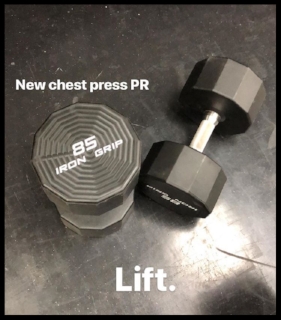
I recently hit a new chest press PR (personal record). When I first got back to the gym I could only do 25 pounds.
Now I could have used my shoulder as an excuse to never work out again or say I’ll never be as strong as I was before, but that wouldn’t have done anything for me.
Even today, injuries continue to happen. I had a go to a chiropractor for a back injury after someone elbowed me during a basketball game and I’m currently dealing with lateral epicondylitis (better known as tennis elbow).
But quitting isn’t going to help. Instead, work will: working on recovering and learning from my injuries, working on stretching, and working on lifting with proper form.
So although work can sometimes seem like a bad thing, it isn’t. Working to have a clean room is better than not working and having a dirty one; working on maintaining relationships is better than doing nothing and being all alone; working to build a good life is better than doing nothing and living a bad one.
Of course, when things go south in life work may seem like the last thing you should do, but give it a try. Push through, and get to work on making things better.
Two books that I’d recommend reading if life seems too difficult are:


The first book is by a well-known psychologist that talks about how changing your perspective can change your life, and the second book teaches people how working and having more discipline in life actually leads to more freedom.
In exchange for a few bucks and a couple hours, a book will give you an enormous amount of valuable information that can help you in life. It’s practically high-robbery. So take advantage of this and read as much as you can.
If you want to check out my list of recommended books, you can find that here.
If you enjoyed this article, consider supporting our site or signing up for our monthly newsletter. Thank you!

"The Productivity Project" by Chris Bailey
Accomplish more by managing your time, attention and energy
Learn the truth about multitasking and the importance of the Rule of 3
Become more productive and a better time manager by reading this book
Book Summary:
"The Productivity Project: Accomplishing More by Managing Your Time, Attention, and Energy" by Chris Bailey is a result of a year-long series of productivity experiments Bailey conducted on himself. He also continued research and interviews with some of the world’s foremost experts, from Charles Duhigg to David Allen.
Among the experiments that he tackled: Bailey went several weeks with getting by on little to no sleep; he cut out caffeine and sugar; he lived in total isolation for 10 days; he used his smartphone for just an hour a day for three months; he gained ten pounds of muscle mass; he stretched his work week to 90 hours; a late riser, he got up at 5:30 every morning for three months—all the while monitoring the impact of his experiments on the quality and quantity of his work.
In an eye-opening and thoroughly engaging read, Bailey offers a treasure trove of insights and over 25 best practices that will help you accomplish more.
Author Bio:
Chris Bailey, a graduate of Carleton University in Ottawa, wrote over 216,000 words on the subject of productivity on his blog, ayearofproductivity.com, during a year long productivity project where he conducted intensive research, as well as dozens of productivity experiments on himself to discover how to become as productive as possible.
To date, he has written hundreds of articles on the subject, and has garnered coverage in media as diverse as The New York Times, The Huffington Post, New York magazine, TED, Fast Company, and Lifehacker.

Author Chris Bailey.
Lessons:
1) Identify Your 3 Most Important Tasks
“That may seem like an arbitrary number on the surface, but it’s large enough to fit the main things you want to accomplish, and small enough to make you think hard about what’s important. ”
Author Chris Bailey writes that the Rule of 3 is “the absolute best technique I’ve found to work deliberately and with intention.” And the good news is that this technique is super easy to implement.
At the beginning of each day, ask yourself “If I could only accomplish three things today, what would they be?” Do the same at the beginning of each week.
That’s it.
This technique will give you direction as to what important tasks need to be completed and will keep you from getting distracted.
Here’s an example of my 3 goals:
Today:
Edit and publish a new article for Alex and Books
Go to the gym to lift weights
Watch Joe Rogan Podcast with Elon Musk (Highly recommend watching)
This Week:
Create, publish and edit a new YouTube video
Invite close friends over and catch up with everyone
Finish reading “Tribe of Mentors” by Tim Ferriss
The goals should be simple, clear, and aligned with your values. Also, it doesn’t have to be all work goals. It’s called work-life for a reason. Make sure you include things like spending time with friends, family or your significant other.
Now why is it called the Rule of 3 and not the Rule of 2 or 5?
It’s because brains are trained early on to think in threes: the beginning, middle and end; the three bears; the three musketeers; gold, silver and bronze; our minds are wired to think in groups of threes.
Try to make this a daily ritual before you go to sleep each night. I find this works best on a calendar or you can also do it on your phone. At the end of each day and week, reflect on how realistic your three goals were.
Were they too small and easy? Or were they too large and intimidating? Reflecting on your goals and accomplishments will help you become better at using the Rule of 3 and will make you more productive than ever before.
2) Identify Procrastination Triggers
“The reasons you feel so much less mental resistance to watching Netflix than you do with doing your taxes is Netflix is far less boring, frustrating, and difficult, and it’s more stimulating and structured. Because watching Netflix has almost no procrastination triggers, we don’t put it off. ”
Procrastination is human. Simply put, the more unattractive a task or project is to you, the more likely you are to put it off. There are 6 main triggers that lead to procrastination:
Boring
Frustrating
Difficult
Unstructured or ambiguous
Lacking in personal meaning
Lacking in intrinsic rewards (i.e. it’s not engaging)
The more of these attributes a task has, the less attractive it becomes and the more likely you are to procrastinate.
For example, doing your taxes likely hits at least half of these triggers. That’s probably why about 7 million taxpayers fail to file their taxes on time each year.
Here are a few ways the author fights back against these procrastination triggers:
Boring: Go to my favorite cafe and have a fancy drink while working.
Frustrating: Work for 30 minutes then take a break.
Difficult: Research ways to make the work easier.
Unstructured or ambiguous: Make a detailed plan that lists very next steps needed to finish the task.
Lacking in personal meaning: Think about how this tasks will benefit you.
Lacking in intrinsic rewards: Reward yourself $5 to spend on anything for every 30 minutes of work.
Bailey finishes the chapter by saying that readers should also be aware of the costs of not doing the thing they are procrastinating. Not doing a project will lower your GPA, not doing your taxes will result in fines, etc.
Also keep in mind that every task, no matter how intimidating, can be broken down into smaller ones, which makes it a lot easier to get started. Cleaning an entire basement can be daunting, but cleaning one-tenth of it can be easy.
So remember to ask yourself why you are procrastinating, find out your procrastination trigger, and look for ways to flip that trigger and get started on the task.
3) Have A Maintenance Day
“My Maintenance Day ritual is incredibly simple, and incredibly powerful: throughout the week, I simply collect all of my low-return maintenance tasks on a list–everything from going grocery shopping to cutting my nails–and instead of doing them throughout the week, I do them all at once.”
Similarly to the Rule of 3, this productivity technique is easy to do and very beneficial to your life. You simply collect a list of little household chores, errands, and tasks, and do them all in one day.
This can include:
Grocery shopping
Meal prepping
Trimming beard and shaving
Cutting nails
Doing laundry
Watering plants
Reviewing Rule of 3 goals
Cleaning the bathroom
Vacuuming the house
To make it even easier, you can perform your maintenance tasks while listening to music or a podcast. For me, my maintenance day is usually Saturday mornings. I like to get all of these small tasks out of the way so I can enjoy my weekend and get a fresh start for the new week.
4) Have A Brain Dump
“To summarize decades’ worth of complex neurological research in one sentence, our brains are built for solving problems, connecting dots, and forming new ideas–not for holding on to information that we can simply externalize.
”
Through his research, Bailey concludes that the brain isn’t meant to store information but rather it’s meant to solve problems. Think about it, people would rather write down phone numbers on paper or save it on their phone rather than memorize the contact info of all of their friends and family members.
Readers should apply the same method to their work. A few simple examples include:
Making a to-do list to get the information out of your brain and onto paper to give your brain more room to solve problems
Putting appointments and meetings on calendars so you don’t have to memorize the person, place and time of the event
Writing down the grocery list so you don’t forget to buy the things you needed
This is what Bailey calls a “Brain Dump.” Write down all of the things that you need to get done, it can be on a notepad, phone, or laptop. And if something new pops into your head during the day, add it to your list. Instead of memorizing that you need to buy milk, eggs and paper towels after work, just write it down to remind yourself. Your head is not for holding ideas–it’s for having ideas and solving problems.
By externalizing your tasks and writing them down, you’ll free up mental space, get organized, reduce stress and increase your focus on important tasks.
5) Multitasking Is A Myth
“Unless you’re doing totally mindless work...your brain is simply not built to focus on more than one thing at once. In fact, your brain can’t focus on two things simultaneously–instead it rapidly switches between them, which creates the illusion that you’re doing more than one thing at a time.
”
Here’s a counterintuitive truth people need to understand, just you feel productive doesn’t mean you are–and the opposite is often true. Multitasking may make you feel like you’re completing four tasks at once, but the truth is the brain doesn’t work that way.
What is actually happening, is that your brain is rapidly switching between each task which creates the illusion of doing more than one thing. The only exception where multitasking works is if the other task requires very little attention. Such as doing chores and listening to music or watching a movie and eating.
Bailey points out that several research studies all come to the same conclusion: multitasking actually makes people less productive, more prone to errors and takes longer because it costs time and attention to switch between tasks.
However, when you only do one thing at a time, you give your work the attention it deserves.
Think about it, when you finished a project or assignment that did really well, you were likely completely focused on it and not listening to music, texting a friend, watching YouTube videos and working on the project at the same time.
This can be a difficult habit to develop because of all the external stimuli in the world: social media, text notifications, emails, and other things that try to steal your attention, but remember when you invest all your attention to one task, you’ll be able to accomplish a lot more in a shorter amount of time.
Make a conscious effort to push back against a wandering mind and continually bring your attention back to your most important activity. This will actually strengthen your attention muscle over time and help you control your brain instead of it being the other way around.
Conclusion:
This is one of the best books about productivity books that I’ve read for two reasons. First, the author has put in a lot of research and talked to several experts in the field and secondly, he has a Tim Ferriss-like style where he actually performs the experiments on himself to test the research.
The author also starts each chapter with a takeaway and ends with a summary and actionable item for the reader. Both are extremely helpful to readers and make it easier to absorb the important information found in the chapter.
The book is less than 300 pages and can be read in two or three days since it is told as a story rather than a textbook style work. If you’re looking to become more productive, I’d highly recommend reading this book. And make sure to apply what you learn!
Rating: 5/5 Stars
You can get the book here or by clicking on the image below.

If you've enjoyed "The Productivity Project" or are looking for another book about productivity, I highly recommend reading "The ONE Thing: The Surprisingly Simple Truth Behind Extraordinary Results" by Gary Keller & Jay Papasan.

For literally 5 bucks and a few hours of time, a book will give you an enormous amount of valuable information that can help you in life. It’s practically highway-robbery. So take advantage of this and read as much as you can.
If you want to check out my list of recommended books, you can find that here.
If you enjoyed this article, consider supporting our site or signing up for our monthly newsletter. Thank you!
Enjoying A&B?
Consider donating to keep the site up and running!