"Subliminal" by Leonard Mlodinow
Book Summary:
“Subliminal: How Your Unconscious Mind Rules Your Behavior” by Leonard Mlodinow is an eye-opening book about how the unconscious mind shapes our experience of the world.
Over the past 20 years through neurological research, it has become increasingly clear that the way we experience the world--our perception, behavior, memory, and social judgment--is largely driven by the mind's subliminal processes and not by the conscious ones, as we have long believed.

In the book, Mlodinow employs his signature concise, accessible explanations of the most obscure scientific subjects to unravel the complexities of the subliminal mind. In the process he shows readers the many ways it influences:
how we misperceive our relationships with family, friends, and business associates
how we misunderstand the reasons for our investment decisions
how we misremember important events
And much, much more.
Author Bio:
Leonard Mlodinow has a PhD in theoretical physics from the University of California, Berkeley, and teaches at the California Institute of Technology. His previous books include three New York Times best sellers: “War of the Worldviews” (with Deepak Chopra), “The Grand Design” (with Stephen Hawking), and “The Drunkard’s Walk: How Randomness Rules Our Lives.”

Author Leonard Mlodinow (credit).
Book Lessons:
1) How the subconscious influences marriage
“The source of love has been pondered for eons by lovers, poets, and philosophers, but it is probably safe to say that none of them has ever waxed eloquent about this particular factor: the person’s name.
”
In the book, Mlodinow shows a table containing the five most common U.S. surnames for grooms and brides. The numbers in the table show how many marriages occurred between a bride and groom with the same last names.

Chart from the book “Subliminal.”
The chart shows how Smiths marry other Smiths three to five times more often than any other surname.
And in all five cases, the most marriages occur when the bride and groom share the same last name. Mr. Williams marries Ms. Williams more often that marrying Ms. Jones or Ms. Brown.
So what does this tell us?
“People have a basic desire to feel good about themselves, and we therefore have a tendency to be unconsciously biased in favor of traits similar to our own.” write Mlodinow.
“Even such seemingly meaningless traits as our name” (pg 19) can have an impact on our decision of picking a life partner.
2) How restaurants can influence customers
“In truth, environmental factors have a powerful–and unconscious–influence not only on how much we choose to eat but also on how the food tastes.
”
When visiting a restaurant many people believe they are making the choice of what they want to eat and drink, but is that really the case?
Say you go to an elegant restaurant that has a menu with fancy food descriptions, such as “velvety mashed potatoes” and “slow-roasted beets on a bed of arugula,” as if other restaurants only served non-velvety mashed potatoes.
Adding the word velvety to the menu doesn’t change the physical structure of the mashed potatoes, but it does change the customer’s mind.
Studies show that adding modifiers to the described foods tempts customers to order it and they rate that food as tasting better than the identical foods given only a generic listing.
Not only does the restaurant menu influence people, but so does the music.
In a wine study, four French and four German wines of matching price, were placed on the shelves of a supermarket. French and German music was then played on alternative days and a record was kept of which wines customers bought.
The results?
When French music was played, 77% of the wine purchased was French. When German music was played, 73% of the wine purchased was German. Music was clearly playing a major role in which type of wine shopper bought.
However, when researchers asked shoppers if the music had influenced their choice, only about one shopper in seven said it had.

My copy of the book “Subliminal.” (No hidden messages here folks…)
3) How Expectations can impact reality
“In one line of research he showed that teachers’ expectations greatly affect their students’ academic performance, even when the teachers try to treat them impartially.
”
In one study, researchers asked students in 18 classes to complete an IQ test. However, the teachers were given the results, not the students.
The researchers told the teachers that the test would identify individuals with high intellectual potential or “gifted.”
What the teachers did not know, however, was that the kids named as “gifted” actually had average scores.
Shortly after the exam, the teachers rated the non-gifted or average students as being less curious and less interested than the gifted students, and the student’s grades reflected their rating.
But, it get more interesting.
Eight months later, another IQ test was given.
Researchers found that about half of the average kids had some gain in IQ, however, about 80% of the “gifted” students had an increase of 10 or more IQ points. Even more surprisingly, about 20% of the “gifted” group gained 30 or more points!
Compare that to the “average” group that only had 5% of students with the same leap.
Labeling children as gifted had proved to be a powerful self-fulfilling prophecy, even when both the “gifted” and “average” student groups, had the same test scores!
Bonus: The importance of touch
“Touch seems to be such an important tool for enhancing social cooperation and affiliation that we have evolved a special physical route along which those subliminal feelings of social connection travel from skin to brain.
”
In fact, scientists recently discovered a nerve fiber in people’s skin that appears to have developed specifically to transmit the pleasantness of social touch.
So how does human touch impact another person?
It helps men connect with women:
In one experiment, three young handsome men approached 240 young women and spoke the same line to them:
“Hello. My name’s Antoine. I just want to say that I think you’re really pretty. I have to go to work this afternoon but I wonder if you would give me your phone number. I’ll phone you later and we can have a drink together someplace.”
The variable in this experiment, or the only difference between the control group and the experimental group, is that the men added a light one-second touch to the women’s forearm for half of the 240 women they talked too.
The results?
When the guys give a light touch, they only got the women’s phone number 10% of the time. But, when they did touch the women, their success rate was 20%, the light one-second touch doubled their results.
Helps servers make more money:
In another experiment which involved eight servers and hundreds of customers, servers were trained to touch randomly selected customers briefly on the arm toward the end of the meal while asking if “everything was all right.”
Can you guess what happened?
The servers that didn’t touch a customer were tipped an average of about 14.5% while those that did lightly touch the customer’s arm were tipped about 17.5%.
In another study, 60% of customers ordered the diner’s special after the server touched the customer’s arm while suggesting the special, compared to 40% of those who were not touched.
Why does touch seem to have such an influence on people?
On the subconscious level, “touch seems to impart a subliminal sense of caring and connection” (pg 136).
The author points out that in all of these studies, the touches were subtle and not gropes or forceful contact with a stranger. In fact, in a debrief after the studies, less than one-third of the subjects were even aware that they had been touched.
And that is what this whole book is about, how subtle and sometimes invisible actions can influence a person’s decision without them even realizing how their subconscious rules their behavior.
Conclusion:
“Subliminal” does a great job of providing readers with countless examples of how even the smallest of changes can affect a person’s mind. From food descriptions at a restaurant to setting expectations for students, the world is filled with tiny gears that can turn the wheel on our personal behavior.
The book is exceptionally well-written and Mlodinow does a good job of keeping readers engaged by telling countless stories from scientific studies. That being said, there are a lot of studies in this book so be prepared for lots of facts and figures.
With all of the studies and stories packed into this book, I wish Mlodinow gave readers a summary at the end of each chapter or action steps for readers to use the new information they’ve learned. Aside from that critique, there isn’t much this book is missing. If you’re interested in science, specifically psychology or neurology, you should definitely read this book.
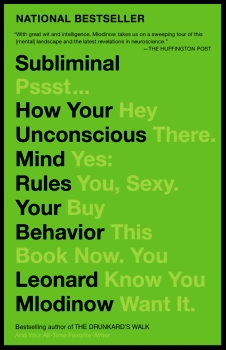
And if you’re not, you may want to consider getting this book just because it has the coolest cover of any book I’ve seen.
Rating: 4/5 Stars
If you’re interested in getting the book, click here or on the image below.
Here are a few similar books to “Subliminal”:


For literally a few dollars and hours, a book will give you an enormous amount of valuable information that can help you in life. It’s practically highway-robbery. So take advantage of this and read as much as you can.
If you want to check out my list of recommended books, you can find that here.
If you enjoyed this article, consider supporting our site or signing up for our monthly newsletter. Thank you!