I Published My First Book!
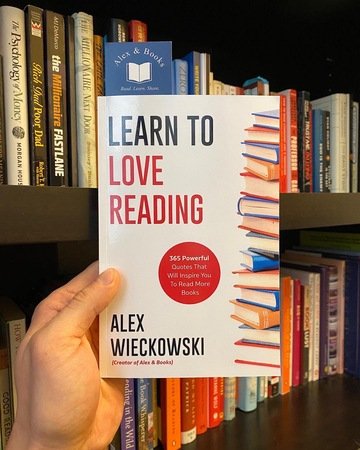
Learn To Love Reading is now available on Amazon!
All of us know reading is good for us and something we should do more often, but for whatever reason, it's never our top priority. This book will change that.
Learn To Love Reading is a collection of quotes that will help you develop a passion for books. It's a pick-me-up for those days when you need a little extra motivation to grab a book instead of your phone. Inside this book, you'll find 365 amazing quotes that will remind you of the wonderful treasures books hold, show you the magical places books can take you, teach you why books are the key to success in any domain, and inspire you to become a lifelong reader.
You'll discover quotes from:
Wise philosophers like Cicero and Socrates
Billionaire entrepreneurs like Elon Musk and Bill Gates
World leaders like Nelson Mandela and Barack Obama
Brilliant investors like Naval Ravikant and Warren Buffett
Bestselling authors like Jordan Peterson and James Clear
Legendary writers like Ernest Hemingway and Victor Hugo
And many more extraordinary people.
Here are a few quotes from the book:
“How can we better employ our time than by reading books?”
–A. EDWARD NEWTON
“Reading is essential for those who seek to rise above the ordinary.”
–JIM ROHN
“Read what you love until you love to read.”
–NAVAL RAVIKANT
“If you love to read, or learn to love reading, you will have an amazing life. Period.”
–ANNE LAMOTT
PS: If you want to learn more about my book, listen to this podcast.
So if you want to develop a love for reading, want to start reading more books, or are already a bibliophile, this book is for you.
5 Favorite Books of 2020 (so far)
2020 is halfway over (and thank goodness).
I’ve managed to read 33 books so far this year and wanted to share some of the amazing books I’ve come across (you can follow my reading journey on Goodreads).
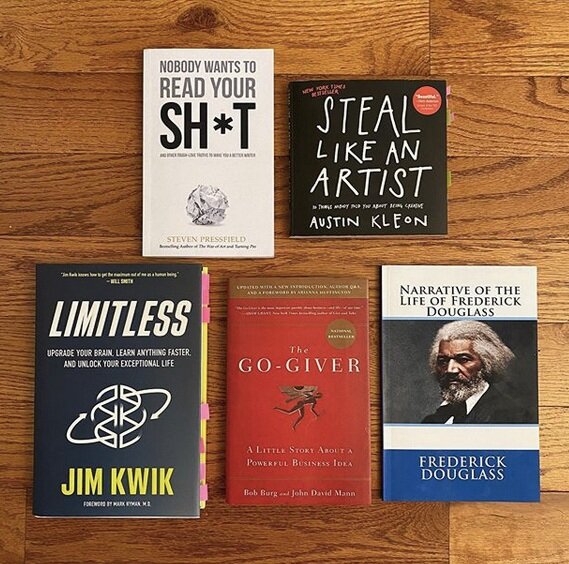
Without further ado, here are my 5 favorite books (in no particular order):
5) Narrative of the Life of Frederick Douglass by Frederick Douglass


This book is a memoir that captures Frederick Douglass’s time as a slave and how he escaped. It’s an eye-opening book about the inhumanity of slavery. The book also teaches readers the importance of reading.
At the time, it was illegal for anyone to teach a slave how to read. However, that didn’t stop Douglass. Here’s how he did it:
His master’s wife taught him the alphabet but once his master found out, he prohibited her from teaching anything else because he said if you teach a slave “how to read, there would be no keeping him.”
Once Douglass realized how much his master disapproved of him learning how to read, Douglass understood reading would be his path to freedom.
Douglass made friends with young white boys and would ask them to give him reading lessons and would often give them bread in exchange. Douglass then got his hands on a book and read it over and over again until he could read with ease.
Learning how to read would alter Douglass’s life forever. He read about how cruel the system of slavery was and was determined to change it. “The silver trump of freedom had roused my soul to eternal wakefulness,” he said.
Douglass would go on to teach other slaves how to read, teach himself how to write, and escape to the North where he would be free. He later became a national leader of the abolitionist movement, a respected American diplomat, and a counselor to four presidents.
If you’re looking for an inspiring read, this book is for you.
Get the book here.
4) Steal Like an Artist: 10 Things Nobody Told You About Being Creative by Austin Kleon


This book is an inspiring guide to creativity that helps readers discover and free their artistic side. Stealing can have a negative connotation, but Kleon teaches readers that there is an ethical way to steal (study the work of the greats, remix their work, and build what they didn’t).
There’s a lot of pressure to be original, but this book will show you that originality is overrated. The greatest of the greats all “stole” work. It’s okay to do the same, as long as it’s done properly.
In total, Kleon provides 10 short lessons that each present a different principle for developing creativity. The book is both artistic and pragmatic, which makes it an enjoyable read.
Here are a few key lessons from the book:
Don’t wait until you know who you are to get started.
Write the book you want to read.
The secret: do good work and share it with people.
Be boring. (It’s the only way to get work done.)
If you’re facing a creative block or are afraid to start your creative journey, grab a copy of this book.
Get the book here.
3) Limitless: Upgrade Your Brain, Learn Anything Faster, and Unlock Your Exceptional Life by Jim Kwik


Our brain is one of the most complex tools in the world and no one really tells us how to use it, until now.
Jim Kwik is a brain coach and has written the owner’s manual for mental expansion and brain fitness. In his book, Kwik reveals science-based practices and field-tested tips to improve your memory, focus, and reading ability.
A few lessons from the book:
Healthy brain foods: Avocados, blueberries, broccoli, eggs, green leafy vegetables, salmon, and walnuts.
Sleep is crucial for brain health: It helps remove neurotoxins and distribute components that enhance cellular repairs.
IQ may be fixed but intelligence levels aren’t. If you’re constantly learning, you can get smarter.
If you fight for your limitations, you get to keep them.
In the book, Kwik also dispels common brain myths, teaches readers how to study better, and provides strategies to become a speed reader (stay tuned for an article about it). If you want to be a better learner then this is a great book to read.
Get the book here.
2) The Go-Giver: A Little Story About a Powerful Business Idea by Bob Burg and John David Mann


You’ve heard of the term Go-Getter but have you heard of the Go-Giver?
The Go-Giver tells a story of an ambitious young man who yearns for success. He turns to a legendary consultant who mentors him & teaches him the 5 Laws of Stratospheric Success.
The Law of Value
Your true worth is determined by how much more you give in value than you take in payment.
The Law of Compensation
Your income is determined by how many people you serve and how well you serve them.
The Law of Influence
Your influence is determined by how abundantly you place other people’s interests first.
The Law of Authenticity
The most valuable gift you have to offer is yourself.
The Law of Receptivity
The key to effective giving is to stay open to receiving.
The book shares a simple yet important message: “Give and you shall receive. ”If you enjoy business fables such as The Alchemist or The Monk Who Sold His Ferrari you’ll like this book.
Get the book here.
Honorable Mentions
The Professor in the Cage: Why Men Fight and Why We Like to Watch by Jonathan Gottschall
Have you ever been curious as to why men fight or like to watch fights? I was, and so was Jonathan Gottschall–an English professor who decided to join an MMA club and research the history and science behind violence. If you’re interested in learning about the history of duels, why people enjoy watching violence, and the reasons why men and women fight, this book is for you.
How to Fight a Hydra: Face Your Fears, Pursue Your Ambitions, and Become the Hero You Are Destined to Be by Josh Kaufman
Productivity expert Josh Kaufman uses the tale of a knight on a mission to defeat a hydra as an analogy to conquering a creative project. The book shares implicit and explicit lessons of courage, determination, perseverance; planning and practice; the value of showing up; and knowing when not to embark on a journey.
The Four Agreements: A Practical Guide to Personal Freedom by Don Miguel Ruiz
This book doesn’t really teach anything new, but it does teach you four simple lessons, that if followed, will significantly improve your life. If you’re looking for a light, self-development book with simple but deep lessons that will improve your life, grab this book.


1) Nobody Wants To Read Your Sh*t by Steven Pressfield


If you’re a writer, this book is a must-read.
Pressfield has experience in every area of writing (advertising, fiction, self-help, screenplays, and more) and in this book he shares countless of valuable lessons he’s learned from over four decades as a writer.
Here are a few tips I picked up from the book:
Streamline your message: Trim it down to the simplest, clearest, and easiest-to-understand form.
Understand that no one wants to read your writing unless it’s valuable and the readers feels they’re gaining something from the transaction.
Start at the end of the story, then write the climax, and then the beginning.
What idea should you write about? The one that scares you the most.
Think in multiple drafts: You can’t fix everything in one draft and thinking in multiple drafts helps take the pressure off.
If you enjoyed The War of Art or are looking for a writing book that’s both entertaining and educating, grab a copy today.
Get the book here.
100 Books That Changed the World

I recently finished reading 100 Books That Changed the World by Scott Christianson and Colin Salter. It’s a beautifully illustrated book that informs and entertains readers about 100 books that shaped, changed, and even revolutionized the world.
The book includes scriptures that founded religions, manifestos that sparked revolutions, scientific treatises that challenged ingrained beliefs, and novels that kick-started new literary movements.
Reading this book is similar to having a time machine as you travel around the globe through time from the I Chang written in 2800 BC to modern-day books such as Harry Potter and This Changes Everything.
This is an excellent book for literature lovers, history buffs, or anyone who wants a fascinating coffee table book that will get your guests talking about books.
Here are the 100 books and a short description of each. Enjoy!
1) I Ching (2800 BC)
An ancient Chinese philosophy text that stresses the importance of caution, humility, and patience in one’s daily living.
2) The Epic of Gilgamesh (2100 BC)
A 4,000-year-old tale that is the oldest work of literature ever recorded and shares classic themes such as friendship, a voyage of self-discovery, and a pursuit for eternal life.
3) Torah (1280 BC)
The guide to daily life that provides the basis for Jewish law and practice.
4) The Iliad and The Odyssey by Homer (750 BC)
Two of the greatest epic poems written by a blind man in ancient Greece. It tells heroic stories of characters caught up in a city’s brutal siege and a warrior’s long journey home.
5) Aesop’s Fables (620 BC)
One of the earliest and greatest collections of fables ever written, it includes classic stories such as: The Wolf in Sheep’s Clothing, The Goose that Laid the Golden Egg, and The Boy Who Cried Wolf.
6) The Art of War by Sun Tzu (512 BC)
An ancient Chinese treatise with wise advice about warfare tactics that can also be applied to modern-day business strategies.
7) The Analects of Confucius (475 BC)
A collection of ancient sayings that offer ethical principles to regulate the 5 relationships of life: the relationships of prince and subject, parent and child, brother and brother, husband and wife, and friend and friend.
8) Kama Sutra by Vatsyayana (400 BC)
An explicit and highly literary sex manual written between 400 BC and 200 AD which makes it one of the oldest surviving texts of ancient Indian history.
9) The Republic by Plato (380 BC)
A masterpiece of philosophy and political thought which covers the nature of justice and the rights and responsibilities of the state and citizens.
10) Elements of Geometry by Euclid (300 BC)
One of the first textbooks in history, it shared the foundational work in mathematics and logic.
11) De Architectura by Vitruvius (20 BC)
A ten-volume treatise that illustrated architectural projects throughout the Roman Empire and the history of ancient engineering.
12) Naturalis Historia by Pliny the Elder (AD 79)
The world’s first scientific encyclopedia which contained everything that the Romans knew about the natural world.
13) The Quran (609)
A religious text that provides Muslims with rules to guide their faith and conduct.
14) Arabian Nights (800)
The first-ever collection of bedtime stories featuring the famous One Thousand and One Nights story.
15) The Tale of Genji by Murasaki Shikibu (1021)
An early masterpiece of Japanese literature with an overarching theme on “the sorrow of human existence.”
16) The Divine Comedy by Dante (1308)
The greatest literary creation of the Middle Ages. It envisions a trip through Hell, Purgatory, and Heaven, guided by the Roman poet Virgil.
17) The Canterbury Tales by Geoffrey Chaucer (1390)
A royal clerk’s path-breaking collection of tales in verse and prose about a motley group of characters on a religious pilgrimage.
18) Gutenberg Bible (1450)
The first major book to be printed using moveable type. It took 3 years to print 180 copies of this Bible.
19) The Prince by Machiavelli (1532)
A book focused on getting and keeping power based on Machiavelli’s own observations of kings, princes, and popes.
20) On the Revolutions of the Heavenly Spheres by Nicolaus Copernicus (1543)
Copernicus shared his famous heliocentric theory and the book is now credited with starting the Scientific Revolution in Western culture.
21) Lives of the Artists by Vasari (1550)
The first book to examine the history of art.
22) The Prophecies by Nostradamus (1557)
Nostradamus was a French mystic who was outlawed by the Inquisition and went into hiding and began publishing grim prophecies that made him famous as history’s greatest seer.
23) Don Quixote by Cervantes (1605)
A famous novel about a thin man on a skinny horse and his fat servant on a tubby donkey, that go on a series of tragicomic episodes.
24) King James Bible (1611)
The finest expression of Christian faith and one of the most influential books of all time.
25) Shakespeare’s First Folio by William Shakespeare (1623)
Published seven years after his death, this book contained some of Shakespeare’s most iconic works including Julius Caesar, Macbeth, Henry VI, and many more.
26) Micrographia by Robert Hooke (1665)
An astonishing book showing huge magnified images of tiny organisms that illustrated a miniature world most readers had never imagined.
27) Paradise Lost by John Milton (1667)
Milton’s retelling of the story of Adam and Eve and their expulsion from the Garden of Eden is considered to be among the greatest poetry ever written in the English language.
28) Samuel Pepys’s Diary by Samuel Pepys (1669)
For ten years, Pepys recorded details of his daily life which later became one of history’s finest eyewitness accounts of many important events including the Great Plague of London.
29) Philosophiae Naturalis Principia Mathematic by Isaac Newton (1687)
One of the greatest contributions in the history of science, the book is a three-volume theoretical work applying mathematics to understanding the laws of nature and the universe.
30) Gulliver’s Travels by Jonathan Swift (1726)
A masterpieces tale of misadventures through imaginary countries that has entertained both children and adults for centuries.
31) Species Plantarum by Carl Linnaeus (1753)
Linnaeus is considered the father of taxonomy and ecology for putting together a simplified binomial taxonomic ranking system to identify every known plant by its specific name (species), classified into its genus.
32) Samuel Johnson’s Dictionary by Samuel Johnson (1755)
Johnson spent 8 years putting together a highly literary dictionary of more than 42,000 words that captured all of the richness and complexities of the English language.
33) The Castle of Otranto by Horace Walpole (1764)
Walpole’s book created a new genre of literature known as Gothic stories and would inspire future authors to write Dracula, Hound of the Baskervilles, and many more Gothic culture pieces.
34) The History of the Decline and Fall of the Roman Empire by Edward Gibbon (1766)
This book is regarded as the first modern historical work for its groundbreaking description of the economic, cultural, and political collapse of ancient Rome.
35) The Wealth of Nations by Adam Smith (1776)
Smith’s book provided a detailed rationale for a new approach to a political economy based on labor and natural liberty that would later become known as capitalism.
36) Rights of Man by Thomas Paine (1791)
Paine’s book shook the world by opposing capital punishment and slavery and raising the idea of independence and natural rights for all men everywhere.
37) A Vindication of the Rights of Woman by Mary Wollstonecraft (1792)
Written as a manifesto to feminism, Wollstonecraft challenged the traditional roles of men and women, and was an advocate of women becoming more educated.
38) Grimm’s Fairy Tales by Jacob & Wilhelm Grimm (1812)
A collection of folklorist fairy tales that would become, despite their dark and brutal themes, the standard children’s book and one of the most controversial literary works in Western culture.
39) Pride and Prejudice by Jane Austen (1813)
A classic love-conquers-all novel about a middle-class woman and an upper-class man who overcome their pride and prejudice.
40) Frankenstein by Mary Shelley (1818)
A classic Gothic horror novel that discusses nature, responsibility, isolation, and the dangers of using powerful knowledge.
41) Procedure for Writing Words, Music and Plainsong in Dots by Louis Braille (1829)
Louis Braille invented the ingenious code of touch reading with this book brought literacy to the blind.
42) Murray’s Handbook for Travellers by John Murray (1836)
One of the first practical resources for travelers that shared local transportation and shops, detailed maps of cities, and helpful information for people traveling to a new town.
43) The Pencil of Nature by William Talbot (1844)
The first commercially produced book of photography, this book become a landmark in the world of illustrated book publishing.
44) Narrative of the Life of Frederick Douglass by Frederick Douglass (1845)
Born a slave, Douglass taught himself how to read and write, later escaped to the North where he wrote a memoir about his life which became one of the most important tracts of the antislavery movement.
45) Jane Eyre by Charlotte Bronte (1847)
A vivid story of love, belonging, and class, this far-from-smooth course of true love tale rings true for each new generation that reads it.
46) David Copperfield by Charles Dickens (1850)
A fictionalized autobiography that shares a coming-of-age tale that follows a character’s journey from oppressive childhood to adult happiness.
47) Moby-Dick by Herman Melville (1851)
An epic tale about a captain’s pursuit of a ferocious white whale, the book shares deep lessons about social status, good and evil, and the existence of God.
48) Roget’s Thesaurus by Peter Roget (1852)
Roget, a brilliant polymath, invented the modern-day thesaurus when he compiled lists of synonyms which became an indispensable reference work for all kinds of writers.
49) Walden by Henry Thoreau (1854)
After spending two years in the wilderness and reflecting on life, Thoreau shares the lessons he learned about the environment, religion, politics, and philosophy in this book.
50) Madame Bovary by Gustave Flaubert (1857)
A tragic story that is considered by many to be the first great novel of literary realism.
51) Gray’s Anatomy by Henry Gray & Henry Carter (1858)
A beautifully illustrated anatomy textbook that presented students with an exact map of human geography.
52) On the Origin of Species by Charles Darwin (1859)
The book where Darwin introduced his new theory of evolutionary biology, considered to be the most important academic book ever published.
53) Mrs. Beeton’s Book of Household Management by Isabella Beeton (1861)
A bestselling book that was designed to improve the home lives of women by providing cooking recipes, first aid, social etiquette, and more helpful advice.
54) Les Miserables by Victor Hugo (1862)
A tragic tale of compassion, hidden identities, and redemption that later became hugely successful on musical stages around the world.
55) Journey to the Center of the Earth by Jules Verne (1864)
Verne is often considered the grandfather of science fiction since he combined cutting-edge scientific discoveries and added extraordinary, but fictionalized, adventures to them.
56) Alice’s Adventures in Wonderland by Lewis Carroll (1865)
A strange fantasy tale about a 10-year-old girl that became one of the most popular works of Victorian children’s literature.
57) Crime and Punishment by Fyodor Dostoyevsky (1867)
Considered to be one of the best novels in modern literature, the book tells a haunting tale about a tormented murderer and his attempt to receive redemption.
58) Das Kapital by Karl Marx (1867)
This book laid the theoretical foundation for all subsequent communist philosophy, economics, and politics.
59) War and Peace by Leo Tolstoy (1869)
A lengthy, but amazing, historical fiction novel that changed literature and captured the Russian soul.
60) The Adventures of Huckleberry Finn by Mark Twain (1884)
A fictional narrative that’s regarded as the great American novel and a classic study of Southern antebellum race relationships.
61) The Picture of Dorian Gray by Oscar Wilde (1891)
Wilde’s first and only novel which told a complex story of morality and duality, poorly received at first but it later became recognized as a masterpiece.
62) The Time Machine by H.G. Wells (1895)
H.G. Wells was the first author to play with the idea of time travel and established his reputation as the father of science fiction.
63) The Interpretation of Dreams by Sigmund Freud (1899)
In this book, Freud argued that dreams were a form of wish fulfillment and outlined a new framework for interpreting dreams.
64) Remembrance of Things Past by Marcel Proust (1913)
An unnamed narrator describes his uneventful life in minute detail. IT may sound dull but this book is considered one of the most important works of fiction of the early 20th century.
65) The Origin of Continents and Oceans by Alfred Wegener (1915)
Wegener came up with the theory that there was originally one supercontinent called Pangaea. His idea forever changed the way geologists and people as a whole saw the planet.
66) Relativity: The Special and General Theory by Albert Einstein (1917)
After a decade of calculations and writing, Einstein published this book which many scholars have since called “the biggest leap of the scientific imagination.” Einstein’s relativity theory introduced a new framework for all of physics.
67) Ulysses by James Joyce (1922)
Modeled on Homer’s epi,c Ulysses is regarded as one of the richest books ever written. It’s filled with tragicomedy, puns, parodies and literary allusions, all of which add up to a passionate affirmation of life.
68) The Trial by Franz Kafka (1925)
This haunting classic of existentialism offers a bleak but compelling vision of what it is to be human and the unavoidable fate of death
69) The Tibetan Book of the Dead by Walter Evans-Wentz (1927)
A collection of writings that describe the process of dying as a natural transition according to Tibetan Buddhist concepts of death and rebirth.
70) Lady Chatterley’s Love by D.H. Lawrence (1928)
A highly charged tale of class, intellect, and sex. Lawrence’s novel is known for pushing the boundaries of publishing as well as exploring social and intellectual divisions.
71) All Quiet on the Western Front by Erich Remarque (1929)
A brutal story of the effects of war on young soldiers at the front lines. Whereas traditional war novels glorified heroism snd patriotism, Remarque presents the grim reality of warfare where death is constant.
72) The General Theory of Employment, Interest and Money by John Keynes (1936)
In this book, Keynes offers a bold new theory: the government needed to take on more public works and deficit spending. He argued that it was wrong to assume that competitive markets would produce full employment and that governments needed to take more action.
73) How to Win Friends and Influence People by Dale Carnegie (1936)
The original self-help book. Written over 80 years ago, this book still sells 300,000 copies every year.
74) Dr. Spock’s Baby and Child Care by Benjamin Spock (1946)
A common sense manual for baby and child care that became one of the best-selling books in American history.
75) The Diary of a Young Girl by Anne Frank (1947)
Forced to go into hiding during World War II, Frank poured out her most intimate thoughts in a personal diary that was later recovered and read by millions.
76) Kinsey Reports by Alfred Kinsey (1948)
Kinsey spent years asking strangers about their sex habits and published two empirical reports detailing the results. The books challenged conventional notions of male and female sexuality and contributed to America’s sexual revolution.
77) 1984 by George Orwell (1949)
The book tells a story of life in a totalitarian society in which “Big Brother” is always watching, lies are decreed as truth, and individuals are micromanaged and crushed by the state.
78) The Second Sex by Simone de Beauvoir (1949)
Beauvoir’s book examined and rejected the traditional roles of women and argued. that women have been oppressed, degraded, and devalued throughout history.
79) A Book of Mediterranean Food by Elizabeth David (1950)
A book about food, fresh ingredients, and seasonal flavors, written in such beautiful prose that is was borderline poetic.
80) The Doors of Perception by Aldous Huxley (1954)
In the book, Huxley describes his hallucinogenic experience in detail and shares the drug’s' good and bad effects. The book influenced the rising drug culture of the 1950s and ‘60s.
81) Lolita by Vladimir Nabokov (1955)
A sexually explicit and controversial tale of tragedy, lust, and love. Nabokov’s book balances on a thin line between pornography and literary merit.
82) The Lord of the Rings by J.R.R. Tolkien (1955)
Tolkien spent 12-years writing this epic high-fantasy trilogy about brutal armies in a mythical medieval land known as Middle-Earth. His iconic creation went on to become one of the best-selling novels of all time and the model for a huge genre of world-building fantasy books.
83) On the Road by Jack Kerouac (1957)
The defining novel of the Beat Generation. Kerouac’s almost-autobiographical voyage of discovery tells of the limits of friendship, of broken dreams, and plans gone awry in postwar America.
84) The Cat in the Hat by Dr. Seuss (1957)
This book broke the mold in young children’s literature. In just 236 different words, Dr. Seuss created a children’s book that would become loved by millions.
85) Things Fall Apart by Chinua Achebe (1958)
Often called the first great African novel, the book shares the story about how colonizers destroy one local institution after another in order to extinguish the native culture.
86) To Kill a Mockingbird by Harper Lee (1960)
Lee’s first and most successful novel which told a story about race and injustice in a small Alabama town in the 1930s. The book helped inspire the civil rights movement.
87) Silent Spring by Rachel Carson (1962)
In this book, Carson revealed the shocking truth about how pesticides were poisoning the environment. Her book inspired a new environmental protection movement that led to sweeping reforms.
88) One day in the Life of Ivan Denisovich by Alexander Solzhenitsyn (1962)
The first-ever book that publicly acknowledged the existence of the Soviet gulags. Solzhenitsyn based the book on his experience in a forced labor camp. Attempts were made to discredit Solzhenitsyn, and even poison him, but he survived and awarded the Nobel Prize for Literature in 1970 for his book.
89) The Feminine Mystique by Betty Friedan (1963)
This book is often credited with starting the second wave of feminism which addressed women’s rights at home, in the workplace, and over their bodies.
90) Quotations from Chairman Mao Tse-tung by Mao Tse-tung (1964)
A sacred text that complied over 400 quotes from the chairman of the Communist Party of China. It’s estimated that between 2-6 billion copies of this book have been printed.
91) One Hundred Years of Solitude by Gabriel Garcia Marquez (1967)
A masterpiece of magic realism, Marquez’s history of a fictional South American town with a universal message about progress and decay. The book won the 1982 Nobel Prize for Literature.
92) I Know Why the Caged Bird Sings by Maya Angelou (1969)
The first of seven volumes of Angelou’s autobiography takes her from infancy to young motherhood. Its frank retelling of incidents of racism and abuse has made it an essential element of many reading lists.
93) Ways of Seeing by John Berger (1972)
The book is a series of philosophical discussions about how we view fine art and is still an essential read for students of both art and political studies.
94) Zen and the Art of Motorcycle Maintenance by Robert Pirsig (1974)
A semi-autobiographical novel that examines the different approaches to enlightenment from the back of a Honda motorcycle during a country road trip.
95) A Brief History of Time by Stephen Hawking (1988)
Hawking’s attempt to explain the universe and everything in it to nonscientists has been hugely successful and sold over 20 million copies to date.
96) The Satanic Verses by Salman Rushdie (1988)
Considered the most controversial novel of modern times for it's perceived offenses against Islam. As a response to the offense, Iran’s spiritual leader issued a fatwa–a call for Muslims everywhere to kill the author.
97) Maus by Art Spiegelman (1991)
A modern masterpiece, Spiegelman’s used interviews with his father (who survived Auschwitz) to create a graphic novel that captured the horrors of the Nazi Holocaust.
98) Harry Potter and the Philosopher’s Stone by J.K. Rowling (1997)
The book that got children reading again and created a magical new world. To date, over 400 million copies of the book and its sequels have been sold.
99) Capital in the Twenty-First Century by Thomas Piketty (2013)
Piketty argues that slow economic growth leads to wealth inequality in which a minority of people contain most of the capital and power and have no incentive to change the system. His solution to the problem: A worldwide tax, not just on income but on wealth itself as a solution.
100) This Changes Everything: Capitalism vs. the Climate by Naomi Klein (2014)
In her book, Klein argues that profits have taken precedence over survival, and that collective action needs to be taken to protect the environment.


If you’re interested in learning more about 100 Books That Changed The World, you can get a copy here.

The Incredible Story of How Fredrick Douglass Learned To Read & Write
The book, Narrative of the Life of Frederick Douglass is an eloquent memoir written by Frederick Douglass. In it, Douglass shares the hardships he endured as a slave and his heroic escape to the free state of Massachusetts. One part of his story that I found especially fascinating was how he taught himself how to read and write, and how he used those two skills to impact the lives of millions.
Let’s start from the beginning
Frederick Douglass was born in Tuckahoe, Maryland around 1818 and had a life that was anything but easy.
Douglass was separated from his mother before he was a year old (a common practice by slave owners during those times). She was moved to a farm that was 12-miles away and Douglass only saw her four or five times before she got ill and passed away.
As a slave, Douglass was treated poorly. He was often overworked and underfed. He was given almost no clothing and slept in a sack to stay warm, “In the hottest summer and coldest winter, I was kept almost naked...I had no bed,” Douglass wrote in his memoir.
One would think growing up in an unjust world would break a person, but Douglass survived, and would soon thrive.
When Douglass was eight-years-old, he was sent to live with another master in Baltimore.
His new master’s wife had never had a slave before and taught Douglass the alphabet before the master found out and told his wife that such an activity was illegal. Not only was it unlawful, but the master added that if a slave learned to read, “It would forever unfit him to be a slave. He would at once become unmanageable, and of no value to his master.”
That moment was an inflection point in Douglass’s life and those words would change his destiny forever. “These words sank deep into my heart...and called into existence an entirely new train of thought,” Douglass wrote.
““From that moment, I understood the pathway from slavery to freedom.””
Learning How To Read
Douglass knew that reading would lead to his freedom, and although he had lost his teacher, he was determined to learn how to read: “I set out with high hope, and a fixed purpose, at whatever cost of trouble, to learn how to read.”
So how did he do it?
Douglass carried a book with him anytime he was sent out for errands, and if he had extra time, would make friends with young white boys and ask them for lessons.
““The plan which I adopted, and the one by which I was most successful, was that of making friends of all the little white boys whom I met in the street. As many of these as I could, I converted into teachers.””
Sometimes the boys would offer lessons for free, and other times Douglass would pay them for lessons with bread.
““This bread I used to bestow upon the hungry little urchins, who, in return, would give me that more valuable bread of knowledge.” ”
After learning how to read, Douglass came across a book containing speeches by Richard Sheridan. Sheridan’s work produced in Douglass a deep love of liberty and hatred of oppression. He read them over and over again, and became inspired to get involved in human rights.
““I read them over and over again with unabated interest...What I got from Sheridan was a bold denunciation of slavery, and a powerful vindication of human rights. ”
Learning How To Write
Once Douglass learned to read, he set out on to acquire another valuable skill, writing.
He first learned how to write while working at a ship-yard. He watched carpenters write on timber the part of the ship the piece was intended for, and copied it down.
“L.” was for larboard.
“S.” for starboard.
“A.” for aft.
“F.” for forward.
“I immediately commenced copying them, and in a short time was able to make the four letters named,” Douglass wrote. After learning those four letters, Douglass once again sought out white boys for lessons, this time for writing.
Douglass told white boys that he could write as well as them, however, they wouldn’t believe him and told Douglass to prove it. Douglass would then write the letters he knew and tell the white boys to write letters that they knew. Thus learning new letters every time he played the game.
““In this way I got a good many lessons in writing, which it is quite possible I should never have gotten in any other way.””
Not only was Douglass clever, he was also resourceful.
“ “During this time, my copy-book was the board fence, brick wall, and pavement; my pen and ink was a lump chalk. With these, I learned mainly how to write.” ”
He also waited until everyone had left the house to practice writing in his master’s son’s old spelling books.
““When left thus, I used to spend the time in writing in the spaces left in Master Thomas’s copy-book, copying what he had written. I continued to do this until I could write a hand very similar to that of Master Thomas.” ”
All in all, it took Douglass seven-years to teach himself how to read and write.
““I lived in Master Hugh’s family about seven years. During this time, I succeeded in learning how to read and write.””
Teaching Others How To Read
But it wasn’t enough that Douglass had taught himself these valuable skills, he wanted others to have the power of reading as well. He created a strong desire in his fellow slaves to learn how to read and taught lessons every Sunday.
““Instead of spending the Sabbath in wrestling, boxing, and drinking whiskey, we were trying to learn how to read.””
Slaves from neighboring farms found out about the lessons and Douglass’s class grew from a handful of individuals to nearly 40 people.
““I had at one time over forty scholars, and those of the right sort, ardently desiring to learn....They were great days to my soul. The work of instructing my dear fellow-slaves was the sweetest engagement with which I was ever blessed.””
Douglass was making a positive influence on his local community, but he had bigger dreams in mind.
Life as a free man
He planned an escape and successfully made it to New York, and then up to Massachusetts. As a literate, free man living in the North, Douglass continued to educate himself and networked with others working for the abolition of slavery.
He read The Liberator, an abolitionist newspaper, and became more acquainted with the anti-slavery movement. He attended speeches by William Lloyd Garrison, publisher of The Liberator, and eventually Garrison became a mentor to Douglass.
Douglass would go on to become a national leader of the abolitionist movement, a respected American diplomat, a counselor to four presidents, a highly regarded orator, and an influential writer. He accomplished all of these feats without any formal education.
In 1845, Douglass published his autobiography, Narrative of the Life of Frederick Douglass, which became a bestseller. Douglass stood as a living counter-example to slaveholders' arguments that slaves lacked the intellectual capacity to function as independent American citizens. Even many Northerners at the time found it hard to believe that such a great orator had once been a slave.
Douglass ends his book by saying, “Sincerely and earnestly hoping that this little book may do something toward throwing light on the America slave system, and hastening the glad day of deliverance to the millions of my brethren in bonds.”
And by teaching himself how to read and write, Douglass was able to write his “little book” and impact of the lives of millions and steer America towards a better society.
I highly recommend reading Douglass’s book to get the full story.
You can get a copy here: Narrative of the Life of Frederick Douglass

5 Amazing books I’ve Read In 2020 (so far)
5 Amazing books I’ve Read In 2020 (so far)
It seems 2020 is flying by, the year is already 33% over.
I’ve managed to read 23 books so far this year and wanted to share some of the fantastic books I’ve come across (you can follow my reading journey on Goodreads).
Without further ado, here are my 5 favorite books:
5) Narrative of the Life of Frederick Douglass by Frederick Douglass
This book is a memoir that captures Frederick Douglass’s time as a slave and how he escaped. It’s an eye-opening book about the inhumanity of slavery. The book also teaches readers the importance of reading.
At the time, it was illegal for anyone to teach a slave how to read. However, that didn’t stop Douglass. Here’s how he did it:
His master’s wife taught him the alphabet but once his master found out, he prohibited her from teaching anything else because he said if you teach a slave “how to read, there would be no keeping him.”
Once Douglass realized how much his master disapproved of him learning how to read, Douglass understood reading would be his path to freedom.
Douglass made friends with young white boys and would ask them to give him reading lessons and would often give them bread in exchange. Douglass then got his hands on a book and read it over and over again until he could read with ease.
Learning how to read would alter Douglass’s life forever. He read about how cruel the system of slavery was and was determined to change it. “The silver trump of freedom had roused my soul to eternal wakefulness,” he said.
Douglass would go on to teach other slaves how to read, teach himself how to write by practicing spelling exercises in his master’s son’s notebooks, and escape to the North where he would be free.
If you’re looking for an inspiring read, this book is for you.
Get the book here.
4) The Professor in the Cage: Why Men Fight and Why We Like to Watch by Jonathan Gottschall
Have you ever been curious as to why men fight or like to watch fights?
I was, and so was Jonathan Gottschall–an English professor who decided to join an MMA club and research the history and science behind violence.
Here are a few interesting takeaways from the book:
Men fight to protect their honor, respect, and climb the social hierarchy (which helps them increase their chances of getting a mate).
Men fight physically while women fight verbally (usually about spreading rumors that a woman is promiscuous).
In many cultures, fighting is a rite of passage or a chance to prove that you’re a man.
Humans have always loved violence: from public executions to horror films and graphic video games, violence is everywhere.
If you’re interested in learning about the history of duels, why people enjoy watching violence, and the reasons why men and women fight, this book is for you.
Get the book here.
3) The Four Agreements: A Practical Guide to Personal Freedom by Don Miguel Ruiz
This book doesn’t really teach anything new, but it does teach you four simple lessons, that if followed, will significantly improve your life.
Here are the four agreements from Ruiz’s book:
1) Be impeccable with your word
Say what you mean and tell the truth. As cliche as it may sound, the truth will, for the most part, set you free.
2) Don’t take anything personally
Don’t let the opinions or words of others affect you. When you’re immune to words, you’ll be free of needless suffering.
3) Don’t make assumptions
Making assumptions often lead to misunderstandings and drama. Communicate as clearly as you can with others.
4) Always do your best
You can’t always do the best, but you can always do your best. When you do your best, you avoid any self-judgment, self-criticism, or regret.
If you’re looking for a light, self-development book with simple but deep lessons that will improve your life, grab this book.
Get the book here.
2) How to Fight a Hydra: Face Your Fears, Pursue Your Ambitions, and Become the Hero You Are Destined to Be by Josh Kaufman
Pursuing a creative project can feel like fighting a hydra, you cut one head off and two more grow in its place. It can be an overwhelming and intimidating experience. That’s where this book comes in to help.
Productivity expert Josh Kaufman uses the tale of a knight on a mission to defeat a hydra as an analogy to conquering a creative project. The book shares implicit and explicit lessons of courage, determination, perseverance; planning and practice; the value of showing up; and knowing when not to embark on a journey.
If you enjoyed The War of Art or need some motivation to pursue a new project, this book is for you.
Get the book here.
Honorable Mentions
The Alter Ego Effect by Todd Herman
This book teaches you how to develop an alter ego to reach a new level of performance in business, entertainment, or sports. Many successful individuals have alter egos. For example, Kobe Bryant had the Black Mamba and Beyonce had Sasha Fierce. If you’re into psychology or high-performance, this is for you.
The Reading Life by C.S. Lewis
This book is a collection of Lewis’s thoughts on books and reading. He shares lessons about what makes a good reader and provides helpful reading advice such as, it’s okay to skip boring parts of a book and that you don’t have to love a book just because it’s popular. If you’re a fan of Lewis or have a strong love for books, pick up a copy.
Write Your Book On The Side by Hassan Osman
If you plan on writing a nonfiction book, you should get this book ASAP. Osman has written several books while working a full-time job and shares how he did it. He also shares a ton of helpful advice on how to write a great book. It’s a short read and incredibly practical.


1) Steal Like an Artist: 10 Things Nobody Told You About Being Creative by Austin Kleon
This book is an inspiring guide to creativity that helps readers discover and free their artistic side. Stealing can have a negative connotation, but Kleon teaches readers that there is an ethical way to steal (study the work of the greats, remix their work, and build what they didn’t).
There’s a lot of pressure to be original, but this book will show you that originality is overrated. The greatest of the greats all “stole” work. It’s okay to do the same, as long as it’s done properly.
In total, Kleon provides 10 short lessons that each present a different principle for developing creativity. The book is both artistic and pragmatic, which makes it an enjoyable read.
Here are a few key lessons from the book:
Steal like an artist.
Don’t wait until you know who you are to get started.
Write the book you want to read.
The secret: do good work and share it with people.
Be boring. (It’s the only way to get work done.)
If you’re facing a creative block or are afraid to start your creative journey, grab a copy of this book.
Get the book here.

My Favorite Books from August & September
A list of my favorite books from August and September.
A few notable reads: “When” by Daniel Pink, “The 5 Love Languages” by Gary Chapman, and “Trillion Dollar Coach.” by Eric Schmidt, Jonathan Rosenberg, And Alan Eagle.
My favorite books from August & September:
When by Daniel Pink


In this book, Pink explores the scientific secrets of good timing and provides tips to help readers succeed in work, school, and life. He looks at dozens of neuroscience and psychology experiments to reveal that perfect timing is more science than just plain luck.
A few interesting lessons:
The most productive naps are 10-20 minutes long. Anything under 10 minutes doesn’t really restore energy and napping over 20 minutes will have you feeling sleepy when you wake up.
People make major life changes after their (x)9th birthday (29, 39, etc) because they realize they are entering a new decade and reflect on their lives more than they would on any other birthday. For instance, people are more likely to run their first marathon at age 29 than any other age.
Get the book here.
The 5 Love Languages by Gary Chapman


Simply put, there are 5 languages that partners use to communicate their love.
Words of Affirmation: This includes compliments, words of appreciation and encouragement.
Quality Time: Focusing on your partner and giving them your undivided attention while doing activities together.
Receiving Gifts: Visual symbols of love and giving objects of deep emotional significance (gifts can be free, hand-made or store-bought).
Acts of Service: Doing things you know your spouse would appreciate (cleaning the dishes, cooking dinner, picking up the kids, etc).
Physical Touch: Holding hands, kissing, hugging, etc.
People usually have two love languages (there’s a quiz in the back of the book that you can take to find out your languages), and it’s important to remember that your two languages can be different from your partner’s love languages. Try to channel the language of your partner and ask them to do the same for you.
Get the book here.
Men Are From Mars, Women Are From Venus by John Gray, Ph.D.


Although many people view dating books as a waste of time, when an author has sold 50+ million copies I say it’s worth giving them a chance, and I’m glad I did. Gray does an excellent job of explaining the different styles of communication between men and women.
For instance, men try to fix every problem that they hear and rather spend less time talking about the issue, but women love to talk about their problems because it helps them think through the situation. Sometimes just listening to a woman talk about her problems is the solution!
This book dives into how men and women argue differently, how each side seeks a separate form of apology, and the unique emotional needs of each gender.
Get the book here.
Trillion Dollar Coach by Eric Schmidt, Jonathan Rosenberg, and Alan Eagle


This book shares coaching and leadership advice from the legendary Bill Campbell–the man who mentored Steve Jobs, Larry Page, Eric Schmidt, and many more visionaries. The book is filled with tons of great lessons such as:
Value people and make people feel valued
Give people room to debate
Build trust with everyone you work with
Your title makes you a manager but your people make you a leader
Be generous to those you fire
People who want to be coached seek criticism and feedback
And many more helpful lessons. I love this quote from Bill: “I don’t take cash, I don’t take stock, and I don’t take shi*t.”
Get the book here.
More book recaps from from August & September:
One Million Followers by Brandon Kane


Author Brandon Kane shares his story of how he got one million followers on Facebook and the strategies he used to get there. The book also covers tips on how to gain followers on Instagram, Twitter, and YouTube, as well as how to use social media ads as a growth hacking technique.
A few tips on how to grow your Instagram following:
If high-profile accounts (verified accounts or those with large followings) like or comment on your post, it will be shown to more people.
You need to have a good caption and relevant hashtags, but the most important part is to have a high-quality image.
Instagram favors accounts that engage with their audience and other people’s content.
Be consistent with your posts and try to provide value to your followers.
Lots of great advice in this book, if you’re building a social media following or want to advertise of a social media platform, give this book a read.
Get the book here.
Dataclysm by Christian Rudder


The author of this book is also the cofounder of OkCupid. He looked at the online dating profiles of millions of OkCupid users to identify how people truly act on the internet.
A few interesting takeaways:
Women usually desire men who is 1-3 years older than them while men, regardless of age, most desire women who are between the ages of 20-24.
“Women want men to age with them. And men always head towards youth.”
Women rarely message men, even the most attractive men only get about 2-3 messages a week while the most attractive women get 25+ messages a week.
Research shows that the more mutual friends two people share, the stronger their relationship will be.
Mutual friends = more time spent together with common interests and people.
Although this book did have a few eye-opening facts, when it comes to understanding men and women, I’d recommend reading Men Are From Mars, Women Are From Venus.
Get the book here.
The Heart To Start by David Kadavy


David Kadavy wrote this book to show readers how to overcome fear, self-doubt, and distractions to stop procrastinating on their creative projects and start their art. Through a combination of stories from famous artists and personal experiences, Kadavy provides readers with dozens of pieces of wisdom to guide them on their creative journey.
This book has a similar vibe to The War of Art by Steven Pressfield. If you enjoyed Pressfield’s work, consider reading this book.
Get the book here.
The Male Brain by Louann Brizendine


If you’ve ever wondered how the brains of guys differ from girls, this is the book for you. Author Louann Brizendine, M.D. shares scientific research that examines the changes in the male brain during infancy, childhood, adulthood, and beyond.
A few interesting takeaways:
The dorsal premammillary nucleus contains the circuits for territorial defense and aggression and is larger in male brains.
The amygdala is the alarm system for threats and danger and is larger in men than women.
The mirror-neuron system or the emotional empathy system is larger and more active in women. This helps explain why women tend to be better at reading emotions and understanding how other people feel than men.
Although I did learn several new facts from this book, I’d recommend reading The Female Brain instead. It’s a more engaging read and is by the same author.
Get the book here.
Do The Work by Steven Pressfield


In this book, the great Steven Pressfield identifies the predictable resistance points artists encounter on their creative journey and provides words of advice on how to overcome them.
A few interesting takeaways:
Start before you’re ready. If you wait for the perfect time, you’ll never start. Begin right now.
Do not judge the first draft. The first version of anything (book, app, song, etc) will always suck. It’s about getting it done, not getting it perfect. Editing will come later.
Keep working! Resistance, self-doubt, and procrastination will al try to stop you. Show them no mercy.
Failure equals growth. Perhaps you failed, but you’re still alive. Learn from your mistakes, find areas for improvement, and keep working towards your goal.
I did enjoy this book, but if you haven’t read any of Pressfield’s work you should definitely start with The War of Art.
Get the book here.
I Will Teach You To Be Rich by Ramit Sethi


This book is a no-BS guide that teaches people how to control their finances in order to live a rich life. The book provides proven get-rich-slow tactics instead of the ridiculous get-rich-fast schemes people try to sell.
Lessons from the book:
Find credit cards that reward you for your purchases and pay your bills on time to avoid interest payments.
Set up a no-fee, high-interest bank account and open a Roth IRA or 401(k).
Create a conscious spending plan that puts 50-60% of your paycheck towards fixed costs, 10% towards long-term investments, 5-10% towards savings, and 20-35% towards guilt-free purchases.
Instead of picking stocks, find target-date funds that diversified and will provide a steady return. The market gains about 8% per year so the earlier you start investing, the longer you keep your money there, the more time it will have to grow.
Lots of practical advice in this book, I’d recommend reading this book if you’ve never read any personal finance books. Also, check out Rich Dad Poor Dad.
If you’re interested in learning about personal finance or get out of debt and start investing, this is a great book for you.
Read more about the book here. | Get the book here.
Read on everyone! -Alex W.
Please consider supporting A&B or signing up for our monthly newsletter. Thank you!

"I Will Teach You To Be Rich" by Ramit Sethi
Book summary, review and lessons from "I Will Teach You To Be Rich" by Ramit Sethi.
Learn key lessons about how to live a Rich Life and gaining control over your finances.
Book Summary:
“I Will Teach You To Be Rich” is by Ramit Sethi, a personal finance expert. His updated book delivers a simple and powerful, no-BS 6-week program that just works.
It will show you:
How to crush your debt and student loans faster than you thought possible
How to set up no-fee, high-interest bank accounts that won’t gouge you for every penny
How Ramit automates his finances so his money goes exactly where he wants it to
A set-it-and-forget-it investment strategy that’s dead simple and beats financial advisors at their own game
How to handle buying a car or a house, paying for a wedding, having kids, and other big expenses—stress free.
And amazing stories of how previous readers used the book to create their rich lives. Master your money—and then get on with your life.

Book Lessons:
10 Rules for a Rich Life:
A Rich Life means you can spend extravagantly on the things you love as long as you cut costs mercilessly on the things you don’t.
Focus on the Big Wins–the 5-10 things that get you disproportionate results, including automating your savings and investing, finding a job you love, and negotiating your salary. Get the Big Wins right and you can order as many lattes as you want.
Investing should be very boring–and very profitable–over the long term.
There’s a limit to how much you can cut, but no limit to how much you can earn.
Your friends and family will have lots of “tips” once you begin your financial journey. Listen politely, then stick to the program.
Build a connection of “spending frameworks” to use when deciding on buying something. For example, Ramit’s book-buying rule: If you see an interesting book buy it, one book might just change your life (like this one).
Beware of the endless search for “advanced” tips. Sometimes the most advanced thing you can do is the basics, consistently.
You’re in control, no one is coming to rescue you. Take control of your finances and build your Rich Life.
Part of creating your Rich Life is the willingness to be unapologetically different. Once money isn’t a primary constraint, you’ll have the freedom to design your own Rich Life. Embrace it, this is the fun part!
Live life outside the spreadsheet. Once you automate your money using the system in the book, you’ll see that the most important part of a Rich Life involves relationships, new experiences, and giving back.
Ramit’s 6 Week Program To Becoming Rich:
Week 1:
Get your credit score and credit report
You can access your report and score at myfico.com
You can also get your free credit report from annualcreditreport.com
Set up your credit card
Get a no-fee card, check out bankrate.com to find the best card for you
Make sure you’re handling your credit cards effectively
Set up automatic payments so your credit card bill is paid off in full every month
If you have debt, start paying it off
Figure out how much you owe, call the lender to negotiate down the APR or restructure your payments, and set up your automatic payment with more money than you’re paying now
Week 2:
Open a checking account or assess the one you already have
Find an account with no-fees and no-minimum
Open an online high-interest savings account
Higher interest = Higher savings
Fund your online savings account
Leave 1-2 months of living expenses in your checking account
Week 3:
Open a 401(k)
Contribute enough to get a full match
Come up with a plan to pay off your debt
Run a calculation by paying an extra $100 or $200 per month
Open a Roth IRA and set up automatic payments
Send as much as you can, even $50 per month is fine
Find out if you’re eligible for an HSA and, if you are, open your account
Week 4:
Get your paycheck, determine what you’ve been spending, and figure out what your Conscious Spending Plan should look like
Break down your take-home income into chunks of fixed costs (50-60%), long-term investments (10%), savings goals (5-10%), and guilt-free spending money (20-35%).
Optimize your spending
Examine your savings goals and monthly fixed costs
Break down expenses into monthly chunks and then recalculate your plan
Pick your Big Wins
Open an account at You Need A Budget or Personal Capital
Assume you wan to cut your spending by $200 per month, what one or two Big Wins will you target?
Start using the envelope system where you allocate a fixed amount of cash each month for a certain activity or expense
Maintain your Conscious Spending Plan
Enter any cash receipts into your system each week
Adjust the percentages to each part of your spending plan
Make sure your system is realistic enough that you’ll stick with it for the long term
Week 5:
List all your accounts in one place
By linking your accounts, you’ll make your life easier and get all the information you need all in one place
Set up your Automatic Money Flow
Have a system that automatically sends money to your investment accounts, savings account, fixed costs, and leave you money for guilt-free spending.
Week 6:
Figure out your investing style
Decide whether you want the simple investment options of a target date fund or the increased control of index funds
Research your investments
Research funds from Vanguard, T. Rowe Price, and Schwab
Buy your funds
Buying a target date fund is easy:
Transfer money to your investment account, log in to your account, enter the ticker symbol and click buy
That’s it! You’re now on your way to becoming rich.
P.S: Don’t try to time the market:
Over the past 15 years, the performance of the S&P 500 earned an annualized return of 7.7%
However, during that 15-year period, if you missed 10 of the best trading days, your returns would drop to 2.96%
And if you missed the 30 best trading days, your returns would be -2.47% (negative returns!)
In other words, if you invested $10,000 you would have:
$30,711 if you kept your money in the market the whole time
$15,481 if you missed the 10 best trading days
$6,873 if you missed the 30 best trading days
Book Review:
“I Will Teach You To Be Rich” by Ramit Sethi is a simple and clear guide to gaining control of your finances. The title may sound gimmicky, but this isn’t a get-rich-quick scheme, rather it is the opposite. Get out of debt, start saving, put your money to work by investing, and you’ll eventually get rich, or at least live a Rich Life (have financial freedom).
If you’re interested in learning about personal finance or get out of debt and start investing, this is a great book for you.
Rating: 4/5 Stars
If you’re interested in this book, you can get it here.
If you want the audiobook version, click here for 2 free audiobooks here.

After reading 100+ books, here are the books I recommend reading:
Please consider supporting A&B or signing up for our monthly newsletter. Thank you!

"The Female Brain" by Louann Brizendine
Book summary, review and lessons from "The Female Brain" by Louann Brizendine.
Learn key lessons about the differences between male and female brains, and how men and women experience the world differently.
Book Summary:
“The Female Brain” by Louann Brizendine serves as a scientific guide to better understanding the nature and experience of the female brain as it guides women through the different stages of life.
Dr. Brizendine distills all her findings and the latest information from the scientific community into this highly accessible book that educates readers and helps them better understand the differences between male and female brains. A few lessons readers will learn:
Why are women more verbal than men
Why women go to the bathroom together
Why women remember details of fights that men can’t remember at all
Why women tend to form deeper bonds with their female friends than men do with their male counterparts
And more.

Book Lessons:
More than 99% of male and female genetic coding is exactly the same. Out of 30,000 genes in the human genome, the less than 1% of variation between the sexes is small, but that percentage accounts for countless differences:
Women:
The part of the brain that weighs options and makes decisions is larger in women than men.
The prefrontal cortex (which rules emotions) is larger in women.
The insula (center that processes gut feelings) is larger and more active in women.
The hippocampus (part of the brain that is responsible for memory) is larger and more active in women.
Women are, on average, better at expressing emotions and remembering the details of emotional events.
Girls are better at reading faces and hearing emotional vocal tones than boys.
By being able to read faces, women can predict what bigger, more aggressive males are going to do and plan ahead to stay safe.
Girl’s social, verbal, and relationship skills develop years earlier than boys’.
On average, girls speak two to three times more words per day than boys.
Why do girls go to the bathroom to talk?
They’re trading secrets and gossiping to create connection and intimacy with their female peers.
When females are competing with other females, they often use more subtle tools, such as spreading rumors to undermine a rival.
Women are less concerned with a potential husband’s visual appeal and more interested in his material resources and social status.
Some research shows that women, on average, look for mates who are at least 4 inches taller and 3.5 years older.
Women do reach the same or higher romantic end point, but they’re often slower to confess to being in love and more careful than males in the beginning weeks and months of a relationship.
The state of romantic love can be reignited by the threat of fear of losing one’s partner–of being dumped.
Being dumped heightens the phenomenon of passionate love in the brain circuits of both men and women.
Women have evolved to cry four times more easily than men–displaying an unmistakable sign of sadness and suffering that men can’t ignore.
Research shows that women typically remember emotional events–such as first dates, vacations and big arguments–more vividly and retain them longer than men.
Men:
Men have two and a half times the brain space devoted to sexual drive as well as larger brain centers for action and aggression.
Men’s self-esteem derives more from their ability to maintain independence from others, while women’s self-esteem is maintained, in part, by the ability to sustain intimate relationships with others.
Abandoned men are 3-4 times more likely to commit suicide, while women, by constant, sink into depression.
Foreplay for men is usually minutes before the act while foreplay for women is usually hours in advance.
Women must get into the mood by first relaxing and reconnecting positively with her partner.
When stress levels are high, men will bond quickly and sexually with the first willing female while women, by contrast, will rebuff advances or expressions of affection and desire when under stress.
Men have evolved over millions of years to scan women for quick visual clues to their fertility:
Age and health are the two main factors, along with symmetrical physical features, smooth skin, and curvy, hourglass figure.
Book Review:
“The Female Brain” by Louann Brizendine gives both men and women an interesting look into understanding how males and females, although 99% genetically alike, have evolved different brains and see the world through a unique lens.
The book is less than 200 pages long, is easy to read (even with a lot of scientific terms) and covers the development of women’s brains from birth through teen years, to dating, pregnancy, childbirth and beyond.
If you’re interested in learning about neuroscience or want to better understand how women think, this is a great book for you.
Rating: 3.5/5 Stars
If you’re interested in this book, you can get it here.
If you want the audiobook version, click here for 2 free audiobooks here.

After reading 100+ books, here are the books I recommend reading:
Please consider supporting A&B or signing up for our monthly newsletter. Thank you!

"Coming Apart" by Charles Murray
Book summary, review and lessons from “Coming Apart: The State of White America, 1960-2010” by Charles Murray.
Learn key lessons about the differences between upper and lower class Americans, the 4 drivers of the new upper class, and more.
Book Summary:
“Coming Apart: The State of White America, 1960-2010” by Charles Murray explains why white America has become fractured and divided by education and class.
Drawing on five decades of statistics and research, this book demonstrates that a new upper class and a new lower class have diverged so far in core behaviors and values that they barely recognize their underlying American kinship—divergence that has nothing to do with income inequality and that has grown during good economic times and bad.
The top and bottom of white America increasingly live in different cultures, Murray argues, with the powerful upper class living in enclaves surrounded by their own kind, ignorant about life in mainstream America, and the lower class suffering from erosions of family and community life that strike at the heart of the pursuit of happiness. That divergence puts the success of the American project at risk.

Book Lessons:
1) Lifestyle differences between upper & lower class Americans
Author Charles Murray writes that to see the lifestyles differences between Americans, all one has to do is visit one public elementary school and one private elementary school:
At the public school, most of the cars will be American brands, while at the elite school, the majority will be foreign.
At the public school, most mothers will be in their late 20s or early 30s, in the private school, most will be in their 40s and almost no mothers will be in their 20s.
At the mainstream school, most parents will be overweight, while at the elite school, the parents will be a lot thinner since the upper class pays a lot of attention to health and fitness.
Additionally, the upper class parents rarely eat fast food or smoke.
Upper class parents are also usually well-informed and read the WSJ, NYT or listen to NPR.
The average American watches about 35 hours of TV per week while upper class American usually watch less than 10 hours per week.
For mainstream Americans, a trip to Europe or Asia is a big deal and something that they many never do even once, for upper class Americans, foreign vacations are a normal part of their lives–they are usually traveling the globe either for business or pleasure.
Upper class Americans can usually work from anywhere as long as they have a cell phone and laptop, meanwhile for the average American, they have a time to punch in and out and a physical location where they have to be during that time.
2) The 4 Drivers of the New Upper Class
1) The increasing market value of brains:
Over the last century, brains have become much more valuable in the marketplace. And since the growth of higher-tech, there has been an increasing demand for people who can improve and exploit the technology.
Secondly, as business decisions become more and more complex, the more businesses rely on people who can navigate through difficult situations that require an advanced cognitive ability.
Lastly, the bigger the stakes, the greater the value of marginal increments in skills. The dollar value of a manager who can increase his division’s profits by 10% instead of 5% will be rewarded handsomely over the manager who can only increase it by half.
2) Wealth:
Given the information above, it’s no surprise to learn that people working in managerial occupations and professions have made a lot more money in 2010 than in 1960. Meanwhile, real family income for families in the middle was flat. Just about all of the benefits of economic growth from 1970-2010 went to people in the upper half of the income distribution.
More wealth gave the upper class more access to privacy–in the form of concierge and security guards, a gated community or a high-end suburb insulated from average Americans.
3) The College Sorting Machine:
Murray writes that people like to be around other people who understand them and whom they can talk to. This creates a cognitive segregation as smart people seek out other smart people and this is exactly what happens in colleges.
About 80% of students at “Tier 1” schools came from families in the top quartile of socioeconomic status, while only 2% came from the bottom quartile. To put bluntly, the children of parents who are well-educated and affluent get into the best schools because their parents are well educated and can afford to pay for a better education.
4) Homogamy:
Homogamy refers to the interbreeding of individuals with like characteristics. Recent trends show that college graduates are more likely to marry college graduates and high school dropouts are more likely to marry other high school dropouts.
Since college brings people together around the time they begin to look for marriage partners, students tend to marry those of a similar level of education and thus the very smart men are more likely to marry the very smart women and have very smart kids and the cycle repeats.
3) A tale of two neighborhoods
Imagine two fictional neighborhoods, one called Belmont–where the people are mostly in the upper-middle class, and the other called Fishtown–where most of the residents are part of the working-class.
What are some differences between the two classes?
In Belmont, nearly 90% of people (whites ages 30-49) were married, compared to approximately 50% in Fishtown.
About 8% of people in Belmont never married, compared to nearly 25% of people in Fishtown.
Roughly 5% of people in Belmont have gone through a divorce, compared to nearly 30% of people in Fishtown.
About 70% of married couples in Belmont describe their marriage as very happy, compared to about 55% of married couples in Fishtown.
About 80% of whites in state and federal prisons came from Fishtown while fewer than 2% came from Belmont.
About 55% of Belmont citizens attend worship services, compared to 45% for Fishtown residents.
Nearly 35% of men in Fishtown don’t make enough to put themselves and one other adult above the poverty line, compared to 5% of men in Belmont.
The book goes on to compare the residents of Belmont and Fishtown in many more categories including self-reported happiness, helpfulness, trustworthiness, fairness and more.
Throughout all of the surveys a common theme emerges. Life is better in almost every aspect imaginable in the upper class community of Belmont, while the working-class citizens of Fishtown experience more hardships and difficulties.
Book Review:
The book may be called, “Coming Apart: The State of White America, 1960-2010” but it is actually about class in America, not race. Author Charles Murray explores the increasing polarization between classes and how each group is becoming radically different.
Essentially, the book highlights the different lifestyles between the top and bottom of Americans, with the powerful upper class surrounded only by their own kind and ignorant about life in mainstream American, while the lower class suffers the erosion of sustainable jobs, core family values and a good community life.
Overall this book was easy to read and understand, especially since the author has graphs throughout the book to help readers visualize the data from surveys and research.
If you’re interested in learning about the current state of America and how different classes live their lives in the U.S., then this book is for you.
Rating: 4/5 Stars
If you’re interested in this book, you can get it here.
If you want to get the audiobook version, click here for 2 free audiobooks here.

After reading 100+ books, here are the books I recommend reading:
Please consider supporting A&B or signing up for our monthly newsletter. Thank you!

"How To Be A 3% Man" by Corey Wayne
Book summary, review and lessons from "How To Be A 3% Man" by Corey Wayne.
Learn key lessons on how to become better at understanding and dating women.
Book Summary:
“How To Be A 3% Man, Winning The Heart Of The Woman Of Your Dreams” by Corey Wayne teaches readers the hidden secrets to understanding women. The book covers both dating and long term relationships.
As an adult, Corey Wayne reached financial success early in his life but still struggled in the dating department. He would get 2-3 dates max and then the women would never want to see him again or just wanted to be friends with him. So, he spent several years reading, researching, practicing, and interviewing men who were successful with women to learn their secrets.
He now shares the lessons he’s learned through his book, blog posts and YouTube channel (which has over 300K+ subscribers).

Key Book Lessons:
Dates are opportunities to get to know one another and get intimate.
BAD dates: loud clubs, movies, concerts
GOOD dates: bars, coffee, art museums, mini-golf (you need places where you can talk and build a connection–go to nice, fun and inexpensive places).
On the date, look for signs of growing attraction: eye contact, touching, questions from her. The more physical touch there is from a woman, the more likely it is she wants to kiss you.
Allow women to do the majority (70-80%) of the talking.
You are there to get to know her and relationships are built on sharing personal details about oneself.
Unless a woman directly asks you a question about yourself, don’t talk much about yourself. Women who are interested in you will want to know more about you and ask you questions.
Keep the conversation positive, uplifting and interesting.
Positive topics elicit positive feelings. Even if a girl asks about your ex and your ex was crazy, say something nice about her and change the topic.
It’s good to share personal details but don’t dump all of your emotional baggage on her at once.
Women are like cats, men are like dogs.
Women need more time to build up a level of attraction and many will run away if pursued too quickly. Guys fall in love quickly because they are visual creatures but remember it isn’t the same for women. Give her time to get to know you and develop an emotional connection.
Women enjoy a challenge and a chase. Often times, the harder it is to get something, the more value we feel it has.
Common mistakes guys make:
Falling in love with women they haven’t even met or known for less than a week– women are likely much different than the fantasy image playing in your mind.
Don’t pressure her into a commitment, when she feels ready, she’s bring up the “what are we” or “marriage” conversation.
Buying gifts for women early on–it comes off as a bribe for sex and may be showing too much attraction when she hasn’t had time to grow her feelings for you.
If you’re not in a relationship with her, don’t buy her any gifts.
Don’t be needy or desperate.
Wait a few days before you text or call her, or until she reaches out to you. You should be busy with life and have other priorities.
If a woman’s attraction level towards you lowers, so should your interest and attention towards her. Give her space and time, don’t over pursue or put too much pressure on her.
The strongest negotiation position is the ability to walk away and not look back.
If a woman cancels a date without bringing up another time or rescheduling, it’s a sign of low attraction.
The more a woman likes you, the easier she will make it for you two to get together and the less “games” she will play.
If she tries to change plans, unless it is an emergency, it’s probably best to cancel the date: “It sounds like it’s not a good time to get together so let’s just do it another night.”
After a date, wait 2-3 days before planning the next one.
You want to give her time to think and wonder about you.
Aim to date once a week until she starts to initiating contact and reaching out to you.
Many women test men by not calling or responding to their texts:
They are trying to find out if you’re needy. It can be a few days or 2 weeks before they get back to you. (I found this to be true on multiple occasions).
If a woman is contacting you, assume she wants to see you.
Minimize talking on phone or text:
Men are more likely to talk themselves out of a woman’s attraction than into it.
Also, talking on the phone also gives you a 0% chance of becoming physical or intimate. You can’t kiss her over the phone. Once you’re girlfriend/boyfriend, then feel free to spend time communicating over the phone.
When a woman is talking about her problems say: “Do you want my advice or do you just want me to listen?”
When a woman says “everything is fine” it likely isn’t. Try to think if you’ve done anything wrong recently and ask her to communicate her feelings.
Communication is the most important part of a relationship. If a woman doesn’t communicate, keeps things to herself or gets physically violent, all are red flags and she may not be worth dating long term.
It is not what a woman says, but what she does that you must pay attention to.
Read her actions, not her words.
Woman have developed subtle ways to reject men to avoid direct conflict and aggressive recoil from men.
Attraction is not a destination, it is a journey that lasts forever. You must be a good man and boyfriend for as long as you two are together.
Keep dating a woman until she brings up the girlfriend conversation. Keep treating her as your girlfriend till she brings up the marriage conversation. Once married, keep dating her and watch her attraction level for as long as you two are together.
Book Review:
“How To Be A 3% Man, Winning The Heart Of The Woman Of Your Dreams” by Corey Wayne may seem like a sketchy book, and trust me I was skeptical at first, but I went into it with an open mind and was thoroughly surprised by the number of valuable lessons I learned from it.
Think about it, there are improvement book in every field, whether it is becoming a better artist, musician, or writer, why can’t people also read books on dating and become better at dating and relationships?
Dating is one of those things most parents don’t teach, nor is it a class taught in high school or college. But everyone deserves a chance at finding love and being with their soulmate, so why not read books on dating and become better at it?
And this isn’t only my point of view here, Corey Wayne’s book has 1,600+ reviews on Amazon with an average rating of 4.7/5 stars. Give this book a chance before you judge it, I’m positive you’ll enjoy reading it and also learn valuable lessons along the way.
Rating: 4.5/5 Stars
If you’re interested in this book, you can get it here.
I highly recommend getting audiobook version, you can get 2 free audiobooks here.

Here are a few similar articles:
After reading 100+ books, here are the books I recommend reading:
Please consider supporting A&B or signing up for our monthly newsletter. Thank you!
Enjoying A&B?
Consider donating to keep the site up and running!