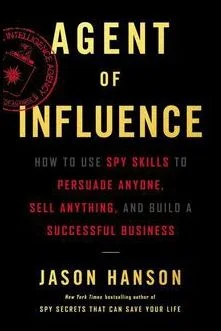
"Agent of Influence" by Jason Hanson
Book summary, review and lessons from "Agent of Influence" by Jason Hanson.
Learn key lessons from an ex-CIA officer, and how you can apply spy skills to grow and develop your business.
Book Summary:
“Agent of Influence: How to Use Spy Skills to Persuade Anyone, Sell Anything, and Build a Successful Business” by Jason Hanson is a practical guide on how to use proven spy techniques to bolster your business strategies.
Bestselling author Jason Hanson, a former CIA special agent and founder of Spy Escape School, reveals how anyone can use spy tactics for increased success. Hanson teaches readers how to develop a winning sales personality and target the perfect business opportunity using the SADR cycle—spotting, assessing, developing, and recruiting. With this invaluable and unique handbook, you will become a more productive and confident professional.
Book Lessons:
1) Key Spy Lessons
Know your contacts contacts.
Spies don’t just know their contacts, they take the time to learn who their contacts are connected to. Who are their relatives, their neighbors or co-workers, expand your network by figuring out your contacts know.
Look at their feet.
Any time you notice someone’s feet pointing away from the person to whom they are talking to, it’s a clear signal that they do not want to engage in the conversation any longer. If their feet are pointing towards the exit, they likely want to head that way.
Hold proper eye contact.
Research shows that most people are comfortable with eye contact that lasts about 3.2 seconds, any more and people begin to feel too intimate or even threatening.
Listen for key words.
When you’re developing a connection with someone, listen to words they emphasize or frequently repeat. These key words will often give you insight into the person’s life.
Repeat their name.
It’s said that a person’s name is the sweetest and most important sound in any language. Make it a point to purposefully repeat the person’s name throughout a conversation to create the feeling that they are interesting and the center of attention.
Own your mistakes.
When something goes wrong in a business, the person in charge should take full responsibility, no matter whose fault it technically was. Take extreme ownership of the situation and set an example by fixing the problem, even if it wasn’t your wrongdoing.
2) Use the hourglass conversation to extract information
“By starting with a broad general topic, narrowing in on a specific topic, and then going broad again, you can quickly pull incredibly valuable information from someone without them suspecting you’re prying.”
One of the most important skills a spy needs to have in their arsenal, is the ability to extract information from people without them becoming suspicious.
This is done through a technique called “the hourglass conversation.”
It starts with the spy talking about a broad general topic, then narrowing the conversation to a specific topic where they can learn valuable information, and then going to a broad topic.
This method works extremely well because people tend to only remember the start and end of a conversation and often forget what happened in the middle.
For example, lets say a spy is at a global conference and wants to extract information from a chemical engineer about the kind of work he does.
The spy would start by making small talk about the atmosphere of the conference and the lectures, then ask about the line of work the engineer does and what he enjoys about his job and then finish by asking if the engineer knows any good places to get food around town.
“People often remember the beginning and end of a conversation–but not the middle. This is why spies ask the probing question in the middle of the conversation. This is how they can determine if their target has what they want without coming off as suspicious.”
Here’s how author Jason Hanson used the Hourglass conversation to land a gig with a billionaire businessman:
Hanson was at an exclusive event and knew a billionaire who had been receiving death threats was at the event. Hanson figured he could provide the businessman with personal security and having him in his network would lead to more lucrative jobs.
However, Hanson couldn’t just walk up to the businessman and announce that he should hire him. In fact, almost everyone in the room wanted to talk to the businessman.
Instead, Hanson took a different approach and talked to the billionaire’s girlfriend. He opened the conversation by talking about the food and event (general broad topic). He shifted the conversation to work and told her about his security company (narrow topic). The girlfriend then mentioned that she had been worried about her boyfriend’s safety and was looking to bring people in since he wasn’t going to do it himself.
After receiving this gem of information, Hanson took the conversation broad again and talked about their favorite hobbies. The two then exchange contact info and went back to the event.
Hanson reconnected with the girlfriend two days later and she was glad to hear from him. She ended up hiring his security company to provide training to her billionaire boyfriend as well as his entire board of directors!
3) Build Alliances, Not Contacts
“There’s a big difference between having a Rolodex full of powerful names and actually being able to put the names to good use.”
Hanson argues that finding a way to access someone isn’t the hardest part of networking, the real challenge is taking that relationship to a higher level.
Instead of having contacts, one should have alliances–an alliance is someone who views you as an asset in their own life, respects you as a peer and values your knowledge and expertise.
Alliances are built by making connections, finding commonalities and making the person feel comfortable.
The first main tactic intelligence officers use to build a relationship is matching and mirroring:
Spies will match and mirror the behavior of someone with whom they want to build an alliance since, generally speaking, people often feel more comfortable with others who are like them.
This technique involves observing the person’s posture, eye contact, physical proximity and other body language cues. “Mirroring cements the feeling that this person is a positive influence and someone we would like to have in our lives.”
A key point to remember is that you don’t have to mirror every behavior a person exhibits and to choose behaviors that feel natural and comfortable for you.
The second tactic is to create a bridge or establish commonalities with the person:
By sharing common interests you build rapport while gaining key insights into the person’s life.
Here are a few tips for building a bridge with someone:
Avoid one-upmanship where you try to be better than the person you’re talking to, don’t judge the person or they will avoid telling you personal information, don’t give advice unless specifically asked for, do not interrupt the person, make sure you’re an extraordinary listener, and use flattery but don’t over do it.
The third and last tactic is give to get to find common ground:
Most people aren’t going to openly share their fears or deep dark secrets with people they don’t know unless the other person opens up first or creates a warm, inviting outlet.
This doesn’t mean you dump your personal life story on a person you just met, but feel free to share bits and pieces of your personal life or your concerns about your business to get the other person to open up and start talking about their life or business.
Sincerity is equally as important as making useful connections so make it your goal to connect with people over a genuine commonality to achieve the best results. As Warren Buffet said, “It takes twenty years to build a reputation and five minutes to ruin it.”
Never risk your brand or personal reputation to make a connection based on a lie, it’s not worth it.
Book Review:
“Agent of Influence” by Jason Hanson is an easy-to-read guide on how business owners and entrepreneurs can apply lessons from the spy world towards business.
The book has a similar vibe to “Extreme Ownership" by Jocko Willink and Leif Babin, while also adding key lessons about negotiation, sales, and even has a bonus chapter explaining how to get on TV.
Overall, I’ve found this book to be both interesting and practical. The author does get a bit irritating since he tends to constantly self-promote himself, but aside from that he provides engaging stories, useful pieces of advice, and summarizes important takeaways and the end of each chapter.
Thank you Dey St. for sending me a copy of this book!
Rating: 4/5 Stars
Get the book here.

After reading 100+ books, here are the books I recommend reading.
Please consider supporting A&B or signing up for our monthly newsletter. Thank you!

“The Algebra of Happiness” by Scott Galloway
Book summary, review and lessons from “The Algebra of Happiness” by Scott Galloway.
Learn key life lessons, why you should take risks and not fear rejection, and how to stay married for the long-term.
Book Summary:
“The Algebra of Happiness: Notes on the Pursuit of Success, Love, and Meaning” is an unconventional book of wisdom and life advice from Scott Galloway–the renowned business school professor and NYT bestselling author of “The Four.”
Galloway’s book is a mix of anecdotes and no-BS insight to share hard-won wisdom about life's challenges, along with touching personal stories. Here are a few lessons readers will learn:
Advice on if you should drop out of school to be an entrepreneur (it might have worked for Steve Jobs, but you're probably not Steve Jobs),
Ideas on how to position yourself in a crowded job market (do something "boring" and move to a city; passion is for people who are already rich),
Discovering what the most important decision in your life is (it's not your job, your car, OR your zip code),
And many more.

Book Lessons:
1) Key Life Lessons
Happiness is usually highest during childhood, teen and college years.
It drops during your mid-20s because of work, stress and other hardships and stays around that level till your mid-40s, but starts to go back up once you hit your 50s.
If you want to be extremely successful in your career, you have to focus on work and not look for work-life balance.
By focusing on your career, you will have a lot more work-life balance later in life.
The ratio of time you spend sweating to watching others sweat is a forward-looking indicator of your success.
Spend more time playing sports than watching sports.
The most important decision you’ll make in life is deciding who will be your life partner.
Look for a partner with similar goals and one who approaches life the same way as yourself.
Two-thirds of economic growth over the next 50 years will be in supercities.
Opportunity is a function of density, get to a place that’s crowded with success.
Compound interest is the most powerful force in the universe.
Invest as early as possible: every $1,000 you put in today will be worth $10,000-$25,000 40 years from.
What is a man’s worst friend? Alcohol.
A Harvard happiness study tracked men for 75 years and found that the one thing that predicted unhappiness better than any other factor was alcohol–it led to failed marriages, careers and bad health.
To be happy, choose experiences over materialism.
Studies show that people overestimate the amount of happiness things will bring them and underestimate the long-term positive effect of experiences.
Nothing is ever as bad or as good as it seems.
You will experience failure and hard times in life, they will not last forever. Failure is often part of the road to success. The good times also don’t last forever, cherish moments of happiness.
Galloway’s book is based on his popular YouTube episode “The Algebra of Happiness.” Watch the video for more lessons.
2) Take risks and be okay with rejection
“Train yourself to take some sort of risk (ask for a raise, introduce yourself around at a party) every day and et comfortable grasping beyond your reach.
”
As the old saying goes, “No risk, no reward.”
Galloway encourages readers to train themselves to take risks, even small ones such as introducing yourself to a stranger at a party. You never know, perhaps the women you introduce yourself to is your future wife (this is how Galloway met his wife).
He also adds that his willingness to endure rejection from peers, investors and women “has been hugely rewarding. Knowing what you want is a blessing, and fear of rejection is a bigger obstacle than lack of talent or the market,” which is why it’s so important to practice risk-taking and being okay with failing.
Failures can be both private and public.
If you fail to get into law school because you bombed the LSAT, no one will know unless you told them. However, if you start your own company and launch it into the public domain, and it fails, people will know. But that’s okay–the road to success is filled with ups and downs, you just have to keep going.
Even if your startup does well in the beginning, you will have to take on more risk and possibly face more rejections. This includes creating and selling new products, hiring new employees, seeking venture funding and finding companies to buy your business.
Life is filled with risks and rejections, don’t let that stop you.
3) Advice for a happy marriage
“Studies show that marriage is advantageous economically. Having a partnership, sharing expenses and responsibilities, being able to focus on your careers, and utilizing the wisdom of crowds leads to better decisions.
”
Marriage is not only better for your personal life, but it is also better for your financial life. Galloway writes that a married couples’ household worth grows at an average of 14% a year.
By their 50s, married couples have 3x the assets of their single peers.
Here are a few pieces of marriage advice from Galloway:
Don’t keep score.
Aim to be as generous and do as much as you can for your partner instead of keeping count of everyone’s contribution and making a loser column. If your partner messes up, and they will, have forgiveness towards them.
Don’t ever let your wife be cold or hungry.
Most fights happen when either you or your partner are cold, hungry, tired or a combination of both. Keep a few snack and oversized scarves with you in the car or when on the go for emergency purposes.
Express affection and desire as often as possible.
Affection, touch and sex all reinforce that your relationship is intact, active and you have romantic feelings for your partner. People who don’t feel desired become insecure and can go down the path of feeling indifferent or disconnected which can lead to them cheating.
The two most rewarding things in life are family and professional achievement, writes Galloway. Life isn’t as fun if you don’t have a close partner to share all the great moments of life with. If you find someone who you can see spending the rest of your life with, make sure you’re a good partner and keep them along for the whole ride.
Book Review:
“The Algebra of Happiness” by Scott Galloway is a surprisingly entertaining and thoughtful book. Although its written by an angry, depressed business professor, Galloway does an excellent job combing research data with personal experiences to offer advice on living a good life.
The book gives tips on succeeding in business, finding the right partner and staying together for the long-term, how to be a good parent, how to take care of your health, and many more wise lessons.
This honest and direct book of advice is a wonderful read for recent graduates, millennials and anyone who feels adrift in life.
Thank you Portfolio Penguin for sending me a copy of this book!
Rating: 4/5 Stars
If you’re interested in this book, you can get it here.

After reading 100+ books, here are the books I recommend reading.
Please consider supporting A&B or signing up for our monthly newsletter. Thank you!

"The Subtle Art of Not Giving a F*ck" by Mark Manson
Book summary, review and lessons from "The Subtle Art of Not Giving a F*ck" by Mark Manson.
Learn why life is an infinite set of problems, why you should adjust your values and how taking responsibility of your life will make it better.
An excellent self-improvement book that delivers the cold, hard truth to readers.
Book Summary:
“The Subtle Art of Not Giving a F*ck: A Counterintuitive Approach to Living a Good Life” by Mark Manson provides readers with a counterintuitive guide to living a good life. Instead of trying to be happy all the time, Manson teaches:
Why problems are infinite, and why that is both a good and bad thing.
How adjusting your values can improve your quality of life.
Why you should take complete responsibility of your life.
And many more lessons.

There are only so many things we can give a f*ck about, so we need to figure out which things really matter in life. Manson’s book delivers the cold, hard truth while also sharing entertaining stories filled with profane humor. This book is a refreshing slap in the face for people to help them lead contented, grounded lives.
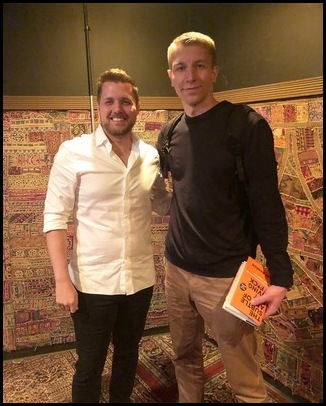
Got to meet Mark Manson at his book tour in NYC.
Book Lessons:
1) Problems are both good and bad
“Life is essentially an endless series of problems...The solution to one problem is merely the creation of the next one...Don’t hope for a life without problems...There’s no such thing. Instead, hope for a life full of good problems. ”
Every single person in the world has problems. It doesn’t matter if you’re rich, happily married and live in a nice house, you will still face the problem of managing your wealth, remembering your wife’s birthday and buying her a gift and keeping the house clean.
Being rich has its problems, as does being poor.
Having a family has its problems, as does not having one.
Being employed has its problems, as does being unemployed.
There is no such thing as a life without problems.
So what can you do?
“Hope for a life filled with good problems,” writes Mark Manson.
Having the problem of having too many good friends and not knowing which ones to hang out with is a good problem.
Getting accepted into all of the colleges you applied to is a good problem.
Planning a vacation that you won from being the number one salesperson at your company is a good problem.
The good news is that people also derive happiness from solving problems.
This is why people are constantly engaging in games, puzzles and challenges.
Since happiness comes from solving problems, happiness is a form of action or activity, not something you’ll magically discover. By taking action and solving problems, your body will reward you with positive emotions.
Since you can’t have a problem free life, it’s important to ask, “What pain do you want to sustain?”
Who you are is defined by what you’re willing to struggle for. People who enjoy the struggles of a gym are the ones who run triathlons and have chiseled abs and can benchpress a small house. People who enjoy long workweeks and the politics of the corporate ladder are the ones who fly to the top of it. People who enjoy the stresses and uncertainties of the starving artist lifestyle are ultimately the ones who live it and make it (page 40).
2) To have a good life, have good values
“The question is not whether we evaluate ourselves against others; rather, the question is by what standard do we measure ourselves?”
According to Mark Manson, here are the differences between good and bad values:
Good Values:
Reality-based
Socially constructive
Immediate and controllable
Bad Values:
Superstitious
Socially destructive
Not immediate or controllable
Honesty, for example, is a good value. It’s something you have complete control over, it reflects reality and it benefits others. Popularity, on the other hand, is a bad value. You have little control over what people think of you and you will spend too much time concerning yourself over every little action that may change your ranking.
When people have poor values, that is, poor standards, they are “essentially giving fucks about the things that don’t matter, things that in fact make our life worse” (88).
Manson proves his point by looking at the values of Dave Mustaine and Pete Best.
In the early 1980s, Dave Mustaine formed the legendary heavy-metal band Megadeth. Megadeth would go on to sell over 25 million albums and tour the world several times. Mustaine became incredibly wealthy from the band’s success and is considered one of the most influential musicians in the history of heavy-metal music.
Unfortunately, before he formed Megadeth, Mustaine was kicked out of the band Metallica. Arguably the greatest rock band of all time–Metallica has sold over 180 million albums, seven times that of Megadeth.
In a 2003 interview, Mustaine admitted he still considered himself a failure for being kicked out Metallica. By adopting the bad values of happiness equals being more successful than his former band, Mustaine felt like a failure even though he was worth millions of dollars, had countless fans and made a career out of something he loved to do.
Now compare that to the life of Pete Best.
Pete Best was also kicked out of a band, and not just any band, it was The Beatles.
Unlike Mutaine, Best didn’t go on to become a global rockstar or make millions of dollars, and yet, in an interview, he said he was happier without the Beatles.
Why?
Best said that getting kicked out of the band led him to meet his wife and then his marriage led to him having children. His values changed and he began to measure his life differently.
Instead of chasing glory and fame, Best sought out a loving family and happy marriage.
One would imagine that Dave Mustaine would be more satisfied with life since he achieved great fame and glory, but yet he felt like a failure whereas Pete Best didn’t become a superstar and yet is contempt with life because he simply changed his values.
Choose better values, and you too will have a better life.
3) Take total responsibility for your life
“There is a simple realization from which all personal improvement and growth emerges. This is the realization that we, individually, are responsible for everything in our lives, no matter the external circumstances.
”
This lesson may be one of the coldest and hardest truths to accept in Manson’s book. The truth that no matter what, you are responsible for your life and must respond to any punches life throws your way.
This doesn’t mean that fault and responsibility are the same things, but you still must take responsibility for things that aren’t your fault.
For instance, if you woke up one day and there was a newborn baby on your doorstep, it would not be your fault that the baby was put there, but the baby would now be your responsibility. You would have to choose what to do (feed the baby, call home services, etc).
In other words, fault is past tense and responsibility is present tense.
Here’s some more cold, hard truth from Mark Manson:
Many people may be to blame for your unhappiness, but nobody is ever responsible for your unhappiness but you. This is because you always get to choose how you see things, how you react to things, how you value things. You always get to choose the metric by which to measure your experiences (page 99).
Don’t fall for the victim mentality–it’s tempting to pass of the responsibility of solving your problems to others, but it won’t get you nearly as far in life as taking responsibility for your own life will.
This isn’t a new idea, Jocko Willink literally wrote a book called “Extreme Ownership” where he shares the most important lesson of leadership, taking complete responsibility and ownership of any situation.
Jordan Peterson also shares a similar lesson in his book, “12 Rules for Life.” Peterson writes that each and every one of us most shoulder as much responsibility as possible in order to improve our lives.
Your problems may not be your fault, but it is up to you, and you alone, to take responsibility of your life and take action to improve it.
Book Review:
“The Subtle Art of Not Giving A F*ck” by Mark Manson is equal parts insightful and entertaining. Manson has an incredible sense of awareness when it comes to life and looking at it from different perspectives, while also cracking poop jokes and talking about a superhero called “Disappointment Panda.”
This is the second time I’ve read this book, and I found it just as helpful and interesting as the first. At 200 pages, this book is quite easy to read and Manson’s stories about Buddha and rockstars keep readers engaged chapter after chapter.
Life is short, stop caring about things that don’t matter. Instead, read this book, focus on the things that do matter and take responsibility for your life.
Rating: 5/5 Stars
If you’re interested in this book, you can get it here.
You can also get the audio version of this book for free by signing up for a trial of Audible here.
Here are a few similar articles:
After reading 100+ books, here are the books I recommend reading.
Please consider supporting A&B or signing up for our monthly newsletter. Thank you!

"The Creative Curve" by Allen Gannett
Book summary, review and lessons from "The Creative Curve" by Allen Gannett.
Read about creative geniuses and the truth behind their work instead of the common myths around them.
Learn practical steps that you can apply to become more creative.
Book Summary:
“The Creative Curve: How to Develop the Right Idea, at the Right Time” by Allen Gannett debunks the mythology around creative genius and reveals the science and secrets behind achieving breakout commercial success in any field.
From writing a popular novel to starting up a successful company, recent research shows that there is a predictable science behind achieving commercial success in any creative endeavor.

By understanding the mechanics of what Gannett calls “the creative curve”–the point of optimal tension between the novel and the familiar, and the four laws of creative success (consumption, imitation, creative communities, iterations) and the common patterns behind their achievement, everyone can better engineer creativity.
Book Lessons:
Become a consumer and spend 20% of your time familiarizing yourself within your chosen field.
Imitate the style of great creatives in your field before you start adding your personal spin to your art.
Develop a creative community that consists of a mentor, collaborator, modern muse and prominent promoter.
Iterate your work by talking to customers and using data-drive processes to refine ideas and turn them into great pieces of work.
Law 1: Consumption
“Painters show up at numerous art exhibits. Chefs eat at cutting-edge restaurants, visit farms, and travel to food shows. Songwriters are constantly listening to music, new and old.”
There is a common pattern among successful creative artists, they are all consumers of their craft.
Great painters visit art galleries.
Skilled chefs explore different restaurants.
Successful authors read hundreds of books a year.
Gannett writes that creative artists spend about 3-4 hours a day or roughly 20% of their time on consuming their respective art.
He calls this the 20% principle:
By consuming material in your creative field, you develop an intuitive, expert-level understanding of the field, where it is on the creative curve, and where it is heading.
Take Ted Sarandos, the chief content officer at Netflix, as an example.
As a kid, Sarandos worked at a video rental store and spent all of his free time at work watching movies. Within a few months, he had watched almost every movie in the shop. He had become a human recommendation engine as was constantly being asked by customers which movies were worth watching.
By going on a consumption binge, Sarandos was able to differentiate what makes a movie great and was makes a movie bomb. He continued to consume movies as he was promoted to general manager of the video store chain and then went on to join Netflix in 2000, where he led content acquisition.
Even today, Sarandos continues to watch 3-4 hours of film and TV today, except now he does so from his corner office in Beverly Hills.
The 20% principle is critical for creative artists because you need to have a certain level of established knowledge of what people like and what already exists in the world before you attempt to create something new.
As author Allen Gannett writes, “If your goal is to achieve mainstream success, your first step should be to immerse yourself in the field you’re interested in, exposing yourself to and consuming as much as possible. This will allow you to identify ideas that are familiar to previous successes” (131).
Only once you have a baseline understanding of your art field can move on to creating something original.
Law 2: Imitation
“You may think that breakout success comes from breaking the pattern. In reality, it is only by following a pattern that you tap into the right level of novelty.
”
There’s an old saying that before you can break the rules, you must first master them. That is especially true for creatives.
Great creative individuals all follow some form of structure, formula, pattern or norm.
Almost all books are 200-300 pages long.
Almost all songs are 2-3 minutes long.
Almost all sitcoms are 20-30 minutes long.
These constraints ensure familiarity to consumers, while also allowing the artist to spice things up by changing 10, 20 or 30% of the art.
Take Andrew Ross Sorkin, author of the bestselling book “Too Big to Fail” and co-creator of the hit show “Billions” as an example.
After graduating from college, Sorkin was hired as a business reporter for the NYT. However there was one problem, he was 22 years old and had no real experience.
So what did he do?
He started to imitate the greats. He sought out NYT stories from previous years and studied their formats. Sorkin began to build outlines of an ideal format based on what worked and then fit his own story into the outline.
Instead of trying to reinvent the wheel, Sorkin learned the formula of what makes an article great and applied it to his own writing. The result? It “helped skyrocket his career” (152).
Sorkin used the same strategy when he began writing the book “Too Big to Fail.”
“I went to the bookstore and bought five or ten of my favorite business narratives and studied what they were doing, how they do it, what was it that I liked about it, and what didn’t I like about it,” Sorkin said.
Sorkin then emulated the book style formula of the writers he admired into his own book. By doing so, he was able to communicate his most persuasive new ideas into a time-tested framework.
“If we imitate the people we admire, and reconstruct their past successes, we are that much closer to absorbing the patterns we need to create content at the right point of the creative curve,” writes author Allen Gannett.
Law 3: Creative Communities
“Studies show that building a community of people around us is essential to achieving world-class success...research demonstrated that an innovator’s network could predict prominence, productivity, and even the length of their career.
”
There’s a common myth that creative geniuses simply sit alone in a house in the woods and create masterpieces. However, more often than not, this is completely false.
The truth is that most creative geniuses have a creative community.
One study found that the “strength of an artist’s reputation was correlated to the number of relationships they had with other successful artists, both within and beyond their own generation” (156).
Author Gannett discovered that creatives had 4 different types of people in their networks:
A Master Teacher
A Conflicting Collaborator
A Modern Muse
A Prominent Promoter
Together, these form what Gannett calls a “creative community.” Each role can be filled by either an individual or a group, and all four roles play a critical part in becoming a successful creative artist.
Here is a short description of each role:
A Master Teacher
Master teachers serve two essential roles: they teach constraints and they assist with deliberate practice through feedback. A master teacher is needed to take your game to the next level, even professional athletes have teachers (coaches).
A Conflicting Collaborator
You don’t want to collaborate with someone who is so easy to get along with that they don’t push you. The goal is to find a person who will help you discover and overcome your flaws.
A Modern Muse
A modern muse is an individual or a group of people who continually inspire and motivate you. This support system will help supply you with energy to power through the low moments of your creative career.
A Prominent Promoter
Prominent promoters are people with credibility who will advocate for you and your work. This could be an agent, publicist or fellow artist with a solid reputation and has influence in their field.
Near the end of the chapter, Gannett writes that “The best innovators know that creative success isn’t a solo adventure, and also know that a single key partner is insufficient. We all need in our orbits a community of people who will fill a variety of roles” (182).
Law 4: Iterations
“The biggest secret to creating something your audience will love? Listen to them.
”
The 4 steps of iteration are conceptualization, reduction, curation, and feedback.
During the conceptualization stage, creatives generate a set of plausible ideas that can later be refined.
In reduction, creatives put their early work in front of an audience to test the ideas and get a sense of which ideas are worth investing time and energy into. This stage can be scary because it involves criticism and rejection, but it’s better to have 3 great ideas that you feel will succeed instead of 30 random ideas.
Then in the curation stage, you take your ideas one step further and allow people to dive deeper into your work so that you can gather extensive information to confirm data and intuition.
The final stage is feedback. Creators need to constantly measure and assess their work to fit customer needs. This can come from phone calls, emails, social media, sales figures or any other data points. Just as authors constantly rewrite their drafts, use customer feedback to improve and refine your product until it is a polished piece of work.
Here’s how Ben & Jerry’s, the famous ice cream company, goes through the iteration process:
Conceptualization: Ben & Jerry’s R&D researchers come up with a list of 200 possible new flavors.
Reduction: Ben & Jerry’s emails those 200 flavors to their newsletter subscribers and asks which flavors interest them and move forward with the top 15 flavors.
Curation: the Flavor Gurus start to make small batches of the 15 flavors and tests them with other teams and stakeholders.
Feedback: During the early release, Ben & Jerry’s looks at fan reactions to see if people like it or not. Then during the official release, the company looks at phone calls, emails, social media, sales figures and any other data points that indicate whether customers like the product and if any improvements are needed.
Book Review:
“The Creative Curve” blew me away. It’s not a NYT or WSJ bestseller, and yet it is a fantastic book filled with engaging stories and wonderful pieces of practical advice.
The book debunks many common myths around creative geniuses and provides insightful recommendations on how anyone can improve their creativity. Author Allen Gannett did an excellent job presenting his ideas with the support of both original research and published scientific studies.
This book is a must read for artists, writers, musicians or anyone in a creative industry. I can’t recommend it enough, I’ve already added it to my list of books that are worth reading more than once.
Rating: 5/5 Stars
If you’re interested in this book, you can get it here.

Here are a few similar articles:
After reading 100+ books, here are the books I recommend reading.
Please consider supporting A&B or signing up for our monthly newsletter. Thank you!

"Loonshots" by Safi Bahcall
Book summary, review and lessons from "Loonshots" by Safi Bahcall
Read about a surprising new way of thinking about the mysteries of group behavior and nurturing radical breakthroughs.
“Loonshots” teaches readers how to keep an eye out for false fails and how to create a company structure that allows loonshots to grow and thrive.
Book Summary:
“Loonshots: How to Nurture the Crazy Ideas That Win Wars, Cure Diseases, and Transform Industries” by Safi Bahcall, teaches readers a surprisingly new way of thinking about group behavior and nurturing radical breakthroughs.
Safi Bahcall combines his business and science background to share dozens of entertaining historical stories about ideas that changed the world. These crazy ideas include the invention of radar, the James Bond and Star Wars franchises, the creation of Lipitor–a multibillion-dollar drug, and many more.

Just like how changing the temperature of a fridge by one degree can change water from a solid to a liquid, “Loonshots” explains how making small shifts in company structure can lead to dramatic outcomes that can alter company’s future. The book distills these insights into lessons for creatives, entrepreneurs, and visionaries everywhere.
Book Lessons:
1) Beware of false fails
“The negative result in the rat experiment was a False Fail–a result mistakenly attributed to the loonshot but actually a flaw in the test.
”
Statins (drugs that lower cholesterol levels in the blood) have generated over $300 billion in sales, and Facebook, a social media giant that has a market cap of over $500 billion are two loonshot ideas that both experienced false fails.
The first statin, mevastatin, showed no lowering of cholesterol levels during the crucial stage of testing in live animals. That is until Akira Endo, the scientist who discovered mevastatin, bumped into a colleague who worked with chickens.
It occurred to Endo that hens might have high blood cholesterol since their eggs have so much of it and convinced his colleague to give mevastatin to chickens (in secret, of course).
““The results were spectacular. Mevastatin decreased cholesterol by nearly half, triglycerides by even more, with no ill effects””
Why did the drug work on chickens but not rats?
It was later discovered that rats have very little LDL or “bad cholesterol” while chickens have both good and bad cholesterol, much like humans.
Today, statins prevent approximately half a million heart attacks and strokes each year–but the drug almost didn’t make it to market because of a false fail during testing.
Facebook had a similar experience.
In the early 2000s, Facebook was seeking venture capital while competing with several other social networks including: Classmates, Sixdegrees, Tribe, Hub Culture, aSmallWorld, and others.
Investors believed social network sites were a fad since users would abandon established sites and join new ones, such as leaving Friendster for MySpace. Several investors passed on Facebook, but investor Peter Thiel decided to dig deeper into the problem.
Thiel found that users of Friendster were leaving the site because it was constantly crashing and although the company had received advice to fix and scale their site, they ignored it. Thiel concluded that users weren’t leaving the social network because of its weak business model, but because of a software glitch.
Thiel wrote Zuckerberg a check for $500,000 and eight years later, he sold most of his stake in Facebook for roughly a billion dollars.
Both Facebook and statins were crazy loonshot ideas that experienced false starts. However, a simple adjustment resulted in two multi-billion dollar entities.
One way to overcome false starts, is to Listen to the Suck with Curiosity or LSC as the author calls it. Overcome the urge to defend and dismiss when your idea is attacked and instead investigate the failure with an open mind.
When the drug testing in rats didn’t work, Endo asked why and set about testing different ideas. Peter Thiel did the same thing and investigated into why users were leaving social networks and found a contrarian answer.
It’s hard to hear that no one likes your beautiful loonshot idea, but it can be even harder to keep asking why it isn’t working. However, that doesn’t mean you should give up.
2) Developing the ideal loonshot environment
“Rather than champion any individual loonshot, they create an outstanding structure for nurturing many loonshots. Rather than visionary innovators, they are careful gardeners.
”
The idea that long-lasting companies are built on the back of a single genius-entrepreneur, is a myth. Rather, the best companies “ensure that both loonshots and franchises are tended well, that neither side dominates the other, and that each side nurtures and supports the other” (38).
Bahcall calls these principles the Bush-Vail rules–separate the groups working on the loonshots and those working on the main business, but allow projects and feedback to travel easily between the two groups.
Start by separating the artists and soldiers
“Artists” are people responsible for developing high-risk, early stage ideas while “soldiers” are responsible for already-successful, steady-growth parts of the organization. Loonshots are often fragile in their early stages since most are seen as crazy ideas, even radar was dismissed by the military as loonshot.
Several major movie studios passed on the loonshot idea of a British spy who saves the world (James Bond) and a script titled The Adventures of Luke Starkiller (Star Wars). By separating the artists and soldiers, you will create a loonshot nursery that projects those embryonic ideas and allows the artists to grow and develop them.
Love your artists and soldiers equally
Both loonshots and franchises are important to a business’ long-term survival, which is why it is important to love both artists and soldiers. During Steve Job’s first stint at Apple, he called the loonshot group working on the Mac “pirates” while he dismissed the group working on the Apple II franchise as “regular Navy.”
Hostility between the two groups grew and resulted in several key employees leaving the company as well as a failed Mac launch. It wasn’t until Steve Jobs returned 12 years later, that he learned to love both his artists (Jony Ive) and soldiers (Tim Cook).
3) Additional rules for a loonshot environment
Separate the phases
Separate your artists and soldiers.
Tailor the tools to the phase.
Watch your blind side: nurture both types of loonshots (product and strategy).
Create dynamic equilibrium
Love your artists and soldiers equally.
Manage the transfer, not the technology: be a gardner, not a Moses.
Appoint, and train, project champions to bridge the divide.
Spread a system mindset
Keep asking why the organization made the choices it did.
Keep asking how the decision-making process can be improved.
Identify teams with outcome mindsets, and help them adopt system mindsets (149).
Reduce the return on politics
Make lobbying for compensation and promotion decisions difficult. Find ways to make those decisions less dependent on an employee’s manager and more independently assessed.
Use soft equity
Identify and apply the non-financial rewards that make a big difference. For example: peer recognition and intrinsic motivators.
Increase project-skill fit
Invest in the people and processes that will scan for a mismatch between employees’ skills and their assigned projects. Adjust roles or transfer employees between groups when mismatches are found. The goal is employees stretched neither too much nor too little by their roles.
Fix the middle
Identify and fix perverse incentives, the unintended consequences of well-intentioned rewards. Pay special attention to the dangerous middle-manager levels, the weakest point in the battle for promotion and toward incentives centered on outcomes. Celebrate results, not rank.
Bring a gun to a knife fight
Competitors in the battle for talent and loonshots may be using outmoded incentive systems. Bring in a specialist in the subtleties of the art–a chief incentive officer.
Fine-tune the spans
Widen management spans in loonsot groups (but not in franchise groups) to encourage looser controls, more experiments, and peer-to-peer problem solving (224).
Book Review:
“Loonshots” by Safi Bahcall does an excellent job explaining how small shifts in company structure can help companies nurture and develop loonshot ideas–a widely dismissed idea whose champion is written off as crazy, that leads to an important breakthrough.
One would believe a book about company structure would be dry and dull, but Bahcall made this book both entertaining and educational. The book is filled with stories about how the military dismissed the invention of radar, how a drug that lowered cholesterol was killed three times, how forest fires and terrorist networks spread, and dozens of more captivating stories.
Although “Loonshots” is an interesting and informative read, it is also for a very niche audience. I would recommend this book for CEOs and executives of medium to large size companies, scientists, military leaders and entrepreneurs. Apply the tools in this book to help your company and employees unlock their potential to create and nurture the crazy ideas that change the world.
Rating: 4/5 Stars
If you’re interested in this book, you can get it here.

Here are a few similar articles:
After reading 100+ books, here are the books I recommend reading.
Please consider supporting A&B or signing up for our monthly newsletter. Thank you!

"Digital Minimalism" by Cal Newport
Book summary and lessons from "Digital Minimalism” by Cal Newport.
Learn how how social media is designed to be addictive, how to perform a digital declutter and how to replace social media with deep meaningful activities.
Matt Ridley is a professor and author of several books including “Deep Work” and “So Good They Can’t Ignore You.”
Book Summary:
“Digital Minimalism: Choosing a Focused Life in a Noisy World” by Cal Newport takes the concept of minimalism and applies it to personal technology. In an overstimulated world, this book will teach readers how to live a focused and productive life.
The book is similar to Newport’s last book, “Deep Work” but has a greater focus on how to properly use smartphones, personal tech and social media.
Newport identifies the common practices of digital minimalists and the ideas that underpin them. He shows how digital minimalists can rethink their relationship to social media, rediscover the pleasures of the offline world, and reconnect with their inner selves through regular periods of solitude.

He also shares strategies for integrating these practices into your life, starting with a thirty-day "digital declutter" process that has already helped thousands feel less overwhelmed and more in control.
Technology is neither good nor bad. The key is using it to support your goals and values, rather than letting it use you. This book shows the how.
Book Lessons:
1) How Social Media is designed to be addicting
“Just as Tristan Harris warned, in many cases these addictive properties of new technologies are not accidents, but instead carefully engineered design features.
”
When the first iPhone was released in 2007, there was no App store, no social media notifications and no Instagram. Fast forward a decade and almost everyone who has a smartphone is addicted to it and social media.
The average modern user spends around “two hours per day on social media” and checks their phone “eighty-five times a day.” People text while driving, they cross the street while looking at Instagram and watch YouTube videos while using the bathroom–the addiction is widespread.
Tristan Harris, a former Google engineer and whistleblower of tech addiction, explains that minimizing distractions and respecting users’ attention would reduce revenue for companies such as Google. Since many tech giants operate on an attention driven model (the more eyeballs they get, the more ads they can sell), these companies don’t have much incentive to become less addictive.
So how do these companies design tech to grab as much of your attention as possible?
One way is by creating attention-catching notifications and making it easy to find the next interesting post.
The original Facebook notification symbol was blue to match the rest of the site, “but no one used it. So they changed the color to red–an alarm color–and clicking sky rocketed.”
Almost every social media platform has copied this concept and also added a news feed with infinite scrolling. Infinite scrolling allows users to see post after post for hours on end–it’s difficult to stop when there is no finish line and the fear of missing out (FOMO) on an interesting post is always in the back of your head.
Social media is also designed to encourage users to seek social approval.
“In Paleolithic times, it was important that you carefully managed your social standing with other members of your tribe because your survival depended on it.” Today, new technologies hijack this deep drive to create a behavioral addiction.
When someone shares a new post, they aren’t sure whether ‘their tribe’ will approve of it or not so they constantly monitor its progress. If the post gets a lot of likes, hearts or comments, people feel a surge of dopamine. If the post doesn’t do well or doesn’t get as many likes as the last post, people will often delete it.
As Sean Parker, the founding President of Facebook, once said that features like these are part of a “social-validation feedback loop...exactly the kind of thing that a hacker like myself would come up with, because you’re exploiting a vulnerability in human psychology.”
2) Take a digital declutter
“Digital Minimalism:
A philosophy of technology use in which you focus your online time on a small number of carefully selected and optimized activities that strongly support things you value, and then happily miss out on everything else.
”
Much like cleaning out a house that is filled with things that provide little to no value to one’s life, Newport suggests doing a digital declutter in which you clear away distracting tools and compulsive habits.
Here’s how:
Take a 30 day break from optional technologies in your life.
During that break, explore and rediscover activities and behaviors that you find satisfying and meaningful.
At the end of the break, slowly reintroduce optional technologies in your life. For each technology you reintroduce, determine what value it serves in your life and how specifically you will use it to maximize this value.
Newport sent this declutter challenge to his mailing list and surprisingly, over 1,600 people signed up. Here are a few tips from for this challenge:
During the first step, remove social media, video games, video streaming and other technologies that aren’t necessary in your life–you can survive without Netflix or Reddit for a few weeks.
For the second step, focus on spending time on rediscovering what’s important to you and what you enjoy outside the digital world–try different hobbies, spend time playing sports, reconnect with old friends by meeting in person, read some books, etc.
The final step requires you to start from a blank slate and only allow the technology that greatly benefits you life to come back in–ask yourself, is this app, social media platform, video game, tv show...etc, really adding value to your life or not?
Lastly, here are 3 pieces of advice when considering whether to bring an optional technology back into your life, it must:
Serve something you deeply value (offering some benefit is not enough).
Be the best way to use technology to serve this value (if it’s not, replace it with something better).
Have a role in your life that is constrained with a standard operating procedure that specifies when and how you use it.
3) Connect in the real world, not the digital one
“Investing energy into something hard but worthwhile almost always returns much more richer rewards.”
The key issue is that using social media tends to take people away from the real world socializing that’s massively more valuable.
Social media isn’t inherently bad, it’s like a knife– a knife can be used to cut open a watermelon for people to enjoy or as a weapon that hurts people.
This is why it’s important to know when and how to use social media so it’s used for good instead of something bad.
Studies show that people who spend more time on social media feel more lonely and miserable because they are spending most of their time online instead of offline.
The tiny dopamine boost a person gets from getting a lot of likes on their Instagram picture isn’t nearly the same as the dopamine wave one gets from spending quality time with a dear friend.
Instead of using your smartphone and social media to connect with people online, use it as a way to plan activities in the real world.
Plan a weekend basketball pickup game
Host a weekly poker night at your house
Meetup with old friends and reconnect at a local bar
Have a weekly game night with the family
Join a volunteer group to help improve the community
There are countless of activities that will result in deeper relationships and be much more meaningful than stay at home and scrolling through your newsfeed.
If you’re more introverted, find a craft that you enjoy and adds value to your life.
This can include:
Crafting a wooden table
Knitting a new sweater
Renovating your guest room
Creating a new song
Working on your jumpshot
Reading great literature
Writing a journal entry
All of these crafts provide a good source of high-quality leisure. “Craft allows an escape from this shallowness and provides instead a deeper source of pride.”
High-skill effort activities (like building your own coffee table) require more than than low-skill effort activities (like answering emails) but yield much more meaning. “Over time, you’ll soon begin to wonder how you ever tolerated spending so many of your leisure hours staring passively at glowing screens.”
Conclusion:
“Digital Minimalism” by Cal Newport is a book that does exactly what it says, it shows readers how to have a focused life in a noisy world.
Social media apps may be free, but people pay for them with their most precious resources, their time and attention. With this book, readers will be able to fight against the tech giants and regain control of their lives, thus becoming aware of to properly use technology to your advantage, instead of tech companies using it to theirs.
By revealing the forces behind addictive technologies and introducing readers to a minimalism philosophy, readers will be well-equipped to thrive in an increasingly digital-first world. Anyone who owns a smartphone or uses social media for more than an hour each day should read this book.
Rating: 4/5
(Thank you Portfolio Penguin for sending over a copy of this book!)
If you’re interested in getting the book, click here or on the images below.

Here are a few similar articles:
After reading 100+ books, here are the books I recommend reading.
Please consider supporting A&B or signing up for our monthly newsletter. Thank you!

"The Red Queen" by Matt Ridley
Book summary and lessons from "The Red Queen" by Matt Ridley.
Learn why women conceal fertility, why women want rich and tall men and why romance novels are porn for women.
Matt Ridley is a scientist, journalist and bestselling author.
Book Summary:
“The Red Queen: Sex and the Evolution of Human Nature” by Matt Ridley answers dozens of riddles about human nature and culture–including why men propose marriage, the method behind our notions of beauty, why humans reproduce sexually instead of asexually and many more human mysterious.
Author Matt Ridley also argues that men are polygamous for the obvious reason that whichever gender has to spend the most time and energy creating and rearing offspring tends to avoid extra mating, while women are far less interested in multiple partners and will commit adultery if stuck with a mediocre mate.
Read on to learn why women conceal their fertility, why women like men who are tall, wealthy and have status, and why romance novels equal porn for women.

Book Lessons:
1) Why Women Conceal Their Fertility
“Women’s genes seem to have gone to inordinate lengths to conceal the moment of ovulation. ”
A lot of animals, such as chimps, mice and dogs, can tell when the other sex is ‘in heat’ and fertile for mating.
Some animals make it extremely clear, “chimpanzees become pink; cows smell irresistible to bulls...female mice solicit male mice” but when it comes to female humans, women have evolved to hide their ovulation, so much so that even they don’t always know exactly when the moment will happen.
So why do women not advertise to mates that they are fertile like other species?
One argument is that since the man doesn’t know when the woman is pregnant, he must stay around and have intercourse with her often to be sure he is the father of the children. “This keeps him from mischief and ensures he is still around to help rear the babies.”
The second argument, is that if females wish to select their choice of partner, it makes little sense for them to advertise their ovulation. She wants to first choose a mate, then advertise to him that she is fertile afterwards while keeping the other males guessing.
Both arguments are logical and make a strong case. Ideally, a woman would want to select the best mate and then keep him around for form a long-term relationship with him instead of advertising that she is fertile and hooking up with the first guy that comes by,
2) Women Want Men With Status, Wealth & Height
“Men consistently place physical features above personality and status when considering women; women do not when considering men.
”
Good news guys, women don’t care about a guy’s physical appearance as men do!
This isn’t because men are shallow, but rather men look for cues to learn about the health of a woman–a symmetrical face, large breasts and hips are all features that indicate a healthy body (read more from "A Billion Wicked Thoughts” by Ogas & Gaddam).
However, everyone already knew what men desire, the million dollar question is what do women desire?
The answer: Status, wealth and height.
Status: Ideally a woman would want to be with someone who is ‘on the top of the food chain’ such as a doctor or CEO, but since most women choose a mate long before a man has had the chance to become high status, women look for clues for future potential.
This includes clues such as past achievements, intelligence, ambition, optimism, poise–”these are the things that cause men to rise to the top of their professions. And not coincidentally, these are the things women find attractive.”
Wealth: The stereotype is true, women want wealthy men. “Women pay attention to cues of wealth and power, men pay attention to cues of health and youth.”
This is because a wealthy husband helps the wife by increasing “the number of and health of her children.” More money equals more food, medicine, shelter and many more things that will improve the odds of her children surviving and thriving.
Height: “Tall men are universally considered more attractive by women than short men...the principle that a man must be taller than his date is so universal that it has been called ‘the cardinal principle of date selection.”
This doesn’t mean you have to be 6’8” to date women, it means if you’re interested in a women who is 5’4”, she would likely prefer someone 5’5” or taller.
3) Why romance novels Equal porn for women
“Porn is designed for, marketed to, and sought out by men, not women. The romance novel, by contrast, is aimed entirely at the female market.
”
While men are attracted to visual images and having fantasize multiple partners, women are not. They prefer touch and fantasize about a familiar partner.
This is one of the main reasons women prefer romance novels over pornography.
While men are interested in intercourse with as many mates as possible (common theme in porn), to have as many offspring as they can, women have a different strategy.
Since a women can only have one child at a time and usually has to raise that child for a decade or two, women go for the best mate (common theme in books).
There is no evolutionary advantage for a woman to have sex with multiple men since she will only produce one offspring. Women have nothing to gain and in fact have a great deal to lose from this, especially if the women is looking for a long-term partner.
This explains why “male sexual fantasies tend to be more ubiquitous, frequent, visual...promiscuous and active” while “female sexual fantasies tend to be more contextual, emotive, intimate, and passive.”
The men in those novels are discussed in great detail, but with a focus on the man’s character and not his body.
Not surprisingly, sex plays a very small part in romance novels, instead, the majority of the book is about “love, commitment, domesticity, nurturing and the formation of relationships.”
Conclusion:
“The Red Queen” by Matt Ridley is a well-written and insightful journey that takes readers through genetics, neurobiology, psychology and many more areas of science to explore the evolution of human nature.
The book explains the benefits of sexual reproduction versus asexual, the different ways animals and humans evolved over thousands of years and how men and women seek different traits in a mate.
Although there were several nuggets of valuable information in this book, it is a bit outdated since it was written in 1993. I’d recommend first reading "A Billion Wicked Thoughts” by Ogas & Gaddam since it was written 2012 and has much more info on sex and human nature.
Rating: 3/5
If you’re interested in getting the book, click here or on the images below.

Here are a few similar articles:
After reading 100+ books, here are the books I recommend reading.
Please consider supporting A&B or signing up for our monthly newsletter. Thank you!

"Can't Hurt Me" by David Goggins
Book summary of "Can't Hurt Me" by David Goggins.
Goggins went from a living in poverty to joining the SEALs and becoming an ultra endurance athlete.
This book is one of my favorite books of 2019 and I highly, highly recommend reading it.
Book Summary:
“Can’t Hurt Me” by David Goggins is unlike any book I’ve ever read. The story of David Goggins is something out of a Hollywood movie. A young boy with a horrible childhood and a myriad of problems overcomes it all to become part of an elite military team and a world famous ultra endurance athlete.
As a child, Goggins had a learning disability, was often ill, and was raised by a single mother. As a young adult, Goggins’ future seemed bleak. He was depressed, overweight and worked as a bug exterminator.
And yet, he would go on to join an elite military team–the Navy SEALS– break the world record for pull-ups and become one of the world’s top endurance athletes, often running races of 100+ miles.

How did Goggins turn his life around and transform from a literal zero to American hero?
He did it through self-discipline, mental toughness, and hard work.
However, his transformation didn’t happen overnight. In fact, it took him several decades to change his life around.
Let’s start by looking at Goggins’ childhood.
Goggins’ Early Years
David Goggins was born in New York in 1975 and although he lived on Paradise Road, his childhood was anything but that.
Goggins’ father, Trunnis, ran a roller-disco rink during the day, but was also involved in shady activities such as moving prostitutes across the border. When Goggin’s mother disobeyed or argued with Trunnis, such as taking Goggins to the doctor because he had an ear infection, he would beat her for disobeying him. When Goggins tried to stop his father, he would end up catching a beating himself.
““I was covered in welts from my neck to the crease at the knees. I didn’t go to school for several days.””
When Goggins was 8 years old, his mother put together a plan to escape from her abusive partner. Despite his cruelty, Goggins’ older brother decided to stay with Trunnis, and so, only Goggins and his mother managed to escape.
Although Goggins was able to get away his abusive father, his life didn’t get much better. He and his mother were free from Trunnis, but they now had no financial support. The two found shelter in a public housing block and paid $7 a month in rent.
Not only was Goggins experiencing poverty, but he was also diagnosed with ADHD and developed a nervous stutter. His traumatic childhood and toxic environment made it difficult to learn, and so he started cheating in school to pass classes.
““I knew that if I didn’t show some improvement I would eventually be shipped out to that special black hole for good, so I found a solution. I started cheating my ass off.” ”
When Goggins was in the 4th grade, his mother met Wilmoth, a man who was the polar opposite of Trunnis. Wilmoth was kind and laid-back. He treated Goggins’ mother well and even played basketball with Goggins.
However, a happy family was not in Goggin’s future. One night, Wilmouth was shot five times as he tried to enter his home. The cops never found the killers and once again, Goggins and his mother found themselves on their own.
Goggins’ Young Adult Years
As a teenager, David continued to struggle with school. To force himself to learn, Goggins had to read the same text multiple times and rewrite his notes over and over again. His work eventually paid off and he finished high school and was he accepted into Air Force training.
David’s dream was to become an Air Force pararescue, a special group of soldiers who specialize in parachuting into war zones and rescuing their brothers-in-arms. However, to complete his training, David would have to face one of his biggest weaknesses, swimming.
However, as a child, David rarely spent time in a pool. When it came time to the water portion of his military training, Goggins found himself overwhelmed with fear and quit the program. He knew he should have fought through his fear and completed his training, but instead he took the easy way out.
Quitting training would become one of Goggins’ biggest regrets, he started to feel sorry for himself and things began to spiral downhill. After leaving the military, Goggins was 24-years-old and working a dead-end job as a night-shift pest exterminator. He used food as a way to numb the pain of failure and weighed nearly 300 pounds.

After quitting the Air Force, Goggins ballooned up to nearly 300 pounds.
Goggins was nearing a dead-end. He hated his job, ate junk food multiple times a day and had trouble looking at himself in the mirror. Fortunately, his life would soon change.
One day, Goggins flipped on the television and happened to stumble upon a documentary about Navy SEALS. He watched as the narrator talked about the SEALs as the most elite fighting force in the world and that only the best of the best made it through training.
Goggins was stunned and amazed by the mental toughness and determination of the men on the screen. They had to carry boats for miles, lift logs, do countless pushups, swim for hours and perform many more difficult tasks.
Goggins wanted to become one of these incredible human beings and set out on a mission to become a Navy SEAL.
Becoming A SEAL
Before Goggins could even enter training, he first had to lose over 100 pounds of weight in less than three months because of the Navy’s maximum weight limit. Many people would have quit at this point, but Goggins decided to double down and commit 110% percent to becoming a SEAL.
Goggins woke up at 4:30 A.M. every day and exercised for two hours on a stationary bike. He then spent two hours in the pool and hit the weight room afterwards. He would also bike for another two hours after dinner. Working out practically became a full-time job for Goggins.
Remarkably, Goggins’ hard work paid off and he was accepted into the SEAL training program.
However, he would still have to endure his hardest training yet. Goggins participated in three Hell Weeks–where he experienced 5 ½ days of grueling exercise, soaked in water and covered in sand, all while getting barely any sleep during the program. In his third Hell Week, a man actually died during training.
Fortunately, Goggins made it through training and became a SEAL.
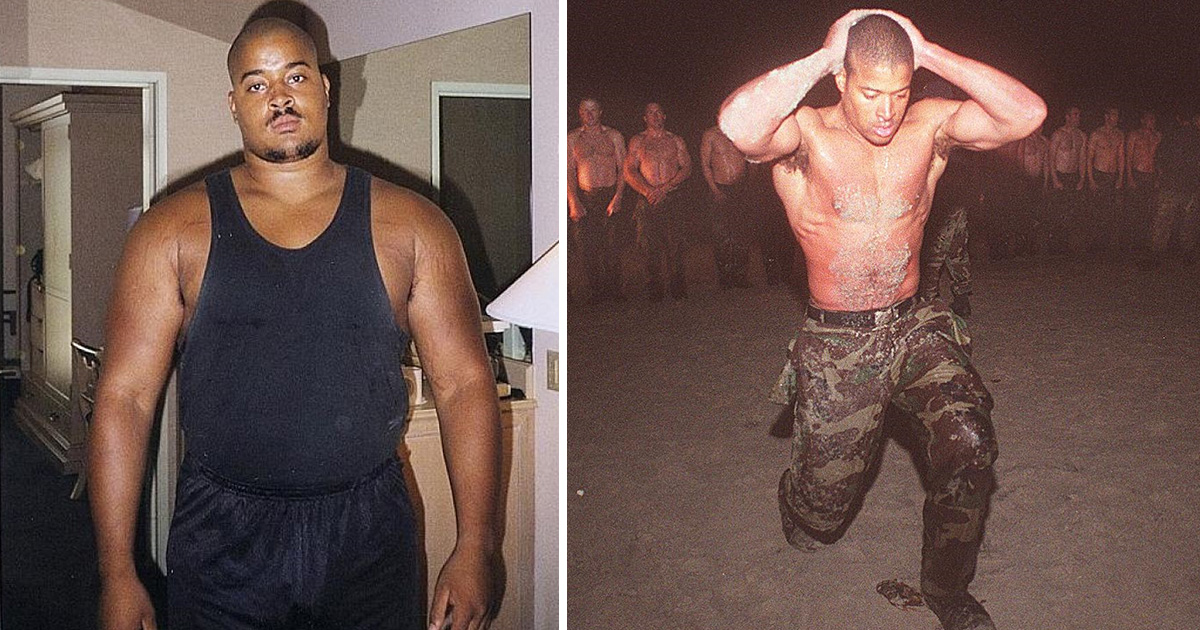
David Goggins (left) before Navy SEAL training and Goggins during Hell Week in BUD/S.
Becoming An Endurance Athlete
Goggins spent several years as a SEAL, but soon found himself craving new challenges. He searched for the toughest challenges known to man and found the Badwater 135, a 135-miles race through California’s Death Valley–one of the hottest places on Earth.
To even qualify for the Badwater race, the race organizers required Goggins to run in a 100-mile race. Although he had never run more than 26.2 miles before, Goggins accepted the challenge and signed up.
Through sheer motivation, willpower and incredible driver, Goggins finished the race in 19 hours, he even ran an extra mile to make sure the judges counted his laps correctly.
Goggins would later describe the race as the most pain he had ever experienced in his life–he was urinating brown piss from experiencing kidney failure and lost his bowel movement while running and defecated on himself. And yet, he would also remember that race as the moment his life changed forever–if he could run a 100-mile race with no training, he could do anything.
Goggins would go on to compete in the Badwater 135 and finish in 5th place, completing the race in 30 hours. He continued to look for the most difficult challenges he could find–he competed in Ironman triathlons, ultra marathons, and even broke the world record for pull-up attempts.
“Talent wasn’t required for this sport. It was all about heart and hard work, and it delivered relentless challenge after relentless challenge, always demanding more.”
Be Like Goggins
Several times throughout the book Goggins admits to readers that he wasn’t born strong, smart or with a hard work ethic. Early on in his life, he took the easy way out by cheating in school, running away from his fears and taking the easy way out as much as possible.
And where did that get him? Nowhere.
Goggins shares that it is only when changed his mindset and realized that the key to success was working harder than anyone else, did his life change for the better.
The secret to Goggins’ accomplishments is his willingess to work and suffer. By punishing himself physically, Goggins was also able to push himself mentally and vice-versa.
Goggins says that too many people get comfortable in their lives, they start to make excuses for working hard, such as not having time to exercise, or even worse, they simply decide not to. But Goggins doesn’t accept excuses.
Goggins didn’t make the excuse of not having time to train when he had a full-time job as a SEAL, he made time to train.
Goggins would get up at 4 A.M. and go for a 6-10 mile run. He would be home by 5:15 A.M., shower and eat breakfast. He would then bike 25 miles to work and arrive at his desk by 7:30 A.M. He would work till lunch time, and lift weights during his break. Once he was done with his day job, he would bike another 25 miles and arrive home at 7 P.M.
“My work ethic is the single most important factor in all of my accomplishments. Everything else is secondary.””
As Goggins says, most people program themselves to seek comfort, carve out safe spaces and spend as little time possible doing things that are hard or straight up suck. Although these things may feel good temporary, in the long-term it makes people weak.
Towards the end of the book, Goggins tells readers to ask themselves one question, “What if?”
Just as Goggins asked himself,
What if I lost 100 pounds in 3 months?
What if a kid afraid of water became a Navy SEAL?
What if I ran 100 miles without any training?
What if you set out to do a so-called impossible goal and actually completed it.
So ask yourself, “What if?”
Book Review:
“Can’t Hurt Me” by David Goggins might be my favorite book of 2019 and the year isn’t even halfway over. David’s story is beyond amazing, if one were to simply look at his achievements, you would took the guy isn’t human. But after reading his book, you realize he is just as human as everyone of us–except he simply chooses to strive for excellence and challenge himself over and over again.
Words cannot convey of important and inspiring this book is–I read the book, listened to the audiobook (which I recommend because Goggins shares bonus stories on the audio version) and watched dozens of podcasts about Goggins, and yet I’m still blown away him.
Just from reading his book, I’ve been motivated to run 5 miles every week–I’ve ran in 20 degree weather, in the snow and in the rain, and have been doing so for almost 4 months now. I’ve even signed up for several races.
This book will motivate you to push yourself to a new level and will make you a better person because of it. Get it, read it and learn from it!
Rating: 5/5
If you’re interested in getting the book, click here or on the image below.

After reading 100+ books, which ones do I recommend? Find out here.
Please consider supporting A&B or signing up for our monthly newsletter. Thank you!

5 Book Bloggers Share Their 10 Favorite Books
Are you looking for book recommendations?
In this article, 5 awesome book bloggers share their 10 favorite books.
This is a must-read article!
One of the best things about the internet is that you get to find and connect with people who share similar passions.
When I first started blogging about books, I thought almost no one else was doing the same, but I soon found several awesome book bloggers that all had the same mission–to encourage people to read books and never stop learning.
So I thought, why not have book bloggers come together and share their favorite books so that readers can get a wide range of recommendations from trusted bloggers whom collectively, have reads hundreds or perhaps even thousands of books.
Now without further ado, here are 5 book bloggers and their 10 favorite books (no specific order):
1) BookMattic

Matt Hutson helps people find meaning through reading nonfiction books. He started doing Personal Development English Lessons with several clients throughout Indonesia and plans on taking on more clients around the world. He believes that the more people develop themselves the better our world will become.
Instagram: @bookmattic & website: bookmattic.com
10 Favorite Books:
“Think & Grow Rich” - Napoleon Hill
“This essential book works on your subconscious mind and mindset so you can become successful at anything you do.”
“The Four Agreements” - Don Miguel Ruiz
“Be impeccable with your word, don’t take things personally, don’t make assumptions, and always do your best are the four agreements that will help you to get out of your own head so you can live how you want, when you want and where you want.”
“The Power of Now” - Eckhart Tolle
“Live in the now, be one with yourself and everything else.”
“The Power of Habit” - Charles Duhigg
“Want to know how to change any bad habit to become a good one? This book tells you exactly how habits make up most of your life and that if you have the right habits you can become extremely successful.”
“Man’s Search For Meaning” - Viktor Frankl
“A WWII holocaust survivor of four death camps explains what kept him alive and how we can overcome any pains in our life no matter how hard.”
“The Alchemist” - Paulo Coelho
“This is a mystical fiction book filled with truths on how to find your purpose in life. It’s short, sweet and inspiring.”
“Start With Why” - Simon Sinek
“You have a purpose driving you even if you don’t know what it is yet. This book helped me to find mine.”
“The Storyteller’s Secret” - Sejal Badani
“Communication skills will only get more important as AI takes over many jobs. Why not learn how to communicate like the masters do by learning how to tell stories just like Malala or Steve Jobs?”
“Building a StoryBrand” - Donald Miller
“Hands down the best marketing book for businesses who want to solve a major problem in their customer’s life”
“If you have a business online or a storefront you need to know how to sell your product or services. Cadence explains simply how to create a sales funnel that will work.”
2) Books of Titans

Erik Rostad started the Books of Titans reading project because he needed help finding the best books. He found out what some of the world's top performers were reading and then started reading those 52 of those books each year. He now helps others find great books and create their own reading plans so they can experience the joy of reading.
Instagram: @booksoftitans & website: booksoftitans.com
10 Favorite Books:
“Crime and Punishment” - Fyodor Dostoyevsky
“This was the first classic novel I read by choice (as opposed to be assigned to read in school) and it opened my eyes to the power of literature.”
“I read it nearly every morning. This book has had the most impact on the direction of my life.”
“Man’s Search For Meaning” - Viktor Frankl
“I've read 100+ books since 2017 for the Books of Titans reading project and this is my favorite book so far.”
“Thinking, Fast and Slow” - Daniel Kahneman
“This is a foundational book and many of the newer non-fiction books relate back to this. Some books take what they learn from this book and apply it to a particular field.”
“Guns, Germs, and Steel” - Jared Diamond
“Another foundational book that provides a framework for considering major historical movements.”
“Start With Why” - Simon Sinek
“People don't care about what you do - they care about why you do it. This transformed how I run my business and help my customers.”
“Born to Run” - Christopher McDougall
“As a runner, this book opened my eyes to new possibilities I never thought possible. I am a better runner today because of this book.”
“The Sacred Romance” - John Eldredge
“I call this my hinge book. My entire library "hinges" upon reading this book. I read it in 1998. It talks about grand story narratives found in novels, movies, and other art, and how they relate to the Christian story. This made me want to begin reading more to see examples in the major works of literature.”
“Les Miserables” - Victor Hugo
“An unbelievable novel of love, war, pain, redemption.”
“The World is Flat” - Thomas Friedman
“I include this book because of its impact in my life. This book convinced me that I needed more education. I went to graduate school as a direct result of reading this book in 2004.”
3) Get Better With Books

Get Better With Books is an online resource dedicated to personal development book readers. Jim (founder) is 31, works in software sales and lives outside Boston with his wife and baby daughter.
Instagram: @getbetterwithbooks
10 Favorite Books:
“How To Win Friends & Influence People” - Dale Carnegie
“Common sense approach for positive personal interactions with others.”
"Rich Dad Poor Dad" - Robert Kiyosaki
“The holy grail of personal finance. While the topics are simple, the concepts are life changing.”
“Arguably the best memoir on entrepreneurship. Beautifully written, packed with lessons for anyone building something from scratch.”
“The Road to Character” - David Brooks
“Thoughtful read that emphasizes the importance of virtues like courage, kindness and empathy.”
“Flow” - Mihaly Csikszentmihalyi
“Brilliant book that describes how happiness works and how we can cultivate it within.”
“Where Men Win Glory” - Jon Krakauer
“Tragic story of Pat Tillman, former NFL star turned US Army hero post 9/11. Vibrant detail and emotion.”
“Watership Down” - Richard Adams
“Classic story about courage, camaraderie, and a journey against all odds.”
“Gripping story of the first trans-Antarctic voyage in 1914. Amazing feat of courage and leadership.”
“Awaken The Giant Within” - Tony Robbins
“Personal development powerhouse.”
“As A Man Thinketh” - James Allen
“Simple and profound process for positivity changing your thoughts.”
4) Timos Notes

My name is Timo, I'm 20 years old and from Germany. I'm currently studying E-Commerce. Ever since I was a little child I loved books. About three years ago I fell in love with personal development and other non-fiction books. One of my favorite genres is biographies.
Instagram: @timosnotes & website: timosnotes.com
10 Favorite Books:
"Rich Dad Poor Dad" - Robert Kiyosaki
“It’s the perfect book to learn the basics of personal finance and start your financial education.”
"Sleep Smarter" - Shawn Stevenson
“This book opened my eyes to the importance of sleep and that we should´nt sacrifice it.”
“Cadence teaches a simple strategy to make your business more profitable, packed in a catchy story.”
“The Alchemist” - Paulo Coelho
“A classic book and a great story, encouraging the reader to chase his or her dreams.”
“Think & Grow Rich” - Napoleon Hill
“One of the best personal development books of all time, teaching you what it takes to be successful.”
"How to Win Friends and Influence People" - Dale Carnegie
“Dale Carnegie teaches you the basics of communication and how to make others feel good about themselves.”
“It blew my mind how George Orwell kind of saw the direction in which our world is heading, back in 1949.”
"Long Walk to Freedom" - Nelson Mandela
“Mandela’s autobiography shows how much he sacrificed for his beliefs and goals, without ever giving in.”
"Can't Hurt Me" - David Goggins
“Probably the most inspiring story I have ever read. Goggins doesn’t just tell you, he shows you, that we are capable of achieving more than we could ever imagine.”
5) Alex & Books

I started Alex and Books because I discovered the incredible value of books, but saw that almost no one I knew read them or took advantage of the treasure trove of important information inside them. So I set out on a mission to read the best books, find key lessons from each one and share them with as much people as possible. On my site, you can find book summaries, lessons, reviews and more great content.
Instagram: @AlexandBooks & website: alexandbooks.com
10 Favorite Books:
“Discipline Equals Freedom” - Jocko Willink
“The more discipline you have in life, the more freedom you’ll have. Wise lessons from a retired Navy SEAL Lieutenant commander.”
“Probably the best book I have ever read on productivity and creating good habits.”
“Extreme Ownership” - Jocko Willink
“Stop blaming the world, by taking extreme ownership of your life you will be able to fix it–no one is doing to do it for you.”
“The Emperor’s Handbook” - Marcus Aurelius
“Aurelius was a wealthy and incredibly powerful Roman emperor that lived a good and just life without corrupting himself and teaches others how to do the same.”
“By changing your mindset, you can quite literally change your life.”
“This book completely changed the way I look at businesses and startups.”
“How To Win Friends & Influence People” - Dale Carnegie
“A must-read book for people who want to improve their social relationships and understand people.”
“Man’s Search for Meaning” - Viktor Frankl
“Viktor Frankl was able to survive and find meaning in Auschwitz, he teaches readers how he endured the camps and how people can find meaning in life.”
“Can’t Hurt Me” - David Goggins
“Probably the most inspiring autobiography I’ve ever read, Goggins pushes his body to incredible limits such as breaking the world pull-up record and running 120+ mile races.”
“12 Rules for Life” - Jordan Peterson
“Perhaps my all-time favorite book, it combines religion, philosophy, psychology and other sciences that teach you if you want to improve the world, the best way to start is by improving yourself.”
Thank you everyone for reading this article. I hope it inspires you to find a fantastic book and to keep learning. Just as the books above have changed the lives of myself and fellow book bloggers, perhaps it will do the same for you.
Read on!
After reading 100+ books, here are my favorite books by genre:
Please consider supporting A&B or signing up for our monthly newsletter. Thank you!

"Write Your Book In A Flash" by Dan Janal
Book summary and lessons from "Write Your Book In A Flash" by Dan Janal
Learn how to outline your book, overcome imposter syndrome and more.
Dan Janal has written more than a dozen book and is an award-winning reporter and editor.
Book Summary:
“Write Your Book in a Flash: A Paint-by-Numbers System to Write the Book of Your Dreams—FAST!” by Dan Janal provides readers with an easy to follow step-by-step guide on how to write a non-fiction business book.
Janal gives readers a clear system for writing a book and provides several examples along the way. Whether you are a business executive, thought leader or entrepreneur, this book will act as your personal Virgil and show you the path to finishing that book you’ve always wanted to share with the world.
Here are a few lessons the book teaches readers:
How to write a simple outline that makes the writing process faster and easier
How to research interesting ideas, stories, and facts so you never run out of ideas or information
How to overcome “The Imposter Syndrome” and other limiting beliefs that stifle nearly every would be author
And much, much more.

Author Dan Janal (source).
Dan Janal has written more than a dozen books. He is an award-winning daily newspaper reporter and business newspaper editor. He holds a master’s degrees in journalism from Northwestern University’s famed Medill School of Journalism.
Book Lessons:
1) How to overcome imposter syndrome
“It’s not unusual for an author to suffer from a horrible condition known as Imposter Syndrome. Even highly successful people in business and education think they are not worthy of success because there is someone better out there.”
It is not uncommon for first-time writers to feel like imposters. They might think that there are better writers or smarter people in the world which is true, but that doesn’t mean you yourself aren’t smart or can’t write.
You don’t have to be the smartest person in the world or write like Hemingway to be an author, if that were true almost no one would write books.
Author Dan Janal says that even Lin-Manuel Miranda, the creator of the hit show “Hamilton” dealt with Imposter Syndrome. He said: “Anytime you write something, you go through so many phases. You go through the ‘I’m a fraud’ phase. You go through the ‘I’ll never finish’ phase.”
And if you truly are a rotten writer, you can always hire a writing coach to guide you through the process, work with a ghostwriter or have a professional editor look over your drafts.
2) How to overcome limiting beliefs
“Here’s a wonderful exercise to overcome limiting beliefs...Think of a limiting belief, and write it in the space below. Think of five reasons why this belief is not true, and write them in the spaces below.”
Another obstacle writers will face on their journey to create a book is the self-doubt and limits they put on themselves.
A writer might have the belief that they don’t have anything to say. If this or another limiting belief pops into your mind, Janal recommends that you come up with 5 reasons that prove the opposite.
“I write a blog every week, so I must have something to say.”
“People respond to my blogs, so they must like what I say.”
“My blog readers ask if I’m writing a book.”
And so on.
Another limiting belief is “I don’t have time to write a book.”
Here is what Janal says:
“I can wake up an hour earlier to write.”
“Instead of watching TV, I can write.”
“I can go to sleep an hour later and use that time to write.”
“I can write while I’m waiting for my kids to finish their soccer practice.”
“I can hire a ghostwriter or work with a book coach.”
If you ever find yourself in a situation where self-doubt or limiting belief start taking over your head, remember to list 5 things you can do to overcome that limiting belief.
3) How to finish and edit your first draft
“The research is the easiest. The outline is the most fun. The first draft is the hardest because every word of the outline has to be fleshed out. -Ken Follett
”
When it comes to finishing your first draft, the most important part is getting it done.
As Janal writes, “It doesn’t have to be perfect. It doesn’t have to look pretty. It doesn’t even need to have all your facts and stories. It just has to get done.”
Janal says that writers shouldn’t expect their first draft to be a masterpiece. In fact, many of his first drafts are disorganized and filled with holes, but that is okay.
Like Anne Lamott, the author of “Bird by Bird” the classic book about writing, said, all first drafts are “shitty first drafts.”
However, it is only once you’ve completed the first draft that you can begin cleaning and polishing it.
That is where editing comes in.
But remember that writing and editing are two separate activities.
Jean Feingold, the author of “The Benefits of Concrete Block Homes” said:
““Don’t edit while you write. Writing and editing are two different activities. Just keep writing as long as ideas come to you. When you reach a stopping point, go back, run spell-check, correct any grammatical errors, and repair any holes in your thinking. This first edit is only designed to fix the rough edges. You will do many more edits before your book is ready for people to read.” ”
During the editing process, your aim should be to cut useless words that dilute your message.
It may be hard to cut words after putting in the time and sweat to write them, but Janal assures writers that it will make their book better.
Janal says that for “Write Your Book In A Flash” he cut more than a thousand words from the first draft.
Here are a few editing tips:
“That” can usually be removed. If it sounds good without it, cut it.
The same goes for the word “the” and “of.”
You can usually cut words like very, just, and only.
Janal writes that a typical editor can cut 2-3% of your draft. However, it is important to remember that editing occurs multiple times on the road to publishing. As Feingold wrote above, “You will do many more edits before your book is ready for people to read.”
So finish your first draft and get to editing!
Conclusion:
“Write Your Book in a Flash” does an excellent job of providing readers with a proven system for writing a business book. It doesn’t debate the pros and cons of self-publishing and traditional publishing, but instead, it shows people how to write the book that always wanted to share with the world.
The book answers many questions first-time authors will have, such as how to outline their book and overcome imposter syndrome. Janal provides exercises to empower novice authors and examples to help readers who may be stuck in a rut.
Overall, if you’re someone who would like to write a non-fiction business book, this book is worth picking up.
Rating: 4/5
If you’re interested in getting the book, click here or on the images below.

Learn more about Dan Janal here:
Here are a few similar books:
After reading 100+ books, here are the books I recommend reading.
Please consider supporting A&B or signing up for our monthly newsletter. Thank you!
Enjoying A&B?
Consider donating to keep the site up and running!