"Can't Hurt Me" by David Goggins
Book summary of "Can't Hurt Me" by David Goggins.
Goggins went from a living in poverty to joining the SEALs and becoming an ultra endurance athlete.
This book is one of my favorite books of 2019 and I highly, highly recommend reading it.
Book Summary:
“Can’t Hurt Me” by David Goggins is unlike any book I’ve ever read. The story of David Goggins is something out of a Hollywood movie. A young boy with a horrible childhood and a myriad of problems overcomes it all to become part of an elite military team and a world famous ultra endurance athlete.
As a child, Goggins had a learning disability, was often ill, and was raised by a single mother. As a young adult, Goggins’ future seemed bleak. He was depressed, overweight and worked as a bug exterminator.
And yet, he would go on to join an elite military team–the Navy SEALS– break the world record for pull-ups and become one of the world’s top endurance athletes, often running races of 100+ miles.

How did Goggins turn his life around and transform from a literal zero to American hero?
He did it through self-discipline, mental toughness, and hard work.
However, his transformation didn’t happen overnight. In fact, it took him several decades to change his life around.
Let’s start by looking at Goggins’ childhood.
Goggins’ Early Years
David Goggins was born in New York in 1975 and although he lived on Paradise Road, his childhood was anything but that.
Goggins’ father, Trunnis, ran a roller-disco rink during the day, but was also involved in shady activities such as moving prostitutes across the border. When Goggin’s mother disobeyed or argued with Trunnis, such as taking Goggins to the doctor because he had an ear infection, he would beat her for disobeying him. When Goggins tried to stop his father, he would end up catching a beating himself.
““I was covered in welts from my neck to the crease at the knees. I didn’t go to school for several days.””
When Goggins was 8 years old, his mother put together a plan to escape from her abusive partner. Despite his cruelty, Goggins’ older brother decided to stay with Trunnis, and so, only Goggins and his mother managed to escape.
Although Goggins was able to get away his abusive father, his life didn’t get much better. He and his mother were free from Trunnis, but they now had no financial support. The two found shelter in a public housing block and paid $7 a month in rent.
Not only was Goggins experiencing poverty, but he was also diagnosed with ADHD and developed a nervous stutter. His traumatic childhood and toxic environment made it difficult to learn, and so he started cheating in school to pass classes.
““I knew that if I didn’t show some improvement I would eventually be shipped out to that special black hole for good, so I found a solution. I started cheating my ass off.” ”
When Goggins was in the 4th grade, his mother met Wilmoth, a man who was the polar opposite of Trunnis. Wilmoth was kind and laid-back. He treated Goggins’ mother well and even played basketball with Goggins.
However, a happy family was not in Goggin’s future. One night, Wilmouth was shot five times as he tried to enter his home. The cops never found the killers and once again, Goggins and his mother found themselves on their own.
Goggins’ Young Adult Years
As a teenager, David continued to struggle with school. To force himself to learn, Goggins had to read the same text multiple times and rewrite his notes over and over again. His work eventually paid off and he finished high school and was he accepted into Air Force training.
David’s dream was to become an Air Force pararescue, a special group of soldiers who specialize in parachuting into war zones and rescuing their brothers-in-arms. However, to complete his training, David would have to face one of his biggest weaknesses, swimming.
However, as a child, David rarely spent time in a pool. When it came time to the water portion of his military training, Goggins found himself overwhelmed with fear and quit the program. He knew he should have fought through his fear and completed his training, but instead he took the easy way out.
Quitting training would become one of Goggins’ biggest regrets, he started to feel sorry for himself and things began to spiral downhill. After leaving the military, Goggins was 24-years-old and working a dead-end job as a night-shift pest exterminator. He used food as a way to numb the pain of failure and weighed nearly 300 pounds.

After quitting the Air Force, Goggins ballooned up to nearly 300 pounds.
Goggins was nearing a dead-end. He hated his job, ate junk food multiple times a day and had trouble looking at himself in the mirror. Fortunately, his life would soon change.
One day, Goggins flipped on the television and happened to stumble upon a documentary about Navy SEALS. He watched as the narrator talked about the SEALs as the most elite fighting force in the world and that only the best of the best made it through training.
Goggins was stunned and amazed by the mental toughness and determination of the men on the screen. They had to carry boats for miles, lift logs, do countless pushups, swim for hours and perform many more difficult tasks.
Goggins wanted to become one of these incredible human beings and set out on a mission to become a Navy SEAL.
Becoming A SEAL
Before Goggins could even enter training, he first had to lose over 100 pounds of weight in less than three months because of the Navy’s maximum weight limit. Many people would have quit at this point, but Goggins decided to double down and commit 110% percent to becoming a SEAL.
Goggins woke up at 4:30 A.M. every day and exercised for two hours on a stationary bike. He then spent two hours in the pool and hit the weight room afterwards. He would also bike for another two hours after dinner. Working out practically became a full-time job for Goggins.
Remarkably, Goggins’ hard work paid off and he was accepted into the SEAL training program.
However, he would still have to endure his hardest training yet. Goggins participated in three Hell Weeks–where he experienced 5 ½ days of grueling exercise, soaked in water and covered in sand, all while getting barely any sleep during the program. In his third Hell Week, a man actually died during training.
Fortunately, Goggins made it through training and became a SEAL.
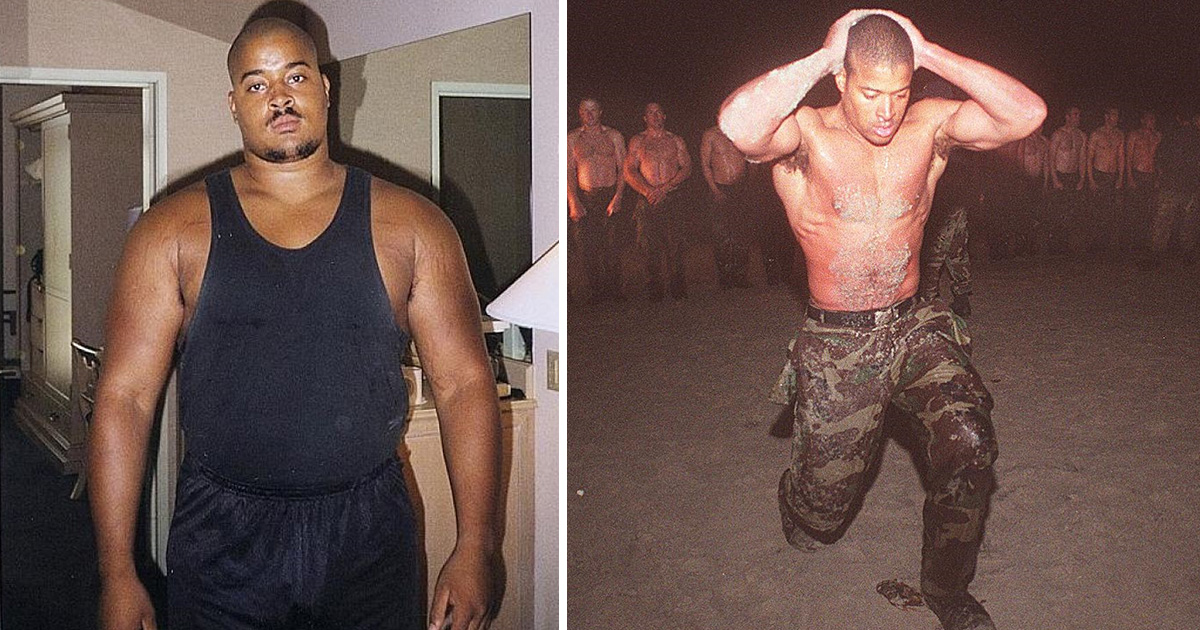
David Goggins (left) before Navy SEAL training and Goggins during Hell Week in BUD/S.
Becoming An Endurance Athlete
Goggins spent several years as a SEAL, but soon found himself craving new challenges. He searched for the toughest challenges known to man and found the Badwater 135, a 135-miles race through California’s Death Valley–one of the hottest places on Earth.
To even qualify for the Badwater race, the race organizers required Goggins to run in a 100-mile race. Although he had never run more than 26.2 miles before, Goggins accepted the challenge and signed up.
Through sheer motivation, willpower and incredible driver, Goggins finished the race in 19 hours, he even ran an extra mile to make sure the judges counted his laps correctly.
Goggins would later describe the race as the most pain he had ever experienced in his life–he was urinating brown piss from experiencing kidney failure and lost his bowel movement while running and defecated on himself. And yet, he would also remember that race as the moment his life changed forever–if he could run a 100-mile race with no training, he could do anything.
Goggins would go on to compete in the Badwater 135 and finish in 5th place, completing the race in 30 hours. He continued to look for the most difficult challenges he could find–he competed in Ironman triathlons, ultra marathons, and even broke the world record for pull-up attempts.
“Talent wasn’t required for this sport. It was all about heart and hard work, and it delivered relentless challenge after relentless challenge, always demanding more.”
Be Like Goggins
Several times throughout the book Goggins admits to readers that he wasn’t born strong, smart or with a hard work ethic. Early on in his life, he took the easy way out by cheating in school, running away from his fears and taking the easy way out as much as possible.
And where did that get him? Nowhere.
Goggins shares that it is only when changed his mindset and realized that the key to success was working harder than anyone else, did his life change for the better.
The secret to Goggins’ accomplishments is his willingess to work and suffer. By punishing himself physically, Goggins was also able to push himself mentally and vice-versa.
Goggins says that too many people get comfortable in their lives, they start to make excuses for working hard, such as not having time to exercise, or even worse, they simply decide not to. But Goggins doesn’t accept excuses.
Goggins didn’t make the excuse of not having time to train when he had a full-time job as a SEAL, he made time to train.
Goggins would get up at 4 A.M. and go for a 6-10 mile run. He would be home by 5:15 A.M., shower and eat breakfast. He would then bike 25 miles to work and arrive at his desk by 7:30 A.M. He would work till lunch time, and lift weights during his break. Once he was done with his day job, he would bike another 25 miles and arrive home at 7 P.M.
“My work ethic is the single most important factor in all of my accomplishments. Everything else is secondary.””
As Goggins says, most people program themselves to seek comfort, carve out safe spaces and spend as little time possible doing things that are hard or straight up suck. Although these things may feel good temporary, in the long-term it makes people weak.
Towards the end of the book, Goggins tells readers to ask themselves one question, “What if?”
Just as Goggins asked himself,
What if I lost 100 pounds in 3 months?
What if a kid afraid of water became a Navy SEAL?
What if I ran 100 miles without any training?
What if you set out to do a so-called impossible goal and actually completed it.
So ask yourself, “What if?”
Book Review:
“Can’t Hurt Me” by David Goggins might be my favorite book of 2019 and the year isn’t even halfway over. David’s story is beyond amazing, if one were to simply look at his achievements, you would took the guy isn’t human. But after reading his book, you realize he is just as human as everyone of us–except he simply chooses to strive for excellence and challenge himself over and over again.
Words cannot convey of important and inspiring this book is–I read the book, listened to the audiobook (which I recommend because Goggins shares bonus stories on the audio version) and watched dozens of podcasts about Goggins, and yet I’m still blown away him.
Just from reading his book, I’ve been motivated to run 5 miles every week–I’ve ran in 20 degree weather, in the snow and in the rain, and have been doing so for almost 4 months now. I’ve even signed up for several races.
This book will motivate you to push yourself to a new level and will make you a better person because of it. Get it, read it and learn from it!
Rating: 5/5
If you’re interested in getting the book, click here or on the image below.

After reading 100+ books, which ones do I recommend? Find out here.
Please consider supporting A&B or signing up for our monthly newsletter. Thank you!

5 Book Bloggers Share Their 10 Favorite Books
Are you looking for book recommendations?
In this article, 5 awesome book bloggers share their 10 favorite books.
This is a must-read article!
One of the best things about the internet is that you get to find and connect with people who share similar passions.
When I first started blogging about books, I thought almost no one else was doing the same, but I soon found several awesome book bloggers that all had the same mission–to encourage people to read books and never stop learning.
So I thought, why not have book bloggers come together and share their favorite books so that readers can get a wide range of recommendations from trusted bloggers whom collectively, have reads hundreds or perhaps even thousands of books.
Now without further ado, here are 5 book bloggers and their 10 favorite books (no specific order):
1) BookMattic

Matt Hutson helps people find meaning through reading nonfiction books. He started doing Personal Development English Lessons with several clients throughout Indonesia and plans on taking on more clients around the world. He believes that the more people develop themselves the better our world will become.
Instagram: @bookmattic & website: bookmattic.com
10 Favorite Books:
“Think & Grow Rich” - Napoleon Hill
“This essential book works on your subconscious mind and mindset so you can become successful at anything you do.”
“The Four Agreements” - Don Miguel Ruiz
“Be impeccable with your word, don’t take things personally, don’t make assumptions, and always do your best are the four agreements that will help you to get out of your own head so you can live how you want, when you want and where you want.”
“The Power of Now” - Eckhart Tolle
“Live in the now, be one with yourself and everything else.”
“The Power of Habit” - Charles Duhigg
“Want to know how to change any bad habit to become a good one? This book tells you exactly how habits make up most of your life and that if you have the right habits you can become extremely successful.”
“Man’s Search For Meaning” - Viktor Frankl
“A WWII holocaust survivor of four death camps explains what kept him alive and how we can overcome any pains in our life no matter how hard.”
“The Alchemist” - Paulo Coelho
“This is a mystical fiction book filled with truths on how to find your purpose in life. It’s short, sweet and inspiring.”
“Start With Why” - Simon Sinek
“You have a purpose driving you even if you don’t know what it is yet. This book helped me to find mine.”
“The Storyteller’s Secret” - Sejal Badani
“Communication skills will only get more important as AI takes over many jobs. Why not learn how to communicate like the masters do by learning how to tell stories just like Malala or Steve Jobs?”
“Building a StoryBrand” - Donald Miller
“Hands down the best marketing book for businesses who want to solve a major problem in their customer’s life”
“If you have a business online or a storefront you need to know how to sell your product or services. Cadence explains simply how to create a sales funnel that will work.”
2) Books of Titans

Erik Rostad started the Books of Titans reading project because he needed help finding the best books. He found out what some of the world's top performers were reading and then started reading those 52 of those books each year. He now helps others find great books and create their own reading plans so they can experience the joy of reading.
Instagram: @booksoftitans & website: booksoftitans.com
10 Favorite Books:
“Crime and Punishment” - Fyodor Dostoyevsky
“This was the first classic novel I read by choice (as opposed to be assigned to read in school) and it opened my eyes to the power of literature.”
“I read it nearly every morning. This book has had the most impact on the direction of my life.”
“Man’s Search For Meaning” - Viktor Frankl
“I've read 100+ books since 2017 for the Books of Titans reading project and this is my favorite book so far.”
“Thinking, Fast and Slow” - Daniel Kahneman
“This is a foundational book and many of the newer non-fiction books relate back to this. Some books take what they learn from this book and apply it to a particular field.”
“Guns, Germs, and Steel” - Jared Diamond
“Another foundational book that provides a framework for considering major historical movements.”
“Start With Why” - Simon Sinek
“People don't care about what you do - they care about why you do it. This transformed how I run my business and help my customers.”
“Born to Run” - Christopher McDougall
“As a runner, this book opened my eyes to new possibilities I never thought possible. I am a better runner today because of this book.”
“The Sacred Romance” - John Eldredge
“I call this my hinge book. My entire library "hinges" upon reading this book. I read it in 1998. It talks about grand story narratives found in novels, movies, and other art, and how they relate to the Christian story. This made me want to begin reading more to see examples in the major works of literature.”
“Les Miserables” - Victor Hugo
“An unbelievable novel of love, war, pain, redemption.”
“The World is Flat” - Thomas Friedman
“I include this book because of its impact in my life. This book convinced me that I needed more education. I went to graduate school as a direct result of reading this book in 2004.”
3) Get Better With Books

Get Better With Books is an online resource dedicated to personal development book readers. Jim (founder) is 31, works in software sales and lives outside Boston with his wife and baby daughter.
Instagram: @getbetterwithbooks
10 Favorite Books:
“How To Win Friends & Influence People” - Dale Carnegie
“Common sense approach for positive personal interactions with others.”
"Rich Dad Poor Dad" - Robert Kiyosaki
“The holy grail of personal finance. While the topics are simple, the concepts are life changing.”
“Arguably the best memoir on entrepreneurship. Beautifully written, packed with lessons for anyone building something from scratch.”
“The Road to Character” - David Brooks
“Thoughtful read that emphasizes the importance of virtues like courage, kindness and empathy.”
“Flow” - Mihaly Csikszentmihalyi
“Brilliant book that describes how happiness works and how we can cultivate it within.”
“Where Men Win Glory” - Jon Krakauer
“Tragic story of Pat Tillman, former NFL star turned US Army hero post 9/11. Vibrant detail and emotion.”
“Watership Down” - Richard Adams
“Classic story about courage, camaraderie, and a journey against all odds.”
“Gripping story of the first trans-Antarctic voyage in 1914. Amazing feat of courage and leadership.”
“Awaken The Giant Within” - Tony Robbins
“Personal development powerhouse.”
“As A Man Thinketh” - James Allen
“Simple and profound process for positivity changing your thoughts.”
4) Timos Notes

My name is Timo, I'm 20 years old and from Germany. I'm currently studying E-Commerce. Ever since I was a little child I loved books. About three years ago I fell in love with personal development and other non-fiction books. One of my favorite genres is biographies.
Instagram: @timosnotes & website: timosnotes.com
10 Favorite Books:
"Rich Dad Poor Dad" - Robert Kiyosaki
“It’s the perfect book to learn the basics of personal finance and start your financial education.”
"Sleep Smarter" - Shawn Stevenson
“This book opened my eyes to the importance of sleep and that we should´nt sacrifice it.”
“Cadence teaches a simple strategy to make your business more profitable, packed in a catchy story.”
“The Alchemist” - Paulo Coelho
“A classic book and a great story, encouraging the reader to chase his or her dreams.”
“Think & Grow Rich” - Napoleon Hill
“One of the best personal development books of all time, teaching you what it takes to be successful.”
"How to Win Friends and Influence People" - Dale Carnegie
“Dale Carnegie teaches you the basics of communication and how to make others feel good about themselves.”
“It blew my mind how George Orwell kind of saw the direction in which our world is heading, back in 1949.”
"Long Walk to Freedom" - Nelson Mandela
“Mandela’s autobiography shows how much he sacrificed for his beliefs and goals, without ever giving in.”
"Can't Hurt Me" - David Goggins
“Probably the most inspiring story I have ever read. Goggins doesn’t just tell you, he shows you, that we are capable of achieving more than we could ever imagine.”
5) Alex & Books

I started Alex and Books because I discovered the incredible value of books, but saw that almost no one I knew read them or took advantage of the treasure trove of important information inside them. So I set out on a mission to read the best books, find key lessons from each one and share them with as much people as possible. On my site, you can find book summaries, lessons, reviews and more great content.
Instagram: @AlexandBooks & website: alexandbooks.com
10 Favorite Books:
“Discipline Equals Freedom” - Jocko Willink
“The more discipline you have in life, the more freedom you’ll have. Wise lessons from a retired Navy SEAL Lieutenant commander.”
“Probably the best book I have ever read on productivity and creating good habits.”
“Extreme Ownership” - Jocko Willink
“Stop blaming the world, by taking extreme ownership of your life you will be able to fix it–no one is doing to do it for you.”
“The Emperor’s Handbook” - Marcus Aurelius
“Aurelius was a wealthy and incredibly powerful Roman emperor that lived a good and just life without corrupting himself and teaches others how to do the same.”
“By changing your mindset, you can quite literally change your life.”
“This book completely changed the way I look at businesses and startups.”
“How To Win Friends & Influence People” - Dale Carnegie
“A must-read book for people who want to improve their social relationships and understand people.”
“Man’s Search for Meaning” - Viktor Frankl
“Viktor Frankl was able to survive and find meaning in Auschwitz, he teaches readers how he endured the camps and how people can find meaning in life.”
“Can’t Hurt Me” - David Goggins
“Probably the most inspiring autobiography I’ve ever read, Goggins pushes his body to incredible limits such as breaking the world pull-up record and running 120+ mile races.”
“12 Rules for Life” - Jordan Peterson
“Perhaps my all-time favorite book, it combines religion, philosophy, psychology and other sciences that teach you if you want to improve the world, the best way to start is by improving yourself.”
Thank you everyone for reading this article. I hope it inspires you to find a fantastic book and to keep learning. Just as the books above have changed the lives of myself and fellow book bloggers, perhaps it will do the same for you.
Read on!
After reading 100+ books, here are my favorite books by genre:
Please consider supporting A&B or signing up for our monthly newsletter. Thank you!

"Write Your Book In A Flash" by Dan Janal
Book summary and lessons from "Write Your Book In A Flash" by Dan Janal
Learn how to outline your book, overcome imposter syndrome and more.
Dan Janal has written more than a dozen book and is an award-winning reporter and editor.
Book Summary:
“Write Your Book in a Flash: A Paint-by-Numbers System to Write the Book of Your Dreams—FAST!” by Dan Janal provides readers with an easy to follow step-by-step guide on how to write a non-fiction business book.
Janal gives readers a clear system for writing a book and provides several examples along the way. Whether you are a business executive, thought leader or entrepreneur, this book will act as your personal Virgil and show you the path to finishing that book you’ve always wanted to share with the world.
Here are a few lessons the book teaches readers:
How to write a simple outline that makes the writing process faster and easier
How to research interesting ideas, stories, and facts so you never run out of ideas or information
How to overcome “The Imposter Syndrome” and other limiting beliefs that stifle nearly every would be author
And much, much more.

Author Dan Janal (source).
Dan Janal has written more than a dozen books. He is an award-winning daily newspaper reporter and business newspaper editor. He holds a master’s degrees in journalism from Northwestern University’s famed Medill School of Journalism.
Book Lessons:
1) How to overcome imposter syndrome
“It’s not unusual for an author to suffer from a horrible condition known as Imposter Syndrome. Even highly successful people in business and education think they are not worthy of success because there is someone better out there.”
It is not uncommon for first-time writers to feel like imposters. They might think that there are better writers or smarter people in the world which is true, but that doesn’t mean you yourself aren’t smart or can’t write.
You don’t have to be the smartest person in the world or write like Hemingway to be an author, if that were true almost no one would write books.
Author Dan Janal says that even Lin-Manuel Miranda, the creator of the hit show “Hamilton” dealt with Imposter Syndrome. He said: “Anytime you write something, you go through so many phases. You go through the ‘I’m a fraud’ phase. You go through the ‘I’ll never finish’ phase.”
And if you truly are a rotten writer, you can always hire a writing coach to guide you through the process, work with a ghostwriter or have a professional editor look over your drafts.
2) How to overcome limiting beliefs
“Here’s a wonderful exercise to overcome limiting beliefs...Think of a limiting belief, and write it in the space below. Think of five reasons why this belief is not true, and write them in the spaces below.”
Another obstacle writers will face on their journey to create a book is the self-doubt and limits they put on themselves.
A writer might have the belief that they don’t have anything to say. If this or another limiting belief pops into your mind, Janal recommends that you come up with 5 reasons that prove the opposite.
“I write a blog every week, so I must have something to say.”
“People respond to my blogs, so they must like what I say.”
“My blog readers ask if I’m writing a book.”
And so on.
Another limiting belief is “I don’t have time to write a book.”
Here is what Janal says:
“I can wake up an hour earlier to write.”
“Instead of watching TV, I can write.”
“I can go to sleep an hour later and use that time to write.”
“I can write while I’m waiting for my kids to finish their soccer practice.”
“I can hire a ghostwriter or work with a book coach.”
If you ever find yourself in a situation where self-doubt or limiting belief start taking over your head, remember to list 5 things you can do to overcome that limiting belief.
3) How to finish and edit your first draft
“The research is the easiest. The outline is the most fun. The first draft is the hardest because every word of the outline has to be fleshed out. -Ken Follett
”
When it comes to finishing your first draft, the most important part is getting it done.
As Janal writes, “It doesn’t have to be perfect. It doesn’t have to look pretty. It doesn’t even need to have all your facts and stories. It just has to get done.”
Janal says that writers shouldn’t expect their first draft to be a masterpiece. In fact, many of his first drafts are disorganized and filled with holes, but that is okay.
Like Anne Lamott, the author of “Bird by Bird” the classic book about writing, said, all first drafts are “shitty first drafts.”
However, it is only once you’ve completed the first draft that you can begin cleaning and polishing it.
That is where editing comes in.
But remember that writing and editing are two separate activities.
Jean Feingold, the author of “The Benefits of Concrete Block Homes” said:
““Don’t edit while you write. Writing and editing are two different activities. Just keep writing as long as ideas come to you. When you reach a stopping point, go back, run spell-check, correct any grammatical errors, and repair any holes in your thinking. This first edit is only designed to fix the rough edges. You will do many more edits before your book is ready for people to read.” ”
During the editing process, your aim should be to cut useless words that dilute your message.
It may be hard to cut words after putting in the time and sweat to write them, but Janal assures writers that it will make their book better.
Janal says that for “Write Your Book In A Flash” he cut more than a thousand words from the first draft.
Here are a few editing tips:
“That” can usually be removed. If it sounds good without it, cut it.
The same goes for the word “the” and “of.”
You can usually cut words like very, just, and only.
Janal writes that a typical editor can cut 2-3% of your draft. However, it is important to remember that editing occurs multiple times on the road to publishing. As Feingold wrote above, “You will do many more edits before your book is ready for people to read.”
So finish your first draft and get to editing!
Conclusion:
“Write Your Book in a Flash” does an excellent job of providing readers with a proven system for writing a business book. It doesn’t debate the pros and cons of self-publishing and traditional publishing, but instead, it shows people how to write the book that always wanted to share with the world.
The book answers many questions first-time authors will have, such as how to outline their book and overcome imposter syndrome. Janal provides exercises to empower novice authors and examples to help readers who may be stuck in a rut.
Overall, if you’re someone who would like to write a non-fiction business book, this book is worth picking up.
Rating: 4/5
If you’re interested in getting the book, click here or on the images below.

Learn more about Dan Janal here:
Here are a few similar books:
After reading 100+ books, here are the books I recommend reading.
Please consider supporting A&B or signing up for our monthly newsletter. Thank you!

"Tribe" by Sebastian Junger
Book summary and lessons from "Tribe: On Homecoming and Belonging” by Sebastian Junger.
Learn why being richer doesn’t equal being happier, why war boosts mental health and why soldiers miss war.
A fantastic book about tribes, PTSD, war and more.
Book Summary:
The book “Tribe: On Homecoming and Belonging” by Sebastian Junger combines history, psychology, and anthropology, to explore what people can learn from tribal societies about loyalty, belonging, and the eternal human quest for meaning.
“Tribe” explains the irony that-for many veterans as well as civilians–war feels better than peace, adversity can turn out to be a blessing, and disasters are sometimes remembered more fondly than weddings or tropical vacations. It also explains why people are stronger when they come together, and how that can be achieved even in today's divided world.

Sebastian Junger is a New York Times bestselling author of Tribe, War, The Perfect Storm, Fire, and A Death in Belmont.
Book Lessons:
1) Richer doesn’t often equal happier
“People in countries with large income disparities–like the United States–run a much higher lifelong risk of developing severe mood disorders. ”
Most people assume that as a country gets richer, it’s citizens get happier.
While there is some truth in that belief, it’s also true that “people in wealthy countries suffer depression at as much as eight times the rate they do in poor countries, and people in countries with large income disparities–like the United States–run a much higher lifelong risk of developing severe mood disorders” (20).
And it gets worse, “urban North American women–the most affluent demographic of the study–were the most likely to experience depression.”
Why is this the case?
Poor people tend to share their time and resources with one another more often while wealthy people often isolate themselves which can lead to a “greatly increaded risk of depression and suicide” (21).
The same effect can be seen in the legal profession.
More than 6,000 lawyers were surveyed in 2015 and the study found that successful lawyers (those with the most billable hours) had zero correlation with levels of happiness and well-being reported by the lawyers themselves. “In fact, public defenders, who have far lower status than corporate lawyers, seem to lead significantly happier lives.”
Another interesting fact is that “Mexicans born in the United States are wealthier than Mexicans born in Mexico but far more likely to suffer from depression” (22).
However, the deeper one dives into the subject, it becomes clear that it’s not the war military members miss, but the feeling of being in an incredibly tight-knit tribe.
Why do wealthier countries and people tend to be less happy?
It’s because modern society seems to emphasize extrinsic values (money, status, beauty) over intrinsic ones (family, relationships, well-being).
Instead of chasing wealth, people should aim for the three basic needs described by self-determination theory:
The need to feel competent at what they do
The need to feel authentic in their lives
The need to feel connected to others
2) How war boosts mental health
“Communities that have been devastated by natural or man-made disasters almost never lapse into chaos and disorder; if anything, they become more just, more egalitarian, and more deliberately fair to individuals. ”
During World War II, English authorities predicted that German attacks would produce 35,000 casualties a day in London alone.
During the war, waves of German bombers flew over London for 57 consecutive days and dropped thousands of tons of explosives, killing hundreds of people at a time.
London residents would see the dead lying in ruble or watch as a bomb vanquished dozens of people in seconds.
And yet, there was no mass hysteria or widespread mental illnesses. “Psychiatric hospitals around the country saw admissions go down...admissions to psychiatric wards noticeably declined, and even epileptics reported having fewer seizures.” (47-48).
These positive effects of war on mental health weren’t just in England, “when European countries went to war, suicide rates dropped. Psychiatric wards in Paris were strangely empty during both world wars, and that remained true even as the German army rolled into the city in 1940” (48).
One possible explanation for this phenomenon is that “When people are actively engaged in a cause their lives have more purpose...with a resulting improvement in mental health” (49).
Interestingly, just a bombing London didn’t slow down its citizens when the Allies bombed the Germans, they found that “Industrial production actually rose in Germany during the war. And the cities with the highest morale were the ones...that were bombed the hardest” (51).
This doesn’t mean violence is the answer to improving mental health, but it does show that people feel better when they have more involvement with their community and a clear purpose.
3) Why soldiers often miss war
“In combat, soldiers all but ignore differences of race, religion, and politics within their platoon. It’s no wonder many of them get so depressed when they come home.”
War is a paradox. It is a complex operation, but it also simple to understand.
There are the “good guys” and “bad guys.” As Junger notes, in combat, it doesn’t matter what skin color or political views a soldier holds, as long as he’s on your side, he’s part of the team.
However back in the United States, people divide themselves among political parties, religion, and other ideologies.
In the war, there is also a strong sense of a tribe. Soldiers are constantly with one another, they eat together, they work together, they sleep near several other soldiers, rarely is one alone.
The tribal bond is so strong that in times of extreme combat, a soldier may risk his life or sacrifice himself to save his brothers. But when these men return from war and enter the civilian world, that tribal bond is no longer there.
Junger brilliantly explains this feeling by saying, “Soldiers experience this tribal way of thinking at war, but when they come home they realize that the tribe they were actually fighting for wasn’t their country, it was their unit” (110).
Conclusion:
“Tribe: On Homecoming and Belonging” by Sebastian Junger finally explains the many paradoxes about war and soldiers.
By combining history, psychology and personal experiences, Junger teaches readers the many lessons of why people seek belonging and crave the chance to be part of a strong and connected tribe.
The book shines light and the positive effects of war, why PTSD develops and how to best combat it, and how people can come together in today’s divided world.
This book is a must read for anyone who has served in the military, knows someone with PTSD or is looking to learn more about war and soldiers.
Rating: 4.5/5
If you’re interested in getting the book, click here or on the images below.


After reading 100+ books, find my most recommended books here.
Please consider supporting A&B or signing up for our monthly newsletter. Thank you!

The Best Quotes from "The Alchemist" by Paul Coelho
Book summary and my favorite quotes from “The Alchemist” by Paulo Coelho
At 197 pages, this book can be read quickly in as little as two or three days.
However, the passages you read from this book will likely stick with you for years or decades to come.
Book Summary:
The book tells the magical story of Santiago, a shepherd boy who longs to travel in search of a worldly treasure. Santiago experiences a recurring dream of a great treasure hidden thousands of miles away at the base of the Egyptian Pyramids.
Along the way, he meets a Gypsy woman, a man who calls himself a king, and an alchemist, all of whom point Santiago in the direction of his quest. No one knows exactly what the treasure is or if Santiago will be able to overcome the obstacles on his path.
Early into his journey, Santiago finds himself in a town where he doesn’t speak the language, is robbed and left completely alone. He contemplates giving up and turning around, but decides to carry on. He finds a job in a crystal shop and saves up money to return home, but then decides to risk it and continue his quest for the treasure.
Santiago meets a girl named Fatima who he falls in love with but must leave her to continue his journey. On his way to the pyramids, Santiago is taken prisoner by a local tribe. Santiago’s friend on this journey, tells the tribesmen that Santiago is a powerful magician and then tribe offers to set them free if he can prove it.
Santiago then asks the elements (stick with me here) to help him turn himself into the wind (yes, the wind) and somehow does it. This scares the tribesmen so they free Santiago and his friend.
Santiago finally makes his way to the Pyramid and finds some gold when he is attacked by robbers. When asked what he is doing there, Santiago replies that he had a dream of a treasure buried at the base of the Pyramids. One of the robbers laughs at him, and mentions that he has had the exact same dream, except that in his dream, the treasure was buried in an abandoned church in Spain (which is where Santiago first started his journey).
The story then jumps forward in time and finds Santiago digging a hole at the base of the tree where he had had his first dream. Sure enough, he finds a trunk full of gold–enough for him and Fatima to live happily for a long time.
The book is essentially a tale of the journey being equally important as the end goal, because of all the experiences and lessons one learns throughout their quest. Just like Santiago, the book encourages readers to find and pursue their life purpose, no matter how discouraged they may at times feel.
Santiago shows readers how to earn to trust their hearts, read the seemingly inconspicuous signs, and understand that as we look to fulfill a dream, the universe works with us to do the same.

Author Paulo Coelho.
Book Quotes:
The “The Alchemist” by Paulo Coelho was published over 25 years ago and has sold over 65 million copies to date. Although every reader will have their own opinion of what they enjoyed about the book, here are my personal favorite quotes from it:
“The problem is that they don’t even realize that they’re walking a new road every day. They don’t see that the fields are new and the seasons change. All they think about is food and water. Maybe we’re all that way, the boy mused.”
““What’s the world’s greatest lie?” the boy asked, completely surprised. “It’s this: that at a certain point in our lives, we lose control of what’s happening to us, and our lives become controlled by fate. That’s the world’s greatest lie.” ”
“People say strange things, the boy thought. Sometimes it’s better to be with the sheep, who don’t say anything. And better still to be alone with one’s books. They tell their incredible stories at the time when you want to hear them. But when you’re talking to people, they say some things that are so strange that you don’t know how to continue the conversation.”
““When you want something, all of the universe conspires in helping you to achieve it,” he had said.”
““I don’t want to change anything, because I don’t know how to deal with change. I’m used to the way I am.””
““When someone makes a decision, he is really diving into a strong current that will carry him to places he had never dreamed of when he first made the decision.” ”
““In pursuit of the dream, he was being constantly subjected to tests of his persistence and courage.” ”
““People are afraid to pursue their most important dreams, because they feel that they don’t deserve them, or that they’ll be unable to achieve them.” ”
““The world we live in will be either better or worse, depending on whether we become better or worse. And that’s where the power of love comes in. Because when we love, we always strive to become better than we are.”
”
Conclusion:
“The Alchemist” by Paulo Coelho is an enjoyable fiction book that anyone can understand. At first, the story may seem too simple: a boy leaves home on a quest to find treasure, encounters foes and friends, gets his treasure stolen by thieves, but then realizes the real treasure was right where he started.
And it is true, the story is simple. But perhaps that is what makes this book loved by millions of readers. A simple story with simple lessons that can be applied to anyone’s life.
Lessons such as: Life is about the journey, follow your dreams, it may not be easy but it will be worth it, what you’re seeking is also seeking you, and many more.
At 197 pages, this book can be read quickly in as little as two or three days. However, the passages you read from this book will likely stick with you for years or decades to come.
Rating: 4.5/5
If you’re interested in getting the book, click here or on the image below.

For just a few dollars, a book can give you an enormous amount of valuable information that can help you improve your life. It’s practically highway-robbery. So take advantage of this and read as much as you can.
If you want to check out my list of recommended books, you can find that here.
If you enjoyed this article, consider supporting our site or signing up for our monthly newsletter. Thank you!

Unit 731: A book about evil and war crimes
“Unit 731 Testimony: Japan's Wartime Human Experimentation Program” by Hal Gold is a disturbing account of a top secret project named Unit 731.
The Unit conducted some of the most unethical and brutal human experiments during World War II.
Although this book is horrific, one must learn from the past in order to prevent it from happening again.
Book Summary:
“Unit 731 Testimony: Japan's Wartime Human Experimentation Program” by Hal Gold is a disturbing account of a top secret project named Unit 731, which conducted some of the most unethical and brutal human experiments during World War II.
Many people know about the battles and bombs dropped during the Second World War, but almost no one has heard of the cruel deeds performed by Japanese doctors and soldiers in Japan’s medical wards where prisoners were treated as human guinea pigs and underwent gruesome medical experiments.

The book is split up in two parts.
The first part retells the story of Japan’s history and involvement in WWII and how Japanese doctors went from fighting biowarfare to running experiments on humans in their own Unit 731 testing labs. The second half of the book involves interviews with actual former Unit 731 members themselves, who recount memories of cutting open pregnant women to injecting plague germs into healthy farmers.
Author Bio:
Hal Gold (1929 – 2009) was a writer, historian, critic, and long-time Kyoto resident. He lived in Kyoto for over 30 years, and was a well-known writer on Japan-related subjects.

Author Hal Gold (1929-2009).
Book Lessons:
1) The Start of an Evil Genius
“The middle makes and breaks you, and ending up on the right side of this line depends on how you manage everything in between. It requires immense perseverance, self-awareness, craftsmanship, and strategy.
”
Shiro Ishii was born on June 25, 1892 in a small village two hours from Tokyo.
He went on to study at the prestigious Kyoto Imperial University and earned awards from the United States and Europe for his work. He also received his Doctorate of Medicine in 1911.
Ishii studied bacteriology for his postgraduate work and married the school president’s daughter.
He also enlisted in the army and quickly rose to a lieutenant.
It was clear Ishii was a gifted and smart young man with a bright future.
Yet, about two years later, he responsible for running Unit 731, a “prison camp” that was used to develop biological and chemical weapons that were tested on prisoners.
When Ishii learned about the Geneva Convention of 1925, which prohibited biological and chemical warfare, he was encouraged by this notion since if something were “bad enough to be outlawed, then it must certainly be effective.”
However, just as it took years for Hitler to gain power and create the concentration camps, Ishii too played the long game.
By the 1930s, Japan was expanding its power on to the Asian mainland and the military needed to figure out ways to prevent diseases infecting their troops.
Ishii also worked on turning bacteria and gas into weapons, but animal research had serious limits in producing usable data.
Then in 1933, Japan withdrew from the League of Nations, which had judged it wrong for its aggression against China. This severance of ties would play a big role in the creation of Unit 731 since the country no longer had promises to keep.
During this time, Japan’s Emperor had created a special police force called like kenpeitai, much like the Nazi SS or the Soviet NKVD.
Groups or individuals responsible for anti-Japanese resistance, were quickly captured by the kenpeitai. They were given jobs such as catching spies and interrogating suspects, and were “authorized to use torture” (pg 30).
All of the pieces were slowly falling into place.

Ishii in 1932. (Photo: Wiki)
2) The start of unit 731
As Japanese troops moved into Manchuria, they were concerned about a clash with Soviet troops along the Soviet-Manchurian border.
Ishii planned to use his specialty to overcome his side’s disadvantage.
In the city of Harbin, he set up a facility to focus on vaccines and other proper medical research. It would serve as a facade of goodwork.
However, about 100 kilometers to the South, he and his troops cleared out a local village and had Chinese laborers build a military complex. It was officially known as the Epidemic Prevention and Water Purification Department of the Kwantung Army, but later adopted the name Unit 731.
The laborers were paid almost nothing for their work, and one man reported that all of the workers were killed after the project was finished.
Once completed, the complex kept around 500 to 600 prisoners. Many of whom were treated well and were given rice, meat and vegetables.
Why?
A normal state of health would provide the most accurate data for their experiments.
However, the life expectancy at the prison was a maximum of one month…

The Unit 731 complex: two prisons are hidden in the center of the main building. Photo: Wiki
3) Prisoners used into experiments (women & children too)
“In the process of building a business–and in life, generally–you should manage expenses carefully. But sometimes frugality backfires.
”
Some prisoners had large amounts of blood taken every two or three days. This went on and on, while scientists kept careful records, until the prisoner was literally drained to death. Others, were injected with poison to see how they would react.
Other experiments were also performed on prisoners, including vivisections, which involved infecting a prisoner with a disease and then cutting them open while they were alive and without anesthesia, to study the effects of the disease. Patients were kept alive because the scientists thought it would give more accurate results.
For more research, several new satellite facilities were built in Xinjing, Beijing, Singapore and other locations.
Outdoor tests of plague, cholera and other pathogens were dropped on subjects while they were tied to crosses. Rats and fleas were raised for experiments to spread diseases and released in local villages.
One satellite facility had a large refrigerator la where subjects had their flesh frozen over and over again. Others used prisoners as bayonet practice for young soldiers.
One of the worst experiments performed was forcing a healthy prisoner to have sex with one who had syphilis. Anyone resisting would be shot. Researchers would track the infection progress every week, and employed live dissection on the infect patient to investigate how their internal organs were affected by the disease.
Countless more horrible experiments were performed in Unit 731. As Japan began losing the second World War, a secret order was issued to perform more vivisections to gather as much research as possible.
It’s estimated that over 10,000 people were killed during the 10 years Unit 731 and its sister facilities were in operation.

Unit 731 studied anthrax, cholera, and other pathogens by forcibly infecting victims. They experimented with the bubonic plague and tried to weaponize it by using infected fleas and various delivery systems. (Photo: Pixnio)
4) No justice for victims
You might be wondering how the scientists and guards of Unit 731 were punished for their crimes after Japan lost the war.
After WWII, Nazi leaders were charged with crimes and sent to the Nuremberg trials. But for Ishii and his fellow researchers, they were given a get out of jail free card.
The researchers involved in Unit 731 were secretly given immunity by the U.S. in exchange for the data they gathered through human experimentation.
Why were the members of Unit 731 granted immunity?
The U.S. believed that the research data was valuable, and did not want other nations (particularly the Soviet Union) to acquire data on biological weapons.
Conclusion:
“Unit 731 Testimony: Japan's Wartime Human Experimentation Program” by Hal Gold is a disturbing book to say the least. But it also serves as an important reminder to the world that life isn’t perfect.
The world can be a very dark and cruel place is people allow it. History will repeat itself if individuals don’t learn from the past and keep an eye out on the emergence of new evils.
Even today, similar concentration still exist around the world. For instance, the book, “The Aquariums of Pyongyang” by Chol-hwan, reveals the truth about North Korea’s concentration camps.
Although the things that happened in this book are horrific, it is important to learn about evil so that people will become aware of its existence, instead of turning a blind eye and pleading ignorance to a problem that still plagues the modern world.
Rating: Unrated
If you’re interested in getting the book, click here or on the image below.

Here are a few similar books to “Unit 731”:


For literally a few dollars and hours of time, a book will give you an enormous amount of valuable information that can help you in life. It’s practically highway-robbery. So take advantage of this and read as much as you can.
If you want to check out my list of recommended books, you can find that here.
If you enjoyed this article, consider supporting our site or signing up for our monthly newsletter. Thank you!

"Living with a SEAL (David Goggins)" by Jesse Itzler
What happens when a multi-millionaire invites a Navy SEAL to live with him for a month?
"Living with a SEAL (David Goggins)" by Jesse Itzler
A hilarious book on fitness, not making excuses and challenging yourself to improve.
Book Summary:
What do you get when you put a U.S. Navy SEAL and a millionaire entrepreneur in the same hous for a month?
Jesse Itzler, the book’s author, is a gritty entrepreneur who co-founded Marquis Jet (he later sold it to Berkshire Hathaway) and helped pioneer the coconut water craze with Zico coconut water (later acquired by Coca-Cola).
He is also married to Spanx founder (and now billionaire) Sara Blakely.
Itzler had it all.
Successful in just about every aspect of his life. However, he felt stuck in a routine.
Wake up, go to work, come home, have dinner, exercise, sleep. Then do it again.
“I wanted to get off it; I wanted to shake things up in a big way,” he writes.
And what better way to shake things up than by asking a SEAL to train you and push you to new limits.
That SEAL, we know now, is David Goggins.
Itzler was speechless when he saw Goggins (then weighing about 260 pounds) run a 100-mile race without any support staff, and he had to meet this incredible man.
Itzler ended up inviting Goggins to live with him in hopes of getting a bit of Goggins’ magic sauce.
Each day, Goggins came up with a new workout to show Itzler that he was nowhere near his potential. This included running with a 50-pound vest, doing 100 chin-ups in a row, swimming in a frozen lake, running 4 miles every 4 hours and much more.
By pushing Itzler physically, Goggins was also pushing him mentally.
Itzler thought many of the tasks where impossible, but by doing them, he realized his mind was playing it safe and was capable of doing more than he thought possible.
In addition to being about fitness and mental toughness, this book is also hilarious (look on the cover, Lebron James agrees). If you’re a fan of David Goggins or Jesse Itzler, you’ll enjoy this book.
Book Lessons:
1) Measure your foundation & track your progress
“If you don’t challenge yourself, you don’t know yourself.”
One of the first things SEAL (Goggins) did when training Itzler was giving him a fitness test and writing down all of his reps. It’s important to know where you are and what you’re capable of doing.
Once the foundation was set, Goggins started to push Itzler in all different types of workouts and at the end of each day, workout totals were jotted down.
After training with Goggins for a month, Itzler’s mile pace went from 9:20 to 7:50 (7 minutes and 50 seconds). A whole minute and a half faster per mile.
Here are Itzler’s workout totals:
222.5 miles run
6,488 push-ups
236 pull-ups
957 sit-ups
200 burpees
800 jumping jacks
50 box jumps
150 flutter kicks
14 fireman carries
Measure your current abilities and track progress every day to see concrete evidence of what you’ve done and how your performance has changed over time.
2) No one ever regrets a workout
“Every day is a challenge, otherwise it’s not a regular day.”
Goggins made Itzler do some crazy things:
Running in a snowstorm
Doing 100 burpees in the office
Jumping into a frozen lake
Jogging with a 50-pound vest
The list goes on…
Many of these workouts flat out sucked. A lot of them Itzler didn’t want to do and he even tells Goggins for him to write down “MISERABLE” in his journal during one workout.
However, Itzler never regretting working out.
He never said, “Man, I really wish I didn’t do 100 burpees today.”
Does Itzler complain that the workouts suck? Yes.
But, to be fair, many of the workouts would be extremely difficult for the average adult to complete and Itzler never said no to a workout.
Even after doing 100 burpees in a row, his legs shaking, but he couldn’t help but smile afterward.
Working out may suck, but no one ever regrets doing it.

Snowing? Cold? Tired? Doesn’t matter, when SEAL says it’s running time, it’s running time.
3) Excuses only exist if you make them
“Don’t get too comfortable. Ever.”
Have you heard these lines before or told yourself this?
I was going to exercise today, but:
It’s raining
It’s too cold out
It’s snowing
I’m sore
My shoulders hurt
I don’t have time today
I have to watch the kids tonight
Sound familiar? I know that I’ve said at least half of these lines to myself.
Here is the honest truth, when you tell yourself these “reasons” you can’t work out, no matter how “good” the reason is, it won’t help you reach your fitness goals. And, all of these reasons are actually excuses.
When Goggins and Itzler were traveling, Itzler didn’t pack an extra pack of underwear. Here is how that conversation goes:
Itzler: I didn’t bring any extra underwear.
Goggins: So what?
I: I can’t run without underwear.
G: Nah, bro, you can’t run without legs. It’s on.
Itzler ends up going “commando” style and the two go for an 8.3-mile run.
Whether it was raining, snowing, cold, windy, it didn’t matter to Goggins. They went running.
What happened when Itzler had to watch his kid? Goggins told Itzler to put the kid in a stroller and run with him. Goggins also gave Itzler a 50-pound vest for some extra fun.
You can have excuses or you can have results. Pick one.
Book Review:
This is one of the funniest books I’ve read. It’s two different worlds colliding, one from a strict, tough, military background, and the other from a business, luxury, laidback setting. And when two worlds collide, a lot of interesting things happen.
As a fitness book, Goggins no BS or excuses approach is inspirational. You won’t find workout plans or what foods to eat to get in shape, but you will learn not to make excuses, track your progress and to get creative with your workouts.
Goggins does curse a lot so this book may not be suitable for children, but if you’re an adult, you’ll find this book to be hilarious. It’s rare that I laugh out loud from reading a book, and yet this book made me do just that several times. You won’t find any deep life-changing lessons in this book, but if you’re looking for an entertaining book about fitness that will make you laugh one minute and motivate you to get off the couch and run the next, I highly recommend getting this book!
Rating: 4.5/5 Stars
If you’re interested in getting the book, click here or on the image below.

Here are a few similar fitness books:
For literally a few dollar a book will give you an enormous amount of valuable information that can help you in life. It’s practically highway-robbery. So take advantage of this and read as much as you can.
If you want to check out my list of recommended books, you can find that here.
If you enjoyed this article, consider supporting our site or signing up for our monthly newsletter. Thank you!

"The Monk Who Sold His Ferrari" by Robin Sharma
An inspiring tale about a rich lawyer that drops everything to pursue happiness and fulfillment.
Learn how to have a good mindset, why reading books is important and the 7 virtues of Enlightenment Living.
A great book for those seeking passion, purpose or peace.
Book Summary:
“The Monk Who Sold His Ferrari: A Fable About Fulfilling Your Dreams and Reaching Your Destiny” by Robin Sharma is an inspiring tale that provides a step-by-step approach to living with greater courage, balance, abundance and joy.
The book tells the extraordinary story of Julian Mantle, a lawyer forced to confront the spiritual crisis of his out-of-balance life, and the subsequent wisdom that he gains on a life-changing odyssey that enables him to create a life of passion, purpose and peace.
It teaches readers how to:
Follow Our Life's Mission and Calling
Cultivate Self-Discipline and Act Courageously
Value Time as Our Most Important Commodity
Live Fully, One Day at a Time
And more.
Author Bio:
Robin Sharma is one of the world's premier speakers on Leadership and Personal Mastery. For nearly 20 years, many of the most well-known organizations on the planet, ranging from Nike, GE, Microsoft and Oracle. Sharma has been ranked as one of the Top 5 Leadership Gurus in the World in an independent survey of over 22,000 businesspeople.

Book Lessons:
1) Search for the positive in every event
“No matter what happens to you in your life, you alone have the capacity to choose your response to it. When you form the habit of searching for the positive in every circumstance, your life will move into its highest dimensions.
”
In the book, the monk says that one’s outer world is a reflection of their inner world and that by controlling their thoughts, they can control the way they respond to events and thus begin to control their destiny.
Interestingly, the Chinese character for ‘crisis’ is comprised of two sub-characters: one that spells ‘danger’ and another that spells ‘opportunity.’
Every challenge, obstacle and hurdle may at first seem like a negative event, but it is actually an opportunity for you to grow as a person by overcoming it.
“From struggle comes strength. Even pain can be a wonderful teacher,” the author writes.
Negative experiences and mistakes aren’t all that bad if you look at them with a positive mindset and learn from the outcome.
“Every event offers you lessons. These little lessons fuel your inner and outer growth. Without them, you would be stuck on a plateau” (pg 47).
This mindset is quite similar to that of Jocko Willink, the best-selling author of several books and retired Navy SEAL of 20 years.
Bad experiences and events will happen in life. There is no way in avoiding it.
However, getting upset or depressed about it won’t improve the situation or make life better.
Instead, look at each experience and ask yourself, “What can I learn from this?” or “What is one positive takeaway from this event?”
When Jocko and his team had their operation canceled, he said “Good, more time to plan the next one.” Or when he didn’t get the new high-speed gear he wanted, he said: “Good, we can keep the mission simple.”
Look for the positive in every event.
2) Never stop learning
“It centers around the whole notion of lifelong learning and expanding your knowledge base for the good of yourself and all those around. ”
The author encourages readers to become lifelong students. Not only that, but he says that people must apply what they’ve learned.
Knowledge is only potential power, it must be put to use to provide actual benefits.
One of the best ways to learn is to read books. Read 30 minutes every day and it will do “wonders for you.” Read philosophy books, great literature and classical works. Read books about amazing humans who have accomplished incredible achievements.
Why is reading so important?
It’s because the answer to almost every problem can be found in a book. How to become a better lawyer, friend or lover, there are tons of books on these subjects. All the mistakes and problems modern day people face have likely been faced by people in the past who wrote books on the topic in order to help others.
“Read the right books. Learn how those who preceded you have handled the challenges you are currently facing. Apply their strategies for success and you will be astonished by the improvements you will note in your life” (pg 118).
3) The 7 Virtues of Enlightenment Living
#1) Master your mind
Cultivate your mind–it will blossom beyond your expectations.
The quality of your life is determined by the quality of your thoughts.
There are no mistakes–only lessons. See setbacks as opportunities for personal expansion and spiritual growth.
#2) Follow your purpose
The purpose of life is a life of purpose.
Discovering and then realizing your lifework brings lasting fulfillment.
Set clearly defined personal, professional and spiritual goals, and then have the courage to act on them.
#3) Practice kaizen
Self-master is the DNA of life mastery.
Success on the outside begins within.
Enlightenment comes through the consistent cultivation of your mind, body and soul.
#4) Live with discipline
Discipline is built by consistently performing small acts of courage.
The more you nurture the embryo of self-discipline, the more it will mature.
Willpower is the essential virtue of a fully actualized life.
#5) Respect your time
Time is your most precious commodity and it is non-renewable,
Focus on your priorities and maintain balance.
Simplify your life.
#6) Selflessly serve others
The quality of your life ultimately comes down to the quality of your contribution.
To cultivate the sacredness of each day, live to give.
By elevating the lives of others, your life reaches its highest dimensions.
#7) Embrace the present
Live in the “now.” Savor the gift of the present.
Never sacrifice happiness for achievement.
Savor the journey and live each day as your last.
Conclusion:
You’ve probably heard of the stereotypical story of the rich, high-powered lawyer who, although financially successful, is unhappy with his life. So, he drops everything and goes on a spiritual journey.
That is this book.
Today we see this story as a cliche: a rich person (CEO, lawyer, surgeon) who has a nice house, fancy car and expensive clothes, is unfulfilled in life so they sell everything and become a yoga teacher, priest or in this case, a monk.
Don’t get me wrong, this book is filled with great lessons and Sharma does an excellent job of telling a story and he gives readers lesson takeaways and action points. However, reading this book in 2018, it seems to be a bit dated. If I read this book 20 years ago when it was published, it would have gotten 5 out of 5 stars. For me personally, it’s not a life changing book, but it is still worth reading.
Rating: 4/5 Stars
If you’re interested in getting the book, click here or on the image below.

Here are a few similar books:


For literally a few dollar a book will give you an enormous amount of valuable information that can help you in life. It’s practically highway-robbery. So take advantage of this and read as much as you can.
If you want to check out my list of recommended books, you can find that here.
If you enjoyed this article, consider supporting our site or signing up for our monthly newsletter. Thank you!

"A Billion Wicked Thoughts" by Ogas & Gaddam
What can a billion internet searches tell us about sexual relationships?
Learn the difference between male and female desires.
Backed with real data, evolutionary psychology and extensive research, this book will change the way you look at the opposite sex.
Book Summary:
“A Billion Wicked Thoughts: What the Internet Tells Us About Sexual Relationships” by Ogi Ogas & Sai Gaddam explores the differences in male and female sexuality, human desire and attraction through extensive research into mountains of data provided by online searches.
The last great sex study was done in the 1950s and looked at about 18,000 people and found shocking results. In this book, neuroscientists Ogas and Gaddam examined over 400 million different searches and the search history of more than 650,000 people, providing a vastly more detailed and improved answer to the question, what do men and women really desire?
Here are a few lessons this book teaches readers:
What really turns men and women on
Why men love large breasts and butts
What makes the set up to a romantic evening so important for a woman
Why women’s desires are so hard to predict
And much, much more.

Author Bio:
Ogi Ogas studies computational models of memory, learning, and vision. He was a Department of Homeland Security Fellow. Ogi Ogas, Ph.D. He is the project head of the Dark Horse Project in the Laboratory for the Science of Individuality at the Harvard Graduate School of Education.
Sai Gaddam studies large-scale data analysis and serves as a data mining consultant in India. Sai conducted his doctoral research at Boston University on biologically inspired models of machine learning.

Authors Ogi Ogas (left) and Sai Gaddam.
Book Lessons:
1) Why men like large breasts and butts
“Visual cues trigger desire in men. If a man’s brain decides a picture is arousing, he swiftly experiences physical and psychological arousal.
”
What cues do men specifically desire?
Breasts, hips and butts are the main cues, along with feet and feminine facial features.
The authors write that across many species (humans included), more attractive female parts are associated with greater health, fertility, and offspring survival. These body parts also signal to a man how many years of healthy childbearing remain in a woman’s lifetime.
Interestingly, all of the things men are attracted to are influenced by the same molecule: Estrogen.
Why estrogen?
“Unhealthy and underfed women produce less estrogen and therefore may not be able to bear children, or may bear unhealthy children” (pg 56). It also indicates if she is getting enough to eat and how much stress she is experiencing.
In addition to estrogen, women need a specific kind of female-only fat called gynoid fat that supports the energy demands of pregnancy and lactation. This fat is also only used during childbearing.
And where is the gynoid fat stored?
In the breasts, hips, butts and thighs.
Usually the larger these parts are, the more gynoid fat they have. For instance, levels of gynoid fat in breast positively predict all aspects of female lifetime reproductive capacity, including conception probability, probability of successful pregnancy and offspring quality.
Since these body parts are the best indicators of a woman’s long-term reproduction value, it’s no surprise that these ornaments have evolved to become the most potent visual cues for men.
2) Women experience sexual arousal differently from men
“The results were very clear. Men experienced a strong correlation between the arousal of mind and body. Women did not. ”
In a study by one of the world’s leading researchers on the neuropsychology of female desire, researchers measured how aroused women were while looking at different images (straight sex, gay sex, lesbian sex, etc).
Researchers measured how psychologically aroused women were by asking them, and also how physically aroused they were by measuring their blood flow to their sexual organs. The same experiment was performed on men.
The results?
If a man was physically turned on, he was also psychologically turned on. However, that was not the case for women.
Women were physically turned on by all of the images (even ones of monkey porn), but were only psychologically turned on by specific images (images of heterosexual sex generated the greatest arousal, monkey porn generated zero arousal).
Thus, it’s clear that there is a dissociation between the conscious arousal of the mind and the unconscious arousal of the body for females. This is why some women even report having an orgasm during unwanted or coercive sex.
Why the mind body split?
It’s because women have to consider the long term consequences of sexual intercourse.
Sex for a woman can result in pregnancy, nursing and more than a decade of child raising. These commitments require enormous amounts of time, resources and energy. Sex with the wrong guy can lead to single motherhood, an abusive spouse or a weak father that can’t protect his offspring.
Females are like detectives, they look for clues and information about mates before committing to one.
Women want a man that is financially stable, nice to children, self-confident, physically and mentally healthy, and makes her feel safe.
While a man only needs one cue to become aroused (she has a thick behind), a woman needs several cues such as personality, commitment, kindness, status and many more pieces of information.
3) Why women love vampires and werewolves
“Over the past decade, sexy vampires, lusty werewolves, and a wide variety of supernatural beasties have replaced mere mortals as the most popular romance heroes and heroines.”
”
Why do women love Edward the vampire or Jacob the werewolf from “Twilight” which has sold over 100 million copies worldwide?
It’s because these paranormal heroes are supernatural males, alphas among alphas.
They are exceptionally strong, often immortal, know how to fight off evil beings, can protect the ones they love, are often rich, and live in a mansion or castle. Essentially all the traits that females desire, but to the max.
Another cue that turns women on is irresistibility. “One of the most fundamental and influential psychological cues for women is irresistibility: the feeling that you are sexually desirable” (pg 109).
This explains why so many women have fallen for Edward Cullen. Not only does he display all of the traits listed above, but he also lusts after Bella’s blood which he can’t let himself give in because he loves her.
As a result, Bella gets to be desired forever by a supernatural being, by a boyfriend who must continuously prove how much he loves her by controlling himself.
Werewolves share some similarities as vampires, but also some differences. Werewolves are known for having monstrous strength and refuse to back down from challenges. Wolf packs have a true designated alpha, a super alpha among alphas. They are also intensely loyal to protecting anyone that is part of the pack, including their human girlfriends.
These superheroes also have tough exterior shells, but inside they are soft and kind, which is something many women desire in a male.
In the end when you combine this huge mix of turbocharged cues of masculinity, few women are able to resist these supernatural beings.
Bonus: Interesting facts from the book
Popular adult pay-sites (i.e. Brazzers) attract an audience that is about 75% male and 25% female.
However, when it comes to actually paying for porn, the gender gap widens to about 98% male and only 2% female.
Indicating that men are much more motivated and are willing to pay for images of the opposite sex than females.
“Teen” and “young” are the most searched sexual keywords by men.
Breasts are the most popular body part in sexual searches in every country the authors looked at (including U.S., Russia, India, Japan and even Saudi Arabia).
Searches for butts are almost as popular as breasts.
Throughout history, about 80% of females reproduced, while only 40% of males have done so. Meaning the majority of men never had any kids. This may explain why men are more willing to task risks.
Sailing off to explore new countries, fighting in wars or starting a business are all risky ventures, but men need to stand out from one another and staying home, although safe, won’t help one reproduce.
For women on the other hand, the optimal thing to do is play it safe because odds are that multiple men will come along and offer sex. The woman simply has to pick the one she likes best.
Romance novels are essentially porn for women.
All hero professions (doctor, king, knight, etc) are associated with status, confidence and competence.
Women want their heroes to be like coconuts: hard and tough on the outside, but soft and sweet on the inside. “The hero is granted free reign to be a badass with everyone else, as long as he’s tender and attentive with the heroine” (pg 99).
Material resources are arousing to females all across the animal kingdom.
Women prefer men who are richer than them, female chimps prefer males with the largest quantity of meat, female pelicans prefer males that give them the most amount of fish.
Women want a man that is competent. When asked if they would date someone that didn’t know how to drive a car, most women answered no, while most men answered yes.
This explains why women mostly go for older men: first, older men have had more time to accumulate wealth and secondly, they have had more time to educate themselves and gather life experiences.
Women find married men attractive because it shows that another woman has vetted the man and approved of him in one form or another.
Women prefer bodies that are muscular, specifically the chest, arms and back, without being overbuilt; these features also indicate testosterone levels. Women prefer men that are taller than them. They also like men in uniform or well-dressed.
Men are wired for sexual jealousy, but women are wired for emotional jealousy.
Men are suspicious of a woman who has slept around many different men, while women are jealous of a man who has loved several women.
“Since a man pays no physical cost for impregnating a woman, evolution made it easy for him to get aroused. After all, any opportunity is precious. For a woman, however, a man is bound to show up eventually, but pregnancy entails a substantial investment. She doesn’t need to chase–she need to choose.”
Conclusion:
They say men are from Mars and women are from Venus, and in a way, that is true. “A Billion Wicked Thoughts” shines light on the ways men and women are wired and how even though they are part of the same species, heterosexual guys and girls desire and are attracted to vastly different traits.
Although the authors are scientists and probably love big data, they do a surprisingly fantastic job of explaining what they found from the data and combine it with evolutionary psychology to create clear and easy to understand lessons that readers can apply to their daily lives.
I’d highly recommend reading this book to both men and women because it helps people better understand the opposite sex through a scientific lens instead of simply saying “Guys are stupid” or “Girls are weird.”
There’s also a good Google Talk about this book done by one of the authors. You can watch that here.
Rating: 5/5 Stars
If you’re interested in getting the book, click here or on the image below.

Here are a few similar books:


For literally a few dollars and hours, a book will give you an enormous amount of valuable information that can help you in life. It’s practically highway-robbery. So take advantage of this and read as much as you can.
If you want to check out my list of recommended books, you can find that here.
If you enjoyed this article, consider supporting our site or signing up for our monthly newsletter. Thank you!

"Subliminal" by Leonard Mlodinow
Do you know how much of your decisions are made by your unconscious?
Best-selling author Leonard Mlodinow returns to explain the many ways people are influenced without knowing it.
This book will change how you view yourself and the world around you.
Book Summary:
“Subliminal: How Your Unconscious Mind Rules Your Behavior” by Leonard Mlodinow is an eye-opening book about how the unconscious mind shapes our experience of the world.
Over the past 20 years through neurological research, it has become increasingly clear that the way we experience the world--our perception, behavior, memory, and social judgment--is largely driven by the mind's subliminal processes and not by the conscious ones, as we have long believed.

In the book, Mlodinow employs his signature concise, accessible explanations of the most obscure scientific subjects to unravel the complexities of the subliminal mind. In the process he shows readers the many ways it influences:
how we misperceive our relationships with family, friends, and business associates
how we misunderstand the reasons for our investment decisions
how we misremember important events
And much, much more.
Author Bio:
Leonard Mlodinow has a PhD in theoretical physics from the University of California, Berkeley, and teaches at the California Institute of Technology. His previous books include three New York Times best sellers: “War of the Worldviews” (with Deepak Chopra), “The Grand Design” (with Stephen Hawking), and “The Drunkard’s Walk: How Randomness Rules Our Lives.”

Author Leonard Mlodinow (credit).
Book Lessons:
1) How the subconscious influences marriage
“The source of love has been pondered for eons by lovers, poets, and philosophers, but it is probably safe to say that none of them has ever waxed eloquent about this particular factor: the person’s name.
”
In the book, Mlodinow shows a table containing the five most common U.S. surnames for grooms and brides. The numbers in the table show how many marriages occurred between a bride and groom with the same last names.

Chart from the book “Subliminal.”
The chart shows how Smiths marry other Smiths three to five times more often than any other surname.
And in all five cases, the most marriages occur when the bride and groom share the same last name. Mr. Williams marries Ms. Williams more often that marrying Ms. Jones or Ms. Brown.
So what does this tell us?
“People have a basic desire to feel good about themselves, and we therefore have a tendency to be unconsciously biased in favor of traits similar to our own.” write Mlodinow.
“Even such seemingly meaningless traits as our name” (pg 19) can have an impact on our decision of picking a life partner.
2) How restaurants can influence customers
“In truth, environmental factors have a powerful–and unconscious–influence not only on how much we choose to eat but also on how the food tastes.
”
When visiting a restaurant many people believe they are making the choice of what they want to eat and drink, but is that really the case?
Say you go to an elegant restaurant that has a menu with fancy food descriptions, such as “velvety mashed potatoes” and “slow-roasted beets on a bed of arugula,” as if other restaurants only served non-velvety mashed potatoes.
Adding the word velvety to the menu doesn’t change the physical structure of the mashed potatoes, but it does change the customer’s mind.
Studies show that adding modifiers to the described foods tempts customers to order it and they rate that food as tasting better than the identical foods given only a generic listing.
Not only does the restaurant menu influence people, but so does the music.
In a wine study, four French and four German wines of matching price, were placed on the shelves of a supermarket. French and German music was then played on alternative days and a record was kept of which wines customers bought.
The results?
When French music was played, 77% of the wine purchased was French. When German music was played, 73% of the wine purchased was German. Music was clearly playing a major role in which type of wine shopper bought.
However, when researchers asked shoppers if the music had influenced their choice, only about one shopper in seven said it had.

My copy of the book “Subliminal.” (No hidden messages here folks…)
3) How Expectations can impact reality
“In one line of research he showed that teachers’ expectations greatly affect their students’ academic performance, even when the teachers try to treat them impartially.
”
In one study, researchers asked students in 18 classes to complete an IQ test. However, the teachers were given the results, not the students.
The researchers told the teachers that the test would identify individuals with high intellectual potential or “gifted.”
What the teachers did not know, however, was that the kids named as “gifted” actually had average scores.
Shortly after the exam, the teachers rated the non-gifted or average students as being less curious and less interested than the gifted students, and the student’s grades reflected their rating.
But, it get more interesting.
Eight months later, another IQ test was given.
Researchers found that about half of the average kids had some gain in IQ, however, about 80% of the “gifted” students had an increase of 10 or more IQ points. Even more surprisingly, about 20% of the “gifted” group gained 30 or more points!
Compare that to the “average” group that only had 5% of students with the same leap.
Labeling children as gifted had proved to be a powerful self-fulfilling prophecy, even when both the “gifted” and “average” student groups, had the same test scores!
Bonus: The importance of touch
“Touch seems to be such an important tool for enhancing social cooperation and affiliation that we have evolved a special physical route along which those subliminal feelings of social connection travel from skin to brain.
”
In fact, scientists recently discovered a nerve fiber in people’s skin that appears to have developed specifically to transmit the pleasantness of social touch.
So how does human touch impact another person?
It helps men connect with women:
In one experiment, three young handsome men approached 240 young women and spoke the same line to them:
“Hello. My name’s Antoine. I just want to say that I think you’re really pretty. I have to go to work this afternoon but I wonder if you would give me your phone number. I’ll phone you later and we can have a drink together someplace.”
The variable in this experiment, or the only difference between the control group and the experimental group, is that the men added a light one-second touch to the women’s forearm for half of the 240 women they talked too.
The results?
When the guys give a light touch, they only got the women’s phone number 10% of the time. But, when they did touch the women, their success rate was 20%, the light one-second touch doubled their results.
Helps servers make more money:
In another experiment which involved eight servers and hundreds of customers, servers were trained to touch randomly selected customers briefly on the arm toward the end of the meal while asking if “everything was all right.”
Can you guess what happened?
The servers that didn’t touch a customer were tipped an average of about 14.5% while those that did lightly touch the customer’s arm were tipped about 17.5%.
In another study, 60% of customers ordered the diner’s special after the server touched the customer’s arm while suggesting the special, compared to 40% of those who were not touched.
Why does touch seem to have such an influence on people?
On the subconscious level, “touch seems to impart a subliminal sense of caring and connection” (pg 136).
The author points out that in all of these studies, the touches were subtle and not gropes or forceful contact with a stranger. In fact, in a debrief after the studies, less than one-third of the subjects were even aware that they had been touched.
And that is what this whole book is about, how subtle and sometimes invisible actions can influence a person’s decision without them even realizing how their subconscious rules their behavior.
Conclusion:
“Subliminal” does a great job of providing readers with countless examples of how even the smallest of changes can affect a person’s mind. From food descriptions at a restaurant to setting expectations for students, the world is filled with tiny gears that can turn the wheel on our personal behavior.
The book is exceptionally well-written and Mlodinow does a good job of keeping readers engaged by telling countless stories from scientific studies. That being said, there are a lot of studies in this book so be prepared for lots of facts and figures.
With all of the studies and stories packed into this book, I wish Mlodinow gave readers a summary at the end of each chapter or action steps for readers to use the new information they’ve learned. Aside from that critique, there isn’t much this book is missing. If you’re interested in science, specifically psychology or neurology, you should definitely read this book.
And if you’re not, you may want to consider getting this book just because it has the coolest cover of any book I’ve seen.
Rating: 4/5 Stars
If you’re interested in getting the book, click here or on the image below.
Here are a few similar books to “Subliminal”:


For literally a few dollars and hours, a book will give you an enormous amount of valuable information that can help you in life. It’s practically highway-robbery. So take advantage of this and read as much as you can.
If you want to check out my list of recommended books, you can find that here.
If you enjoyed this article, consider supporting our site or signing up for our monthly newsletter. Thank you!
Enjoying A&B?
Consider donating to keep the site up and running!