3 Helpful Books for Aspiring Writers
Writing is hard, but becoming a writer is even harder. Writers should seek mentors, such as successfully published authors. Although not everyone can have such a mentor, everyone can read books to improve their craft and take a step closer to becoming a writer.
Writing is hard, but becoming a writer is even harder. However, this doesn't mean it's impossible. Becoming a writer takes a lot of time, energy, and focus. One must practice every day. Furthermore, writers should seek mentors, such as successfully published authors. Although not everyone can have such a mentor, everyone can read books to improve their craft and take a step closer to becoming a writer.
And remember, practice and rejection cannot be avoided on the journey to becoming a writer. Even legendary writers know this lesson.
““Stephen King’s first four novels were rejected. ‘This guy from Maine sent in this novel over the transom,’ said Bill Thompson, his former editor at Doubleday. Mr. Thompson, sensing something there, asked to see subsequent novels, but still rejected the next three. However, King withstood the rejection, and Mr. Thompson finally bought the fifth novel, despite his colleagues’ lack of enthusiam, for $2,500. It was called Carrie. ”
3) "The First Five Pages" by Noah Lukeman

Book: “The First Five Pages” by Noah Lukeman
Pages: 208
For: Novelists, journalists, poets, screenwriters and anyone who wishes to have their work published
Lesson: Learn the elements of good writing, learn what publishers are looking for and what common mistakes most writers make
As a literary agent, Noah’s client include Pulitzer Prize nominees, New York Times bestselling authors and American Book Award winners.
In this book, Noah acts as your personal editor. In each chapter, he describe a mistake that often gets manuscripts rejected and then offers examples of typical works of writing he would reject, and closes by offering the reader solutions and exercises to better their craft.
Although there are no rules to great writing, there are ways to avoid bad writing. This is the focus of Noah’s book. To learn how to identify and avoid bad writing, and thus hopefully have your work published.
2) "On Writing Well" by William Zinsser
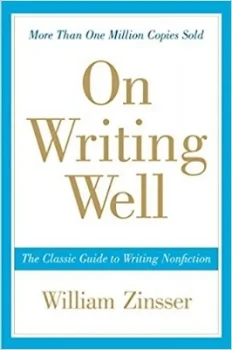
Book: "On Writing Well" by William Zinsser
Pages: 336
For: Anyone who wants to improve their writing whether they’re an engineer, businessman, journalist, or editor
Lesson: Learn how to write clearly and concisely from a long-time journalist and professor of writing
Zinsser worked at The New York Tribune and at Yale where he taught students how to write. By the end of his career, he had written 15 books.
The first part of the book begins by teaching the principles of good writing. Just like in sports, before you want to play the game, you must learn the rules to it. The principles include learning how to make your writing simple, free of clutter, and which words you should use and avoid.
In part two of the book, Zinsser shares lessons on writing in unity, having a good lead and ending, and writing with proper grammar and punctuation. In the last part of the book, Zinsser gives advice on how to find your voice, face the fear and enjoyment of being a writer, and what it means to be a nonfiction writer.
1) "The Art of War for Writers" by James Bell

Book: “The Art of War for Writers”
Pages: 272
For: Aspiring writers, especially those who write fiction
Lesson: Writing a book is a series of battles, learn tactics and strategies for idea generation, character building, dealing with rejection, coping with unrealistic expectations, and much more.
James Scott Bell is a best-selling author and wrote Plot & Structure and Revision & Self-Editing in addition to his ultimate novel-writing battle plan: The Art of War for Writers. The original book, “The Art of War” by Sun Tzu is filled with tactics and strategies that are widely used by military generals and business leaders but these principles can also be applied to the creative field.
Bell uses the principles of war strategies and applies it to writing and the battle that each writer must face when trying to create a novel. In the book, you’ll find tactics and strategies for idea generation and development, character building, plotting, drafting, querying and submitting, dealing with rejection, coping with unrealistic expectations, and much more.
Get the book here.
Bonus: "Ernest Hemingway on Writing" edited by Larry Phillips

Book: “Ernest Hemingway on Writing" edited by Larry Phillips
Pages: 140
For: Anyone interested in Hemingway's writing, aspiring writers
Lesson: Learn Hemingway's thoughts on being a writer, his work habits and advice for aspiring writers
Ernest Hemingway is one of the most well-known writers of the 20th century. In 1954, he was awarded the Nobel Prize for literature. The Sun Also Rises and A Farewell to Arms established Hemingway as one of the greatest literary writers of his time. He started his career as a journalist and worked as an ambulance driver during World War I. He covered the Spanish Civil War and World War II. He won a Pulitzer Prize in 1953 for The Old Man and the Sea. He died in 1961.
If you enjoyed this article, consider supporting our site here or signing up for our monthly newsletter here. Thank you!




The 25+ Books Hemingway Recommends For Writers
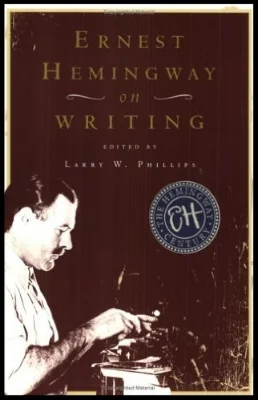
- Book: “Ernest Hemingway on Writing" edited by Larry Phillips
- For: Anyone interested in Hemingway's writing, aspiring writers
- Lesson: Learn Hemingway's thoughts on being a writer, his work habits and advice for aspiring writers
The book, “Ernest Hemingway on Writing” is a collection of Hemingway quotes taken from novels, stories, letters, interviews and other sources.
When it comes to writing, Hemingway said “I think you should learn about writing from everybody who has ever written that has anything to teach you” (page 91).
Hemingway goes on to recite a list of necessary books to read including:

“‘Should a writer have read all of those?’ ‘All of those and plenty more.’”
What are your thoughts on Hemingway’s list of necessary books to read to become a writer?
If you've enjoyed this article, consider getting the book. Get it here.


10 Interesting Quotes on Writing by Ernest Hemingway
- Book: “Ernest Hemingway on Writing" edited by Larry Phillips
- For: Anyone interested in Hemingway's writing, aspiring writers
- Lesson: Learn Hemingway's thoughts on being a writer, his work habits and advice for aspiring writers
Ernest Hemingway is one of the most well-known writers of the 20th century. In 1954, he was awarded the Nobel Prize for literature. The Sun Also Rises and A Farewell to Arms established Hemingway as one of the greatest literary writers of his time.
He started his career as a journalist and worked as an ambulance driver during World War I. He also covered the Spanish Civil War and World War II. He won a Pulitzer Prize in 1953 for The Old Man and the Sea. He died in 1961.
Here are 10 interesting quotes from the book “Ernest Hemingway On Writing.”
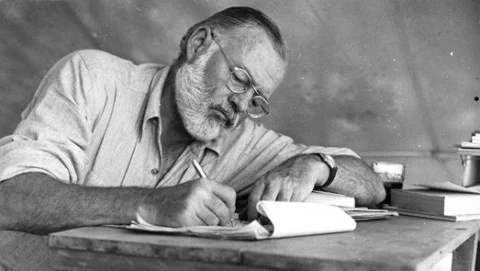
10)
“Writing is something that you can never do as well as it can be done. It is a perpetual challenge and it is more difficult than anything else that I have ever done–so I do it. And it makes me happy when I do it well.”
9)
“I have to write to be happy whether I get paid for it or not. But it is a hell of a disease to be born with. I like to do it. Which is even worse. That makes it from a disease into a vice. Then I want to do it better than anybody has ever done it which makes it into an obsession. An obsession is terrible. Hope you haven’t gotten any. That’s the only one I’ve got left. ”
8)
“Forget your personal tragedy. We are all bitched from the start and you especially have to be hurt like hell before you can write seriously. But when you get the damned hurt use it–don’t cheat with it.”
7)
“You see I’m trying in all my stories to get the feeling of the actual life across–not to just depict life–or to criticize it–but to actually make it alive. So that when you have read something by me you actually experience the thing. You can’t do this without putting in the bad and the ugly as well as what is beautiful. Because if it is all beautiful you can’t believe in it. Things aren’t that way. It is only by showing both sides...”
6)
“You just have to go on when it is worst and most helpless–there is only one thing to do with a novel and that is go straight on through to the end of the damn thing.”
5)
“Ordinarily I never read anything before I write in the morning to try and bite on the old nail with no help, no influence and no one giving you a wonderful example or sitting looking over your shoulder.”
4)
“The more I’m let alone and not worried the better I can function. ”
3)
“‘Tell me first what are the things, the actual, concrete things that harm a writer?’ ‘Politics, women, drink, money, ambition. And the lack of politics, women, drink, money and ambition.’”
2)
“For Christ sake write and don’t worry about what the boys will say nor whether it will be a masterpiece not what. I write one page of masterpieces to ninety one pages of shit. I try to put the shit in the wastebasket.”
1)
“All the critics who could not make their reputations by discovering you are hoping to make them by predicting hopefully your approaching impotence, failure and general drying up of natural juices.”
If you've enjoyed this article, consider getting the book. Get it here.

If you enjoyed this article, consider supporting our site or signing up for our monthly newsletter. Thank you!
Reader freebies:
"On Writing Well" by William Zinsser
- Book: "On Writing Well" by William Zinsser
- For: Anyone who wants to improve their writing
- Lesson: Learn how to write better
- Book: "On Writing Well" by William Zinsser
- Pages: 336
- Lesson: Learn how to write better
- For: Anyone who wants to improve their writing
Most people that know English can read and speak the language with ease but almost everyone has trouble when it comes to writing.
But whether you’re a businessman, politician or high school student, it is important to know how to write well so that you can express yourself, communicate clearly, and make sure people read what you’ve written.
This is what William Zinsser teaches in his book “On Writing Well,” which has sold millions of copies.
Zinsser worked at The New York Tribune and at Yale where he taught students how to write. By the end of his career, he had written 15 books.

Author William Zinsser
So what lessons can we learn from Zinsser’s book?
The first part of the book begins by teaching the principles of good writing. Just like in sports, before you want to play the game, you must learn the rules to it.
The principles include learning how to make your writing simple, free of clutter, and which words you should use and avoid.
“You must know what the essential tools are and what job they were designed to do.”
One way to accomplish this is by studying famous writers.

Ernest Hemingway and Leo Tolstoy
“Make a habit of reading what is being written today and what has been written by earlier masters…and trying to figure out how they did it. ”
In part two of the book, Zinsser shares lessons on writing in unity, having a good lead and ending, and writing with proper grammar and punctuation.
Zinsser writes that “the most important sentence in any article is the first one. If it doesn’t induce the reader to proceed to the second sentence, your article is dead” (Page 55).
When it comes time to end the piece Zinsser writes, “if you presented all the facts and made the point you want to make, look for the nearest exit” (Page 66).
The third part of the book is focused on specific forms. Here Zinsser teaches readers how to write about people you’re interviewing, places you’re traveling to and writing about yourself in a memoir.
When writing a travel piece Zinsser advises readers to not ask the tourists what they think of the attraction, but instead ask those who work there or the locals. The tourists visiting have only been there for a few hours or days, but the people who live there have been there for years or sometimes decades.
“By interviewing local men and women…I tapped into one of the richest veins waiting for any writer.”
Zinsser also goes into detail on how to write about science, business, art, sports, and humor.
When writing about movies, books or art, Zinsser believes only people who love the medium should review it.
“The reader deserves a movie buff who will bring along a reservoir of knowledge, passion and prejudice. It’s not necessary for the critic to like every film; criticism is only one person’s opinion. But he should go to every movie wanting to like it. If he is more often disappointed than pleased, it’s because the film has failed to live up to its best possibilities.”
In the last part of the book, Zinsser gives advice on how to find your voice, face the fear and enjoyment of being a writer, and what it means to be a nonfiction writer.
To find your voice, Zinsser tells readers to once again, study great writers.
“Don’t worry that by imitating them you’ll lose your own voice and your own identity. Soon enough you will shed those skins and become who you are supposed to become.”
And when it comes to being an excellent nonfiction writer, one must chase their interests.
“If a subject interests you, go after it, even if it’s in the next county or the next state or the next country. It’s not going to come looking for you.”
Overall, whether you’re a student, scientist, or businessman, Zinsser’s book can help everyone become a better writer!

If you enjoyed this article, consider supporting our site or signing up for our monthly newsletter. Thank you!
Reader freebies:
"You Are A Writer" by Jeff Goins
Book Review: You Are a Writer by Jeff Goins
Each person has a story, whether that be their life story or a fiction story that they thought of as a kid. However, most of these stories are never heard because few people choose the grueling and difficult career path of being a writer. But, for those that are looking for inspiration or motivation on their journey, Jeff Goins’ book You Are A Writer, is here to help.
At roughly 130 pages long, Goins book is incredibly short. But in the case of this book, less really is more. Goins cuts out any unnecessary information and only keeps what readers will find to be helpful.

Author Jeff Goins
Goins starts the book by saying that the world is filled with closest artists and authors–people who want to pursue a creative craft but are afraid they will fail. To overcome this, one must believe in themselves and start acting like the person they’re supposed to be. Goins writes that before anyone else will believe in you, you must first believe in yourself.
A person must declare themselves a writer and accept the fact that although they are starting from the bottom as a beginner, they will have the opportunity to grow and make their craft into something great, if they are willing to put in the time and work.
Once a person proclaims themselves a writer, the next step is, unsurprisingly, to start writing. However, this doesn’t mean waiting till one feels motivated or inspired. It means, writing every single day, without excuses.
Just as professional weightlifters workout every day, writers must do the same. As with all muscles, even creative ones, the muscle gets stronger the more one practices.
Goins writes that there will be pain in the beginning. There will be days when you don’t want to write, and there will be days when have almost no time, but good writers must practice.
Professional writers take the time to write, craft and edit their piece until it is right. Then they spend hours or days revising it. Finally, they must be able to take criticism and feedback in a positive light, and use it to make their work better.
This may be harsh advice to people who believe that the first thing they write, is usually the best thing they write. However, Goins says this is a myth. To put it plainly, “All first drafts suck, so get over it already.”
The genius part, Goins writes, is in the editing process. It is a constant cycle of writing, getting feedback, and rewriting. Every word counts. If a writer is simply trying to fill the page with unnecessary words, they are wasting the reader’s time.
To be a great writer, one must write with passion, says Goins. Passion is contagious and helps make the work deep and true. Not only does it make the writer’s work better, it will help create a connection with readers. Once readers feel a connection, they will slowly spread the writer’s message and soon a community will be formed.
To spread their message, a writer needs a platform. This can be anything from a blog to a newspaper column or social media site. From there, writers should work on their craft by posting often and seeking feedback. There’s no such thing as an overnight success, so instead of expecting a book deal right away, writers should focus on gradually building up their community of fans over time.
Having published several books and become a regular contributor to several magazines, Goins gives examples of ways writers can pitch their work for to magazines and guest blogs. Most writers shouldn’t be surprised if they get rejected. Goin notes that this happens to all writers without exception.
In fact, early in his career, Stephen King kept his rejection letters and pinned them above his writing desk. Each “no” helps a writer build thick skill, and over time getting rejected will have little effect on a person.
Overall, Jeff Goins gives readers a practical guide to becoming a writer, improving their writing, and getting published. Now all that is left is for you to start.

If you enjoyed this article, consider supporting our site or signing up for our monthly newsletter. Thank you!
Reader freebies:
"How To Read Literature Like A Professor" by Thomas Foster
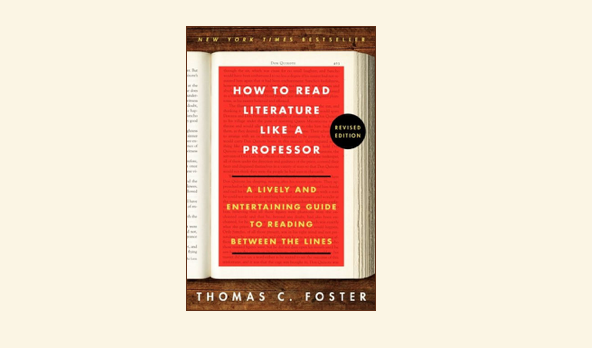
Book Review: How To Read Literature Like A Professor by Thomas C. Foster
Book Review: How To Read Literature Like A Professor by Thomas C. Foster
By the time students reach high school or college, they’ve taken several years of English courses and are able to speak, write, and read the language with ease. Yet, many students still have trouble reading classic literature and most readers often miss out on the deeper literary meaning of the story.
To help readers understand and enjoy literature, Thomas Foster, an English professor with more than thirty years of experience and expertise, has written How to Read Literature Like a Professor.

Author Thomas C. Foster
The book serves as an entertaining guide that introduces readers to literary basics, including symbols, themes, and settings–that provides readers with the tools to better understand literature.
Foster notes that no literature is completely original; the truth is that all literature grows out of other literature. There are certain works of writing that almost all authors have read, such as Shakespeare, the Bible, and the Odyssey.
Authors are inspired by these famous works, and often draw on these texts for inspiration for their own stories, sometimes consciously and other times subconsciously.
Foster advises readers to look for glimpses of familiar stories and ask what the two texts have in common.
To find an example of inspiration from a famous work one can look at Ernest Hemingway’s novel, The Old Man and The Sea (1952).
Hemingway writes about an old and poor fisherman that hasn’t had much luck but remains a good and pure man. The man goes on a three-day fishing trip during which he puts up with a great deal of suffering and injuries while attempting to hook a large fish. When he returns to port, he goes to bed and lays his arms out in the position of crucifixion. The next morning, people see his great fish and start to believe in the fisherman’s skill once again.
Hemingway has a more subtle narrative, but it’s clear to see that the fisherman is a Christ-like figure. Foster points out that almost all text in literature can have a deeper meaning.
Take seasons and weather for example. More often than not, if an author tells readers it is a warm summer day, she is saying that to help convey a specific message.
Foster writes that spring is associated with youth and childhood, summer with romance and adulthood, fall with decline and middle age, and winter with resentment and old age. This is especially important to look for in short works such as poems and short stories to gain a better understanding of the author’s work.
However, Foster notes that sometimes readers have to be careful of a certain event because it may have more than one meaning. Rain in a story can be either a rebirth through baptism or destruction through floods.
Snow can blanket the forest and make it beautiful, but it can also create blizzards that make the world a cold and deadly place.
Towards the end of the book, Professor Foster encourages readers to use what they learned and put their knowledge to the test by analyzing a short story. Foster then asks readers to compare their notes to his own and points out several of the hidden meanings that readers may have missed.
Foster’s book serves as a wonderful nonfiction literary guide that aids readers and students in their engagement with literature.
In the famous poem Divine Comedy, Dante has Virgil to guide him through his journey; for readers of literature, we have Thomas Foster.
If you'd like to get the book, click the button below!
If you enjoyed this article, consider supporting our site or signing up for our monthly newsletter. Thank you!
Reader freebies:
Enjoying A&B?
Consider donating to keep the site up and running!